Clear Sky Science · en
Evaluation of mdh, dld, tcfA, and folE gene markers for detection of enteric fever using real-time PCR
Why faster tests for typhoid matter
Enteric fever—better known as typhoid and paratyphoid fever—still sickens millions of people each year, especially in South Asia and Africa. The illness spreads through contaminated food and water and can cause weeks of high fever, gut pain, and sometimes life‑threatening complications. Yet diagnosing it quickly and accurately remains difficult, especially in crowded hospitals and clinics. This study explores a DNA‑based test that could spot typhoid‑causing bacteria more reliably and much faster than traditional methods, helping doctors treat patients sooner and track outbreaks more effectively. 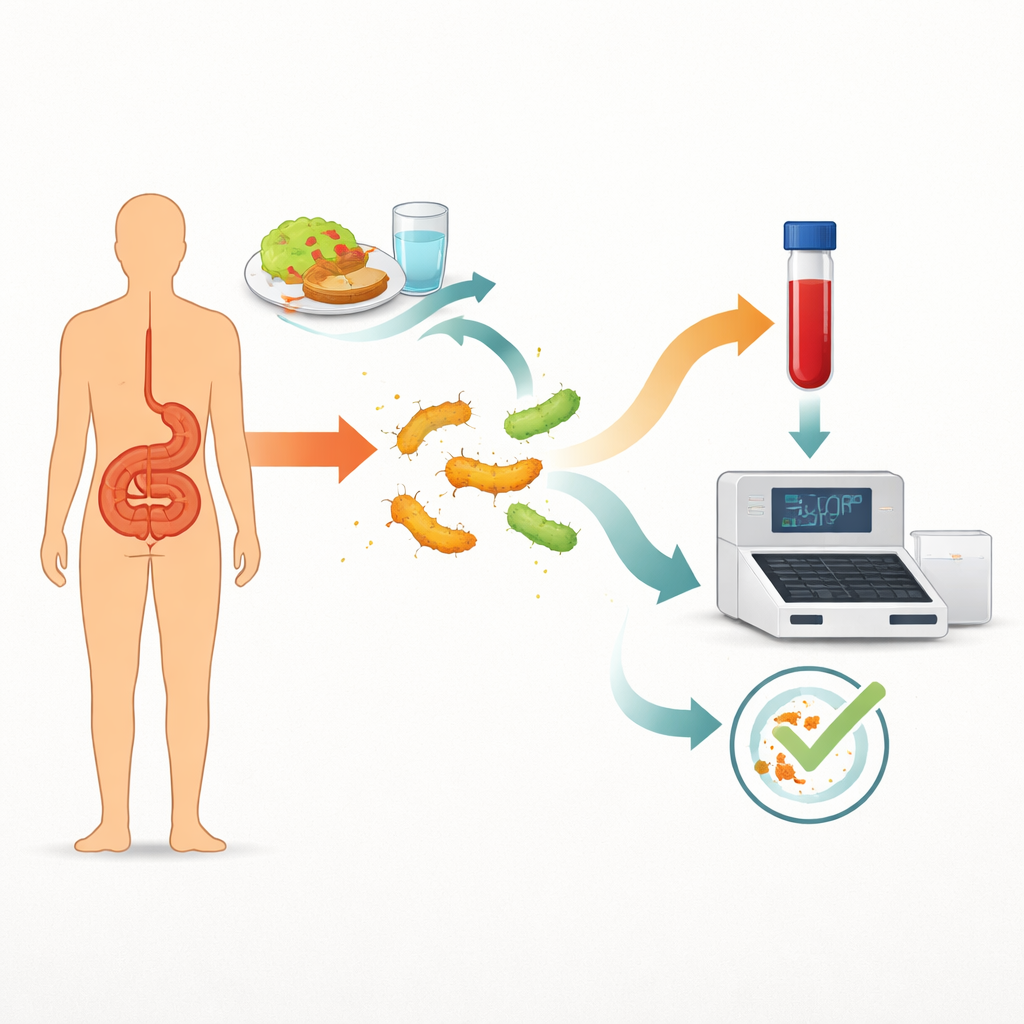
The challenge of spotting a hidden infection
Typhoid and paratyphoid fevers are caused by closely related Salmonella bacteria that live in the bloodstream and gut. Their early symptoms—fever, headache, tiredness, and stomach upset—mimic many other infections such as dengue, malaria, and influenza. Standard lab tests rely on growing the bacteria from blood or stool, or on detecting the body’s immune response. These approaches can take several days, miss many true cases, and sometimes confuse typhoid with other diseases. In many clinics, doctors are forced to treat based on guesswork, which can delay the right therapy and fuel antibiotic resistance.
Reading bacterial fingerprints in DNA
The researchers set out to build a rapid test that reads the genetic “fingerprints” of typhoid‑causing bacteria directly from patient samples. They focused on real‑time PCR, a technique that copies tiny amounts of DNA and tracks the reaction as it happens. Using genome databases, they chose four genes—called mdh, dld, tcfA, and folE—that together should reveal whether Salmonella is present and, ideally, which kind of typhoid bacteria it is. After designing short DNA primers to latch onto each gene, they first fine‑tuned the reaction conditions using conventional PCR and gel electrophoresis, then shifted to a faster SYBR Green–based real‑time PCR format.
How well the new test worked
When the team applied their assay to clinical isolates of Salmonella Typhi and Salmonella Paratyphi, along with a panel of other bacteria, they found that each gene contributed a different piece of the diagnostic puzzle. The mdh gene, a core metabolism gene, proved to be an excellent general marker for Salmonella, lighting up in almost all typhoid samples and none of the non‑Salmonella strains. The dld and tcfA genes were detected mainly in typhoid‑related strains, giving extra evidence that a sample contained the disease‑causing forms of the bacterium. Initially, computer predictions suggested that folE would be unique to S. Typhi, but the lab results told a more nuanced story: folE also appeared in most S. Paratyphi isolates, showing that this gene is shared across typhoid‑causing strains rather than limited to just one. 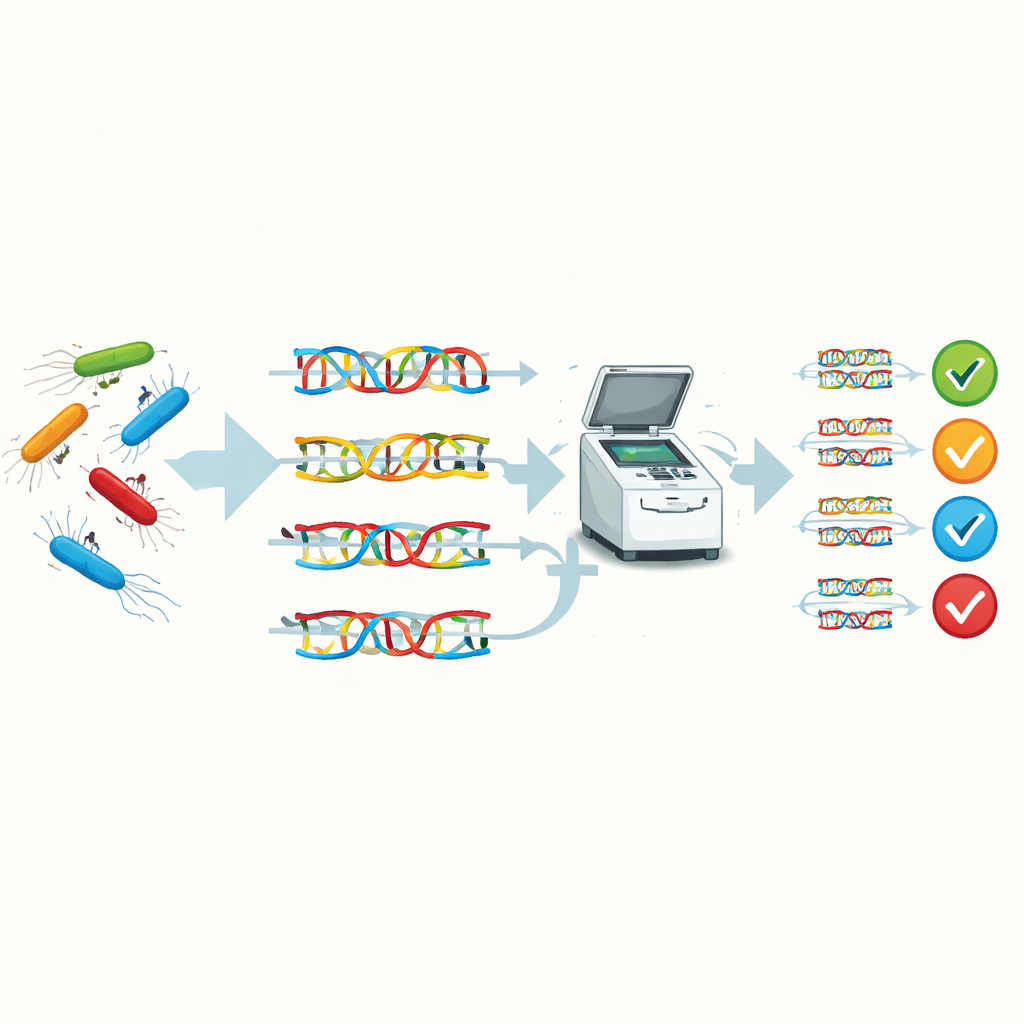
Genetic clues and their limits
To understand this surprise, the researchers sequenced folE from one S. Typhi and one S. Paratyphi sample. The DNA and protein sequences were almost identical, differing at only a single position in a way that did not alter the resulting enzyme. This confirmed that folE plays the same role in both bacteria, helping them make folate, a vital molecule for growth. Overall, the four‑gene panel showed good agreement with standard biochemical identification: it reliably distinguished typhoidal Salmonella from unrelated bacteria and highlighted occasional mismatches where traditional methods may have mis‑typed a strain. However, because several of the genes are shared between S. Typhi and S. Paratyphi, the assay still struggles to cleanly separate these closely related culprits from each other.
What this means for patients and public health
For a layperson, the key message is that this work brings us closer to a quick, DNA‑based test for typhoid that could deliver answers in hours instead of days. By targeting multiple genetic clues at once, the assay can sensitively detect the presence of typhoid‑causing bacteria and confirm that the infection is real, even when traditional cultures fail. At the same time, the study shows that more refined genetic markers are needed to tell different typhoid strains apart, information that matters for tracking outbreaks and tailoring vaccines. In short, this research demonstrates that modern molecular tools can greatly speed and sharpen typhoid diagnosis, while also mapping the next steps toward even more precise tests.
Citation: Arshad, S., Younas, S., Qadir, M.L. et al. Evaluation of mdh, dld, tcfA, and folE gene markers for detection of enteric fever using real-time PCR. Sci Rep 16, 8912 (2026). https://doi.org/10.1038/s41598-026-35011-9
Keywords: enteric fever, typhoid diagnosis, Salmonella detection, real-time PCR, molecular markers