Clear Sky Science · en
Plant growth point localization via epoch-based prior annealing
Smarter Weeding for a Hungry World
As the global population grows, farmers are under pressure to produce more food while using fewer chemicals and protecting the environment. One major challenge is getting rid of weeds without harming valuable crops. This article presents a new artificial intelligence (AI) training strategy that helps machines pinpoint exactly where plants grow from—their growth points—so that tools like laser or electric weeders can target weeds with surgical precision and leave crops unharmed.
Why Growth Points Matter
Weeds steal sunlight, water, and nutrients from crops, reducing yields and threatening food security. Farmers often rely on herbicides, but overuse raises concerns about health, pollution, and resistant weeds. New techniques such as flame, electric, and laser weeding promise cleaner control by destroying plants mechanically or with energy beams. To work safely, these systems must distinguish crops from weeds and then locate the tiny growth points—often at stem junctions—where damage is most effective. Many existing computer-vision tools can detect whole plants, but they struggle to find these small targets accurately and quickly enough for real-time use in the field.
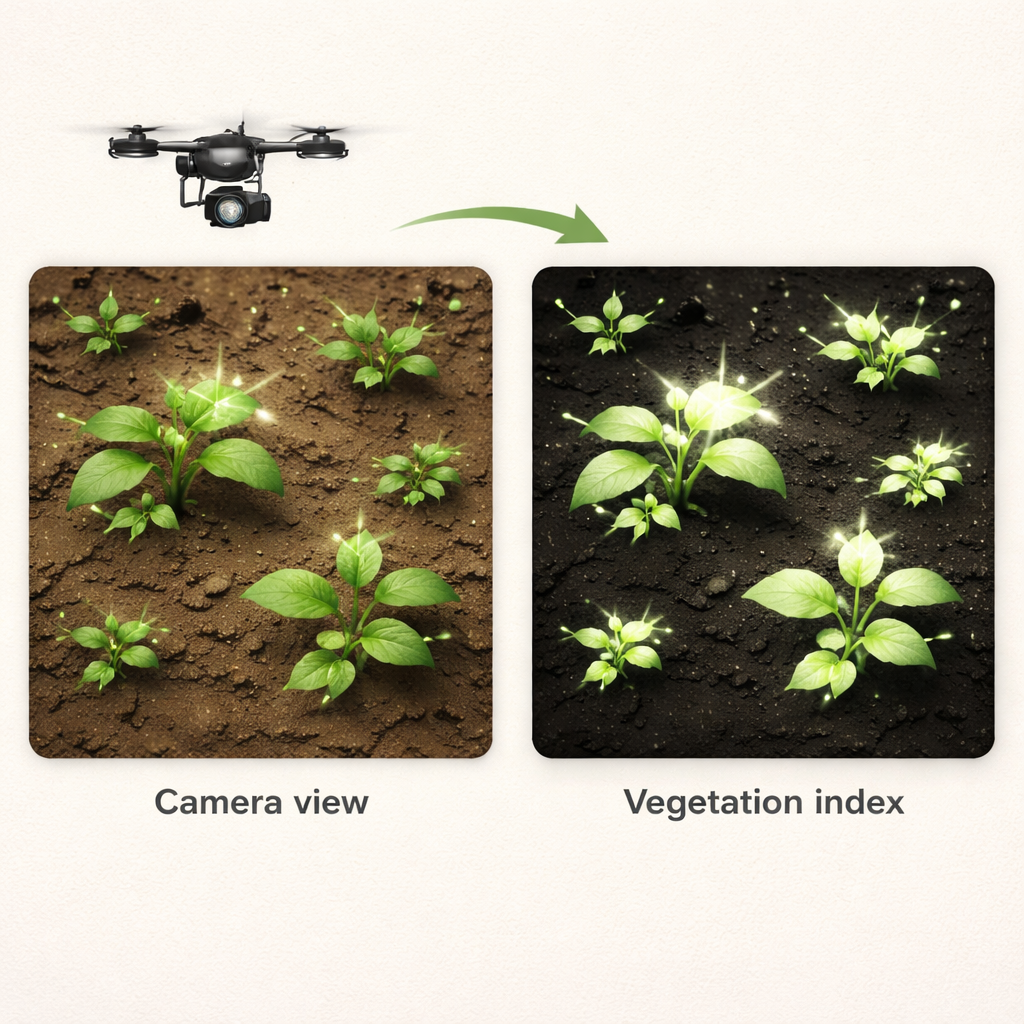
Turning Simple Color Cues into Powerful Guidance
The researchers build on a simple idea: green plants look different from brown soil in regular color photos. A well-known color formula, called the ExG-ExR vegetation index, combines the red, green, and blue values of each pixel so that plant pixels stand out as bright and soil pixels appear dark. This index can be computed from any standard camera without extra sensors. In the new system, this vegetation index is added to the usual three color channels as a fourth input to a popular AI detector known as YOLO-Pose. This four-channel view gives the model a clearer picture of where plants are, helping it concentrate on the right areas when searching for growth points.
Teaching AI from Easy to Hard
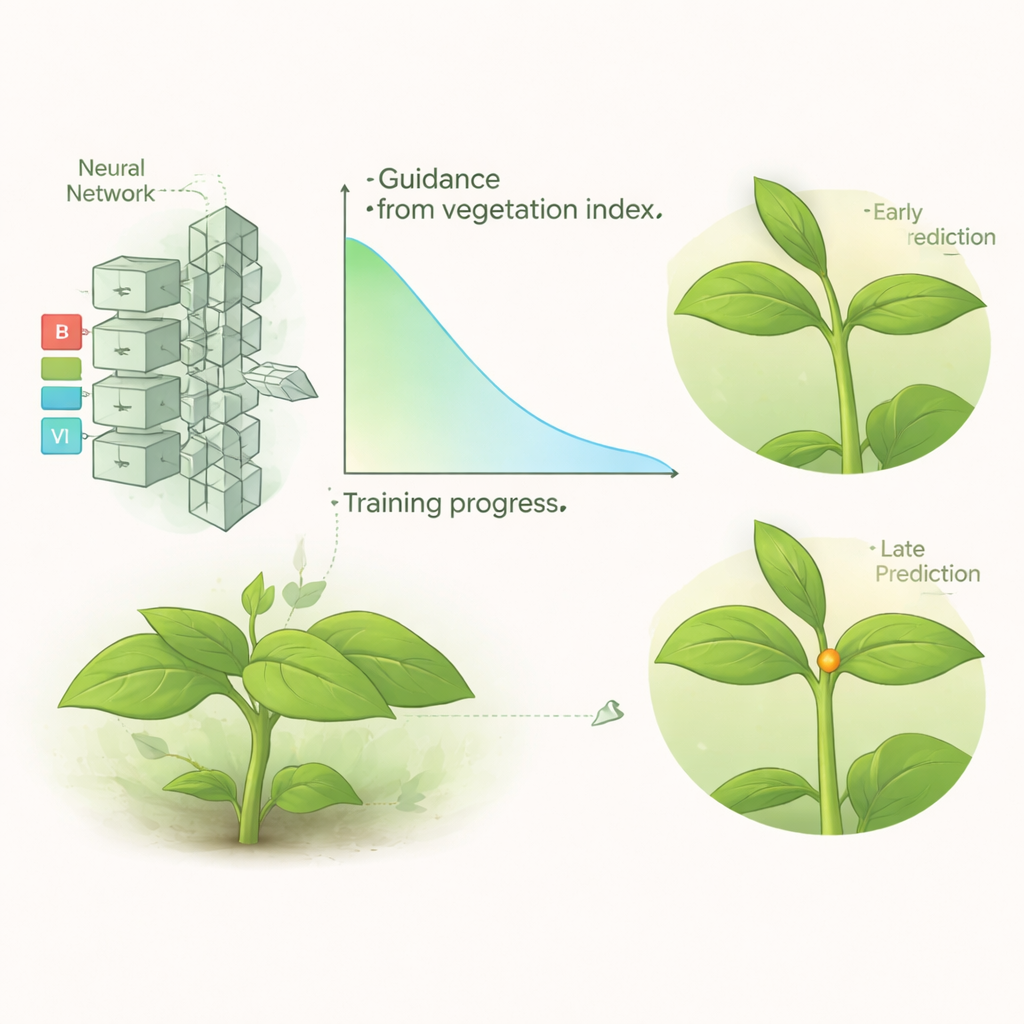
Simply providing extra information is not enough; the model must also learn how to use it. The team introduces an "epoch-based prior annealing" (EPA) strategy, inspired by how humans learn. Early in training, the model is strongly encouraged to keep its predicted growth points inside plant regions, using the vegetation index as a guide. If it places a point in soil, the training algorithm imposes a heavier penalty; if the point lies within plant pixels, the penalty is lighter. As training progresses, this guidance is gradually dialed down using a smooth schedule, allowing the model to rely less on the rough color cue and more on the fine visual patterns it has learned. By the end, the AI is no longer forced toward the greenest pixels, which may not be the true growth points, but instead fine-tunes their locations on its own.
Proving the Idea in Real Fields
To test their approach, the authors trained models on two real-world datasets containing thousands of field images with multiple crop species and many kinds of weeds. They compared versions of the YOLO-Pose model with and without the extra vegetation channel and the EPA training strategy. Adding the vegetation index alone gave modest gains, but combining it with EPA led to clear improvements in growth point accuracy—about 2.4 percentage points in a standard detection score—without hurting the model’s ability to draw boxes around whole plants. The extra computation was tiny (less than half a percent of total cost), making the method suitable for resource-limited farm robots. Tests across different lighting conditions, soil moisture levels, and even different YOLO model versions showed that the strategy is broadly useful, though somewhat sensitive to how strongly and how long the prior guidance is applied.
What This Means for Future Farming
For non-specialists, the key takeaway is that a small tweak in how we train AI—using a simple color-based cue at first and then gradually letting the model think for itself—can make machines much better at finding the exact spots on plants where action matters. This improvement in growth point localization could help future weeding robots direct electric pulses or laser beams precisely at weeds while sparing crops, reducing herbicide use and environmental impact. The same strategy may be adapted to other types of plant signals and AI models, opening the door to smarter, more reliable vision systems that support sustainable, high-precision agriculture.
Citation: Ma, C., Zhang, Z., Tian, F. et al. Plant growth point localization via epoch-based prior annealing. Sci Rep 16, 4994 (2026). https://doi.org/10.1038/s41598-026-35009-3
Keywords: precision agriculture, weed control, computer vision, deep learning, plant growth points