Clear Sky Science · en
High-frequency characteristics analysis and optimization of coaxial-like TGVs
Why Better Tiny Wires Matter for Future Electronics
As our phones, base stations, and AI accelerators push into ever higher radio frequencies, the weak link is often not the chip itself, but the microscopic “wiring” that carries signals between stacked chips. This paper looks at a special kind of vertical wire, called a coaxial-like through-glass via, and shows how careful design and computer-aided optimization can make these links lose less signal, paving the way for faster, more reliable 5G, radar, and future 6G systems.
From Flat Chips to Three-Dimensional Stacks
For decades, chip performance has followed Moore’s Law by shrinking transistors. Today, that approach is reaching physical and economic limits, so engineers are turning to three-dimensional packaging: stacking chips and connecting them vertically. Traditional vertical connections are drilled through silicon (through-silicon vias), but silicon is relatively “lossy” at high frequencies and expands differently with temperature than surrounding materials. That mismatch can crack connections over time. Glass offers a more attractive base: it has a lower electrical loss and a thermal expansion close to that of silicon, which means signals can travel farther with less energy lost as heat, and the structure survives rapid temperature changes better.
Why Coaxial-Like Vias Beat Simple Holes
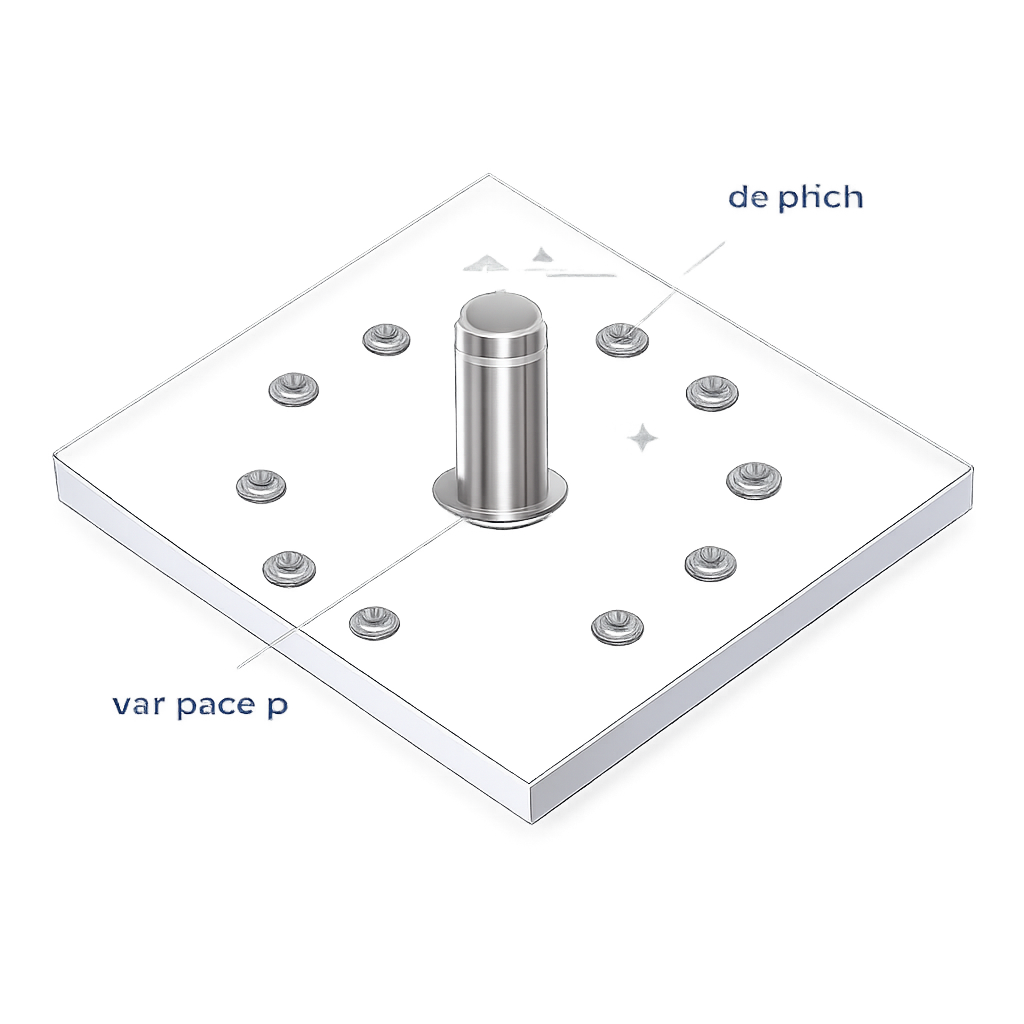
A basic through-glass via is just a single metal plug passing through glass. At everyday frequencies this works fine, but in the millimeter-wave and terahertz ranges used for advanced communication, it starts to misbehave. Impedance mismatch causes reflections, electric and magnetic fields leak into nearby circuitry, and closely packed vias can interfere with each other. The coaxial-like design tackles these issues by surrounding one central signal via with a ring of grounded vias. This arrangement mimics a coaxial cable: the grounds form a shield that traps the fields, keeps interference low, and makes the electrical “size” of the line easier to control.
Peering Inside with Models and Simulations
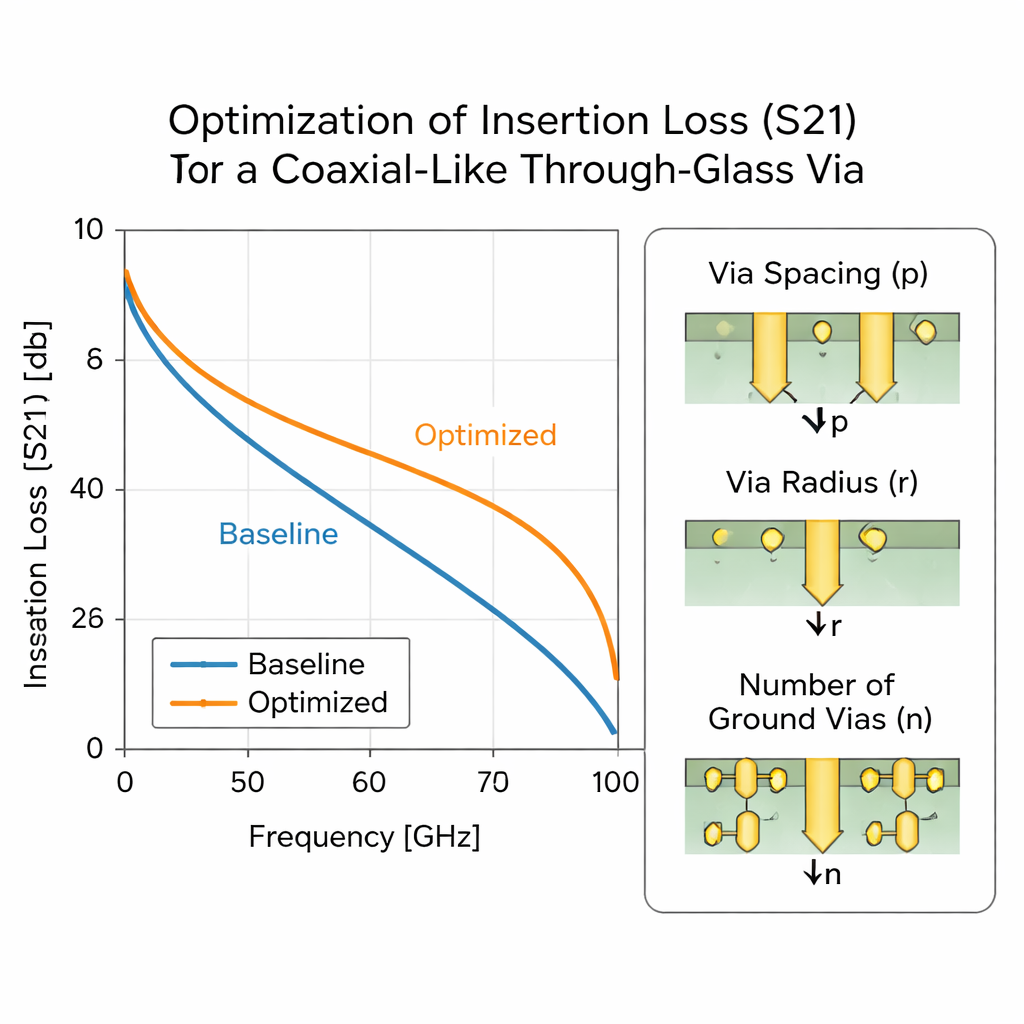
The authors first build a detailed electromagnetic model of a coaxial-like via, using well-established physics to break its behavior into equivalent resistance, inductance, capacitance, and leakage paths. These quantities depend on three main geometric choices: how far the ground vias are from the signal via (pitch), how thick the signal via is (radius), and how many ground vias are used. They then validate this analytical picture with full three-dimensional simulations up to 100 gigahertz, tracking two key measures: how much of the signal reflects back (S11) and how much gets through (S21). Higher S21 means less insertion loss, and therefore better transmission.
Teaching the Computer to Tune the Geometry
Instead of manually trying dozens or hundreds of geometries, the team uses a two-step optimization strategy. First, they apply a statistical method called response surface methodology. By carefully choosing just 17 simulated designs that span reasonable ranges of pitch, radius, and via count, they fit a smooth mathematical surface that predicts S21 from any combination of the three parameters. This surrogate model is checked with statistical tests and shown to match the simulations very closely. Second, they feed this fast model into a genetic algorithm, a search method inspired by evolution. The algorithm “breeds” many candidate designs, keeps the best performers, and gradually homes in on the combination that maximizes S21 at 100 gigahertz.
What the Optimized Design Delivers
The best design the algorithm finds uses a slightly tighter ring of ground vias, a somewhat thicker central via, and ten ground vias in total. In simple terms, this combination reduces magnetic energy storage, lowers resistance on the metal surfaces, and strengthens the shielding around the signal path. The net result is an improvement in insertion loss of 0.0052 decibels at 100 gigahertz—about a 22 percent relative gain for this already low-loss structure. While the number sounds small, high-frequency systems often contain many such vertical links; shaving off a bit of loss at each stage adds up to better signal-to-noise ratio, longer communication distances, and less wasted power as heat.
What This Means for Future High-Speed Systems
For a non-specialist, the takeaway is that even tiny adjustments in the geometry of microscopic connections can have meaningful effects once signals reach tens or hundreds of gigahertz. This work provides both a physics-based recipe and a practical optimization playbook for designing low-loss through-glass vias. By showing that a hybrid of statistical modeling and evolutionary search outperforms more conventional optimization approaches, the study offers a reusable method for other high-frequency components. As electronics continue to move into 3D and into higher bands, such optimized coaxial-like glass vias will help keep signals clean, power consumption in check, and complex systems reliable.
Citation: Chen, S., Wang, J., Liu, X. et al. High-frequency characteristics analysis and optimization of coaxial-like TGVs. Sci Rep 16, 4796 (2026). https://doi.org/10.1038/s41598-026-35007-5
Keywords: through-glass vias, 3D packaging, millimeter-wave, RF interconnects, genetic algorithm optimization