Clear Sky Science · en
The impact of virtual synchronous compensator on the transient synchronous stability of renewable energy
Why keeping the lights on is getting harder
As more wind and solar farms replace traditional coal and gas plants, our power grids are quietly changing character. Old‑style spinning generators naturally helped keep voltage and frequency steady. Inverter‑based renewables do not, especially when they are connected to long, weak transmission lines. This paper explores a new helper device for such grids — the virtual synchronous compensator, or VSCOM — and shows how it can make large renewable plants ride through severe faults without losing their grip on the grid.
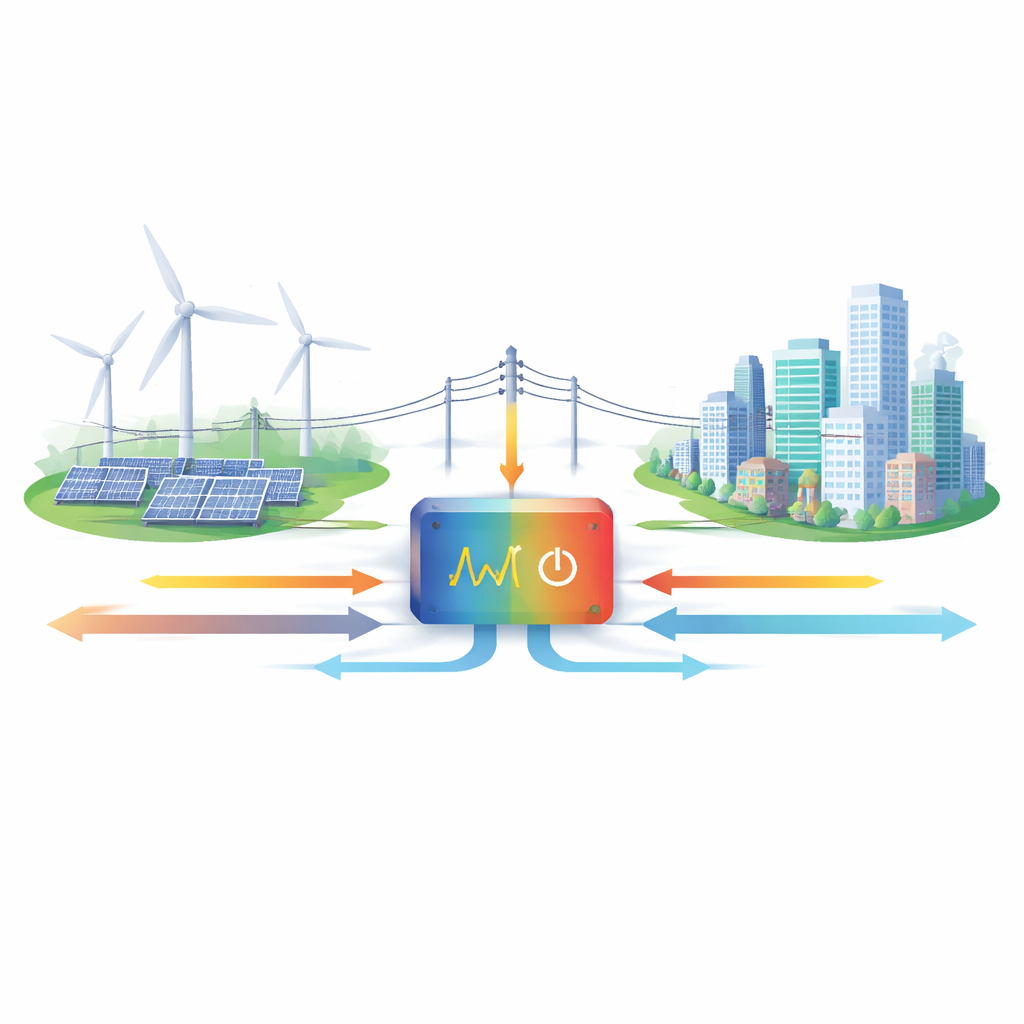
A new stabilizer for renewable power plants
Modern wind and solar plants connect through electronic converters that “follow” the grid. They watch the grid voltage with a phase‑locked loop and inject current accordingly. Under strong grid conditions this works well, but when the surrounding grid is weak, even modest faults can cause these converters to lose synchronization, forcing renewable plants to disconnect just when power is needed most. Traditional support devices such as static var compensators and static var generators can inject reactive power, but they still behave like followers and struggle when the grid voltage collapses.
Turning a follower into a leader
The VSCOM upgrades an existing static var generator so that it behaves more like a voltage source than a current source. Instead of waiting for the grid to set the voltage, it “forms” the local voltage at the connection point of the renewable plant. Inside, it imitates the physics of a spinning machine by using the energy stored in its DC capacitor as virtual inertia. The authors design a special control strategy that limits current during faults without destroying this voltage‑forming behavior. When the grid voltage sags, the VSCOM automatically lowers its voltage setpoint just enough to keep current within safe bounds, yet continues to hold up the plant’s connection point so other converters still see a healthy voltage.
Raising the safe power limit in weak grids
Using a simplified but realistic circuit model, the study examines how much active power a renewable converter can safely feed into a weak grid before its own terminal voltage collapses. Without the VSCOM, this limit shrinks sharply as the short‑circuit ratio of the grid falls. In very weak conditions, the plant cannot even reach rated output. Once the VSCOM is added at the point of common coupling, it effectively clamps the local voltage. The analysis shows that the maximum stable power of the renewable converter can increase by more than a quarter, allowing full‑power operation even under extremely weak grid conditions.
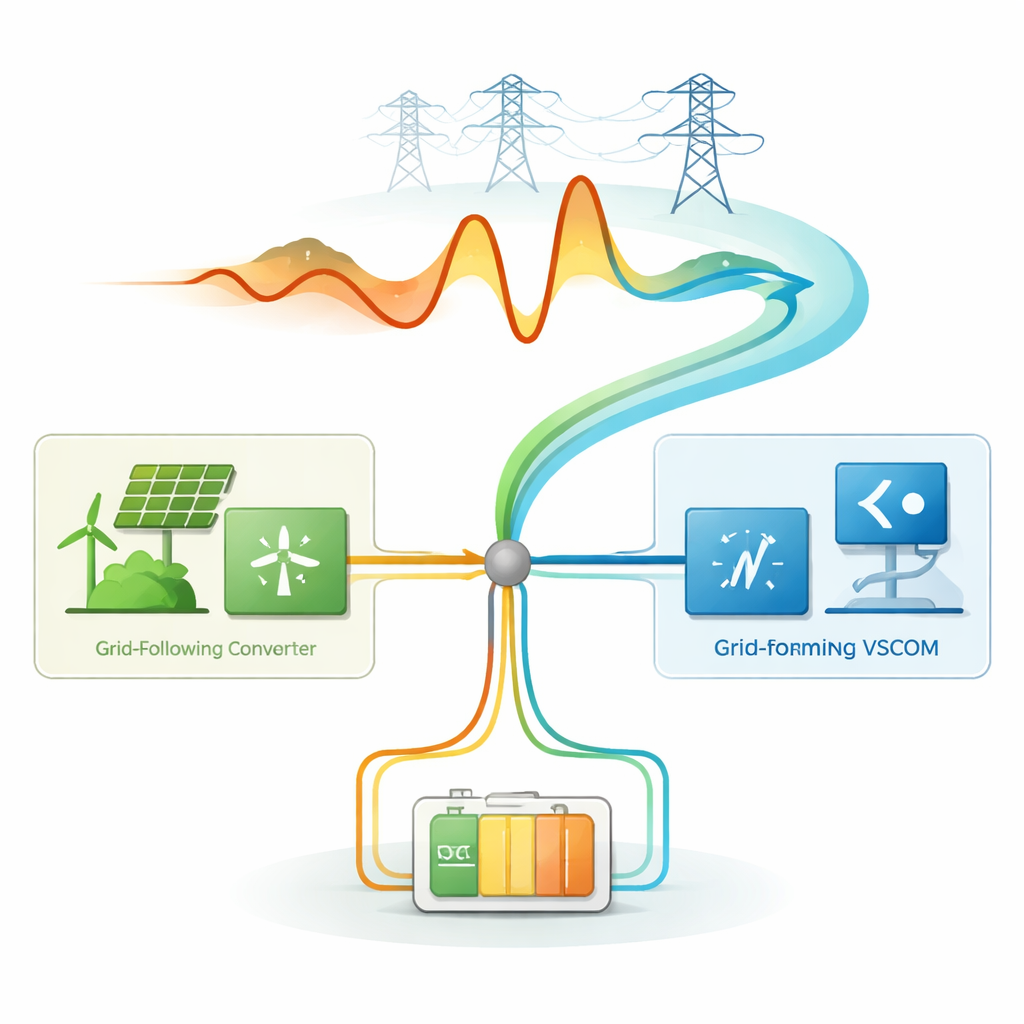
How the new device tames violent transients
Beyond steady limits, the authors focus on what happens in the first fractions of a second after a severe fault. They build a joint dynamic model in which the grid‑forming VSCOM and the grid‑following renewable converter interact through their phase angles and shared voltage. In this picture, the VSCOM introduces a new, slower and better‑damped path that dominates the converter’s motion after a disturbance. The model predicts that with the VSCOM present, the renewable unit’s frequency “jump” at fault inception is greatly reduced, and its phase trajectory is pulled toward that of the VSCOM instead of spiraling out of step.
Tuning the virtual machine for best behavior
The team then explores how device settings shape stability. If the renewable plant is electrically close to the VSCOM, coupling is strong and the stabilizing effect is greatest; longer internal lines weaken this link. The virtual inertia and damping built into the VSCOM act much like those of a real generator: more damping consistently improves stability, while too much inertia can cause large swings and even renewed instability. Increasing the VSCOM’s reactive power capacity further boosts its ability to support voltage during faults, making it easier for the renewable converter to stay synchronized. Detailed simulations with a realistic wind or solar plant model confirm the analytical findings.
What this means for future green grids
For non‑specialists, the main message is straightforward: as we move toward power systems dominated by wind and solar, we will need devices that not only inject energy but also actively shape voltage and frequency. The virtual synchronous compensator is one such device. Properly controlled and sized, it can hold up local voltage, share its virtual “inertia” with nearby converters, and keep renewable plants in step with a weak and faulted grid. This makes large‑scale renewables more robust, reduces the risk of cascading disconnections during disturbances, and helps ensure that cleaner power does not come at the cost of a less stable electricity supply.
Citation: Sun, F., Chen, Y. & Wang, W. The impact of virtual synchronous compensator on the transient synchronous stability of renewable energy. Sci Rep 16, 7875 (2026). https://doi.org/10.1038/s41598-026-34998-5
Keywords: virtual synchronous compensator, weak grid stability, grid-forming inverters, renewable energy integration, voltage support