Clear Sky Science · en
Ancient genomes reveal early-stage admixture and genetic diversity in the Northwestern Kyushu Yayoi
Ancient roots of today’s Japanese people
Modern Japanese people carry a genetic legacy shaped by both long‑standing hunter‑gatherers and later farmers from the Asian continent. This study zooms in on northwestern Kyushu, one of the closest points to the Korean Peninsula and a key gateway for early migrants, to ask a simple but powerful question: when rice‑farming newcomers arrived, did they completely replace the earlier residents, or did the two groups live side by side and intermarry over many generations?
Life on the islands at the dawn of farming
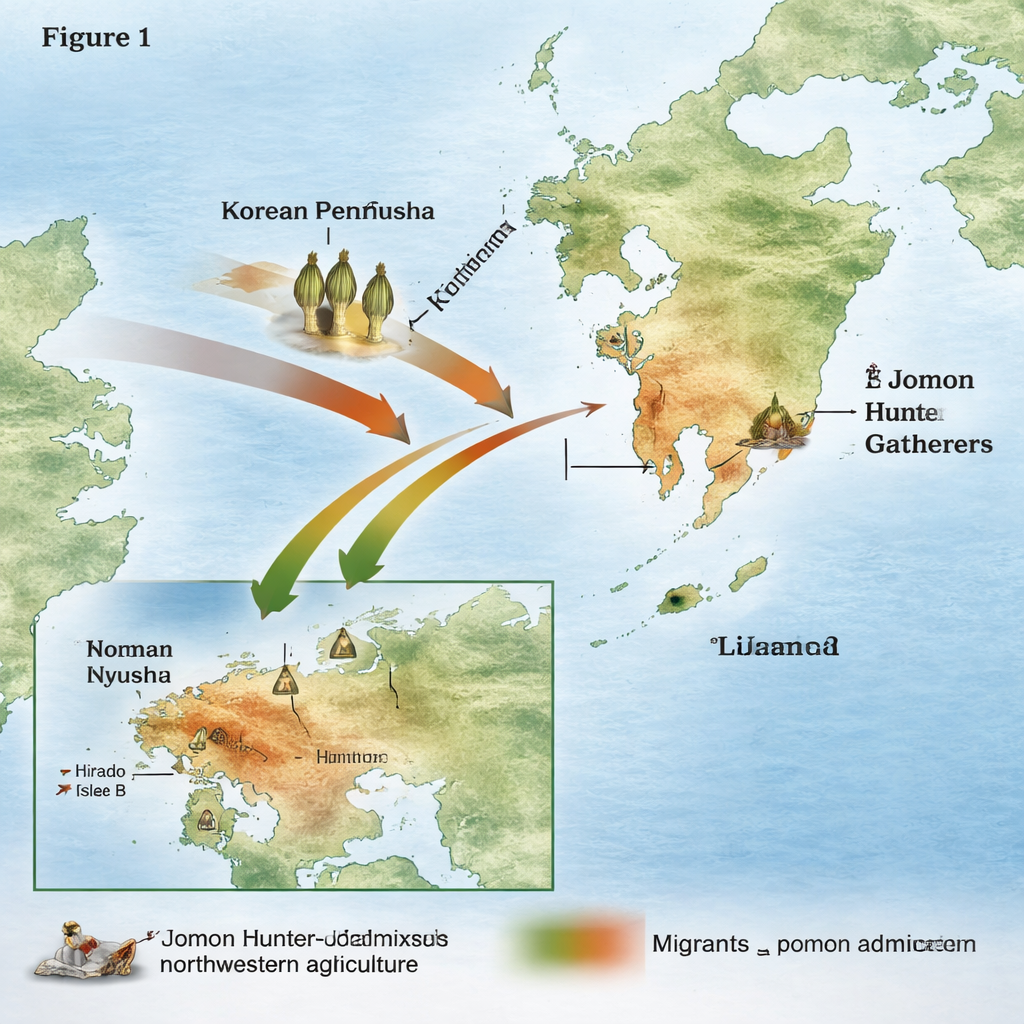
Archaeologists divide ancient Japan into two broad eras. For thousands of years, Jomon hunter‑gatherers lived across the islands, fishing, foraging, and making distinctive cord‑marked pottery. Around 3,000 years ago, the Yayoi period began, marked by wet‑rice agriculture and metal tools brought by migrants from the continent, likely via Korea. Northern Kyushu, facing Korea across a narrow strait, shows early rice fields and Korean‑style artifacts, suggesting it was a main landing point. Yet skeletons from its northwestern corner look surprisingly short and broad‑faced, more like older Jomon remains than like taller, narrower‑faced Yayoi people found elsewhere. This hinted that local Jomon people might have persisted there even as farming spread.
Reading history from ancient bones
To test this idea, the researchers sequenced whole genomes from four individuals buried more than 2,200 years ago at two coastal sites on Iki and Hirado islands. Radiocarbon dating and chemical analysis of their bones show they lived during the early to middle Yayoi period and ate a mix of land foods, marine resources, and probably rice. The team examined both the overall genome and special markers passed down only through mothers (mitochondrial DNA) and fathers (Y‑chromosomes). Some lineages matched those common in continental East Asia, while others matched lineages usually linked to the older Jomon people, immediately suggesting a mix of origins among these islanders.
Side‑by‑side lives of locals and newcomers
When the genomes were compared with those of ancient Jomon, other Yayoi people, and modern East Asians, a striking pattern emerged. Two of the islanders clustered genetically with Jomon individuals and showed no detectable continental ancestry. In other words, they were almost pure Jomon descendants living in the Yayoi era, right next to the main migration route from Korea. The other two individuals clearly carried a blend of Jomon and continental ancestry, similar to other Yayoi people from Kyushu and nearby Yamaguchi. Advanced statistical tests and computer models confirmed that all four shared strong ties to Jomon groups, especially those from western Japan, but that gene flow from Korean‑related farmers had already begun.
A slow blend, not a sudden takeover
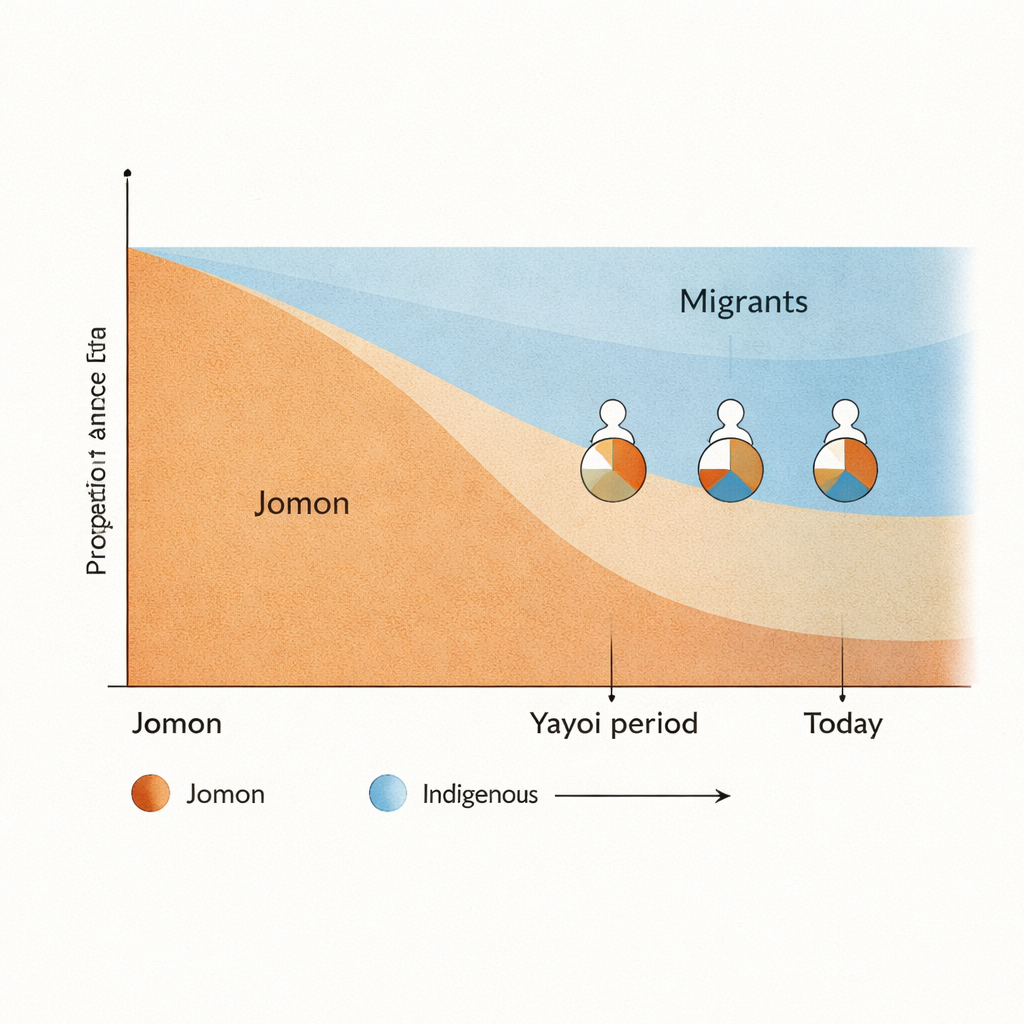
By measuring how mixed segments of DNA break up over generations, the authors estimated when the Jomon and continental lineages first interbred in this region. Their calculations suggest that the earliest mixing in northwestern Kyushu happened about 2.5–2.6 thousand years ago, only a few generations before the lives of the admixed individuals studied here. At that time, the population was highly diverse: some people were direct Jomon descendants, others had recent continental ancestors, and many fell somewhere in between. Over the following centuries and into the Kofun period, this mixing spread across mainland Japan, eventually producing the relatively uniform blend seen in most Japanese people today.
What this means for Japan’s deep past
To a non‑specialist, the key message is that cultural change and genetic change do not always move in lockstep. Rice farming and new technologies arrived in Japan with migrants, but they did not erase the older inhabitants overnight. In northwestern Kyushu, Jomon descendants and newcomers shared the landscape, intermarried, and gradually formed a new population. This study shows that the genetic story of Japan is not one of simple replacement, but of centuries‑long contact and blending between island foragers and continental farmers—an intricate process that helped shape the ancestry of people living in Japan today.
Citation: Kim, J., Mizuno, F., Matsushita, T. et al. Ancient genomes reveal early-stage admixture and genetic diversity in the Northwestern Kyushu Yayoi. Sci Rep 16, 4833 (2026). https://doi.org/10.1038/s41598-026-34996-7
Keywords: ancient DNA, Jomon, Yayoi, human migration, Japanese ancestry