Clear Sky Science · en
Hybrid PSO-SVM and symbolic regression model for agricultural water demand prediction
Why farm water use matters to everyone
In dry regions around the world, the same rivers and aquifers must supply water for cities, industry, and the crops that feed us. When agriculture takes too much, taps run dry and ecosystems suffer; when it gets too little, food production is at risk. This study looks closely at Bayannur City in Inner Mongolia, one of China’s major irrigation hubs, to ask a crucial question: how will its demand for irrigation water change in the coming years, and which levers—technology, policy, or production—matter most?
A dry region with thirsty fields
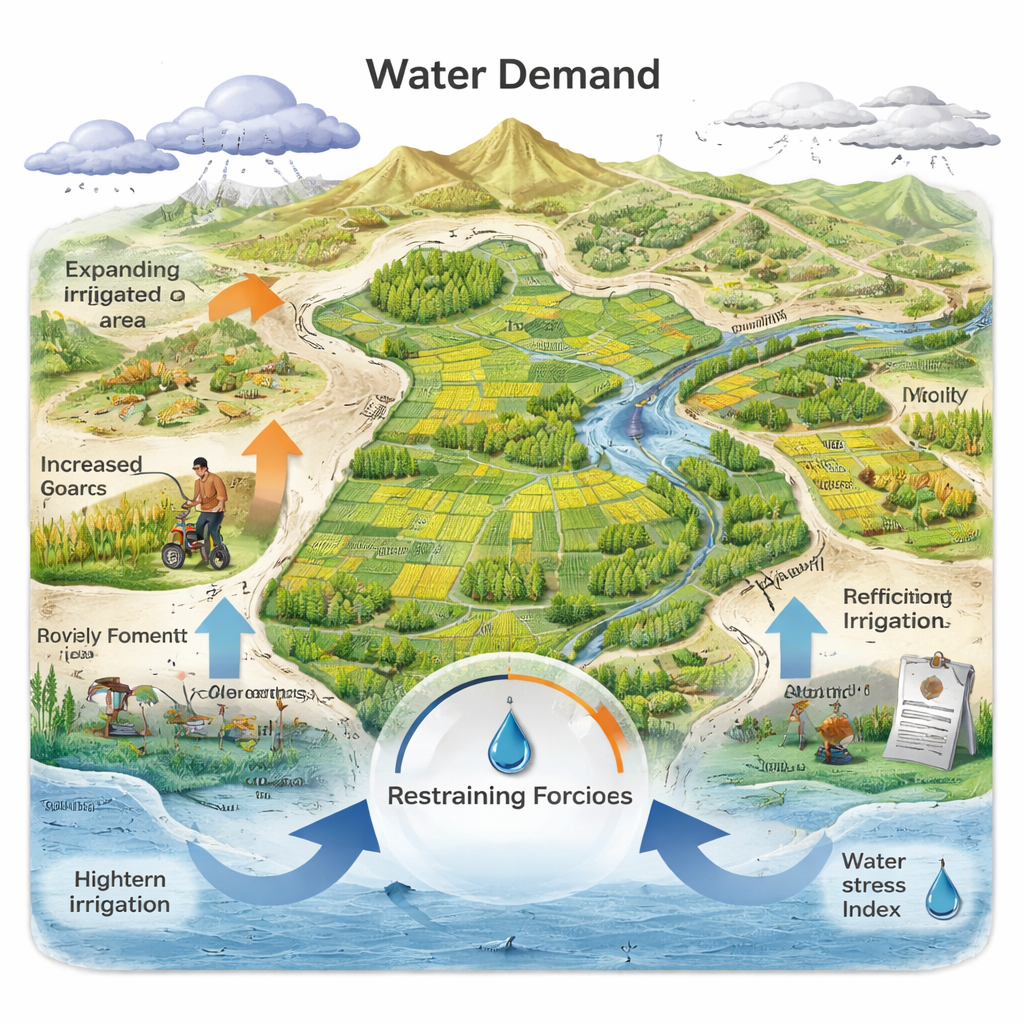
Bayannur sits in northwest China’s Hetao Irrigation Area, a landscape where fertile soils and sunny weather support wheat, corn, sunflower, and tomato fields—but only if enough water is delivered through canals. From 1990 to 2022, agriculture used about 97% of all water consumed in the city, averaging nearly 5 billion cubic meters a year. Yet the region’s natural water endowment is limited, with low rainfall and tight supplies from rivers and groundwater. That imbalance makes it vital to understand how farming practices, rural livelihoods, and government policies together shape the ups and downs of irrigation demand.
Untangling what pushes water demand up and down
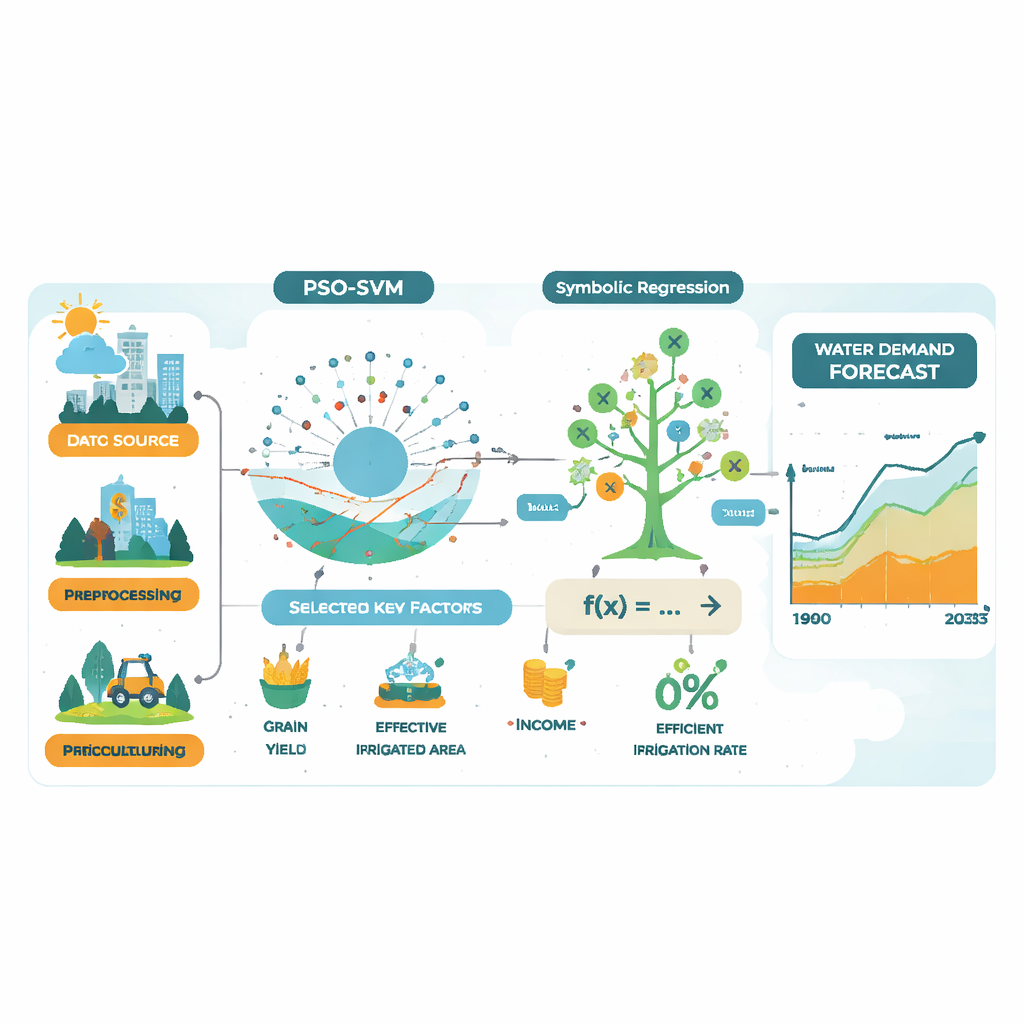
The researchers assembled 33 years of official statistics describing climate, water availability, farm production, rural demographics, machinery, fertilizer use, irrigation technology, and water prices. They first used a machine-learning approach that couples Particle Swarm Optimization with Support Vector Machines (PSO-SVM). In simple terms, this method lets a “swarm” of trial models search for the best way to predict water use from many possible factors. By gently adjusting each factor and watching how the predictions change, the team could label some influences as “drivers” that increase water demand and others as “brakes” that hold it back.
Production pushes, technology and income pull back
The analysis revealed a clear tug-of-war. On the driving side, higher grain yields and a larger effectively irrigated area were the strongest forces raising water demand, supported by more rural employment, greater fertilizer use, and expanded grain planting. These reflect the basic reality that larger and more intensive farms need more water. On the restraining side, the single most powerful brake was rising rural income: as farm households became wealthier, they shifted away from the most water-hungry activities. Wider adoption of high-efficiency irrigation—such as drip and sprinkler systems—also cut the need for water, as did higher irrigation water prices, natural limits captured by a water stress index, and greater mechanization. Together, these brakes explain why Bayannur’s agricultural water use has generally fallen since the early 2000s even as food output rose.
Turning a black box into a readable equation
Machine-learning models often give accurate forecasts but hide their inner workings, which makes them hard to use in policy debates. To avoid this “black box” problem, the team fed only the most influential factors into a second tool called symbolic regression. This method searches for a human-readable equation that links a few key variables—here, rural income, grain yield, irrigated area, and efficient irrigation rate—to water demand. The final equation reproduces almost 88% of the year-to-year variation in Bayannur’s water use and quantifies how these four levers interact in nonlinear ways. For example, higher income tends to accompany both more productive fields and more water-saving practices, so its net effect is to restrain water demand even while supporting better harvests.
Peering ahead to 2035
Armed with this transparent equation, the authors projected Bayannur’s agricultural water demand from 2023 to 2035. They find that annual use is likely to stay above 5 billion cubic meters, peaking around 2028 and then stabilizing. In other words, the city will remain a heavy water user, but the rapid swings of the past should calm as water-saving technologies spread and policies such as water pricing, water rights trading, and strict quotas take full effect. The model’s uncertainty range—only a few percent above or below each estimate—suggests the forecasts are robust enough to guide planning.
What this means for food and water security
For non-specialists, the key message is that smart combinations of policy and technology can loosen the link between growing food and using ever more water. In Bayannur, efficient irrigation systems, better farm incomes, and firm management rules are gradually outweighing the old pattern in which expanding fields automatically meant higher withdrawals from rivers and aquifers. The study’s hybrid modeling framework shows not just how much water future farming might use, but also which social and technical changes matter most. That kind of insight can help other dry agricultural regions chart a realistic path toward feeding people while staying within their water means.
Citation: Lv, H., Zhao, Y., Wang, W. et al. Hybrid PSO-SVM and symbolic regression model for agricultural water demand prediction. Sci Rep 16, 5121 (2026). https://doi.org/10.1038/s41598-026-34995-8
Keywords: agricultural water demand, irrigation efficiency, machine learning models, water resource policy, China drylands