Clear Sky Science · en
Benchmarking econometric, decomposable additive, and neural network methods for food inflation prediction featuring policy insights
Why rising food prices matter
For families in Bangladesh and across the developing world, food inflation is not an abstract economic term; it decides whether households can afford rice, vegetables, and cooking oil at the end of the month. In recent years Bangladesh has landed on the World Bank’s “Red List” for persistently high food inflation, with prices rising more than 10% a year. This study asks a practical question with big human consequences: can modern artificial intelligence help governments anticipate food price surges driven by weather extremes and volatile energy costs, so they can act before a crisis hits?
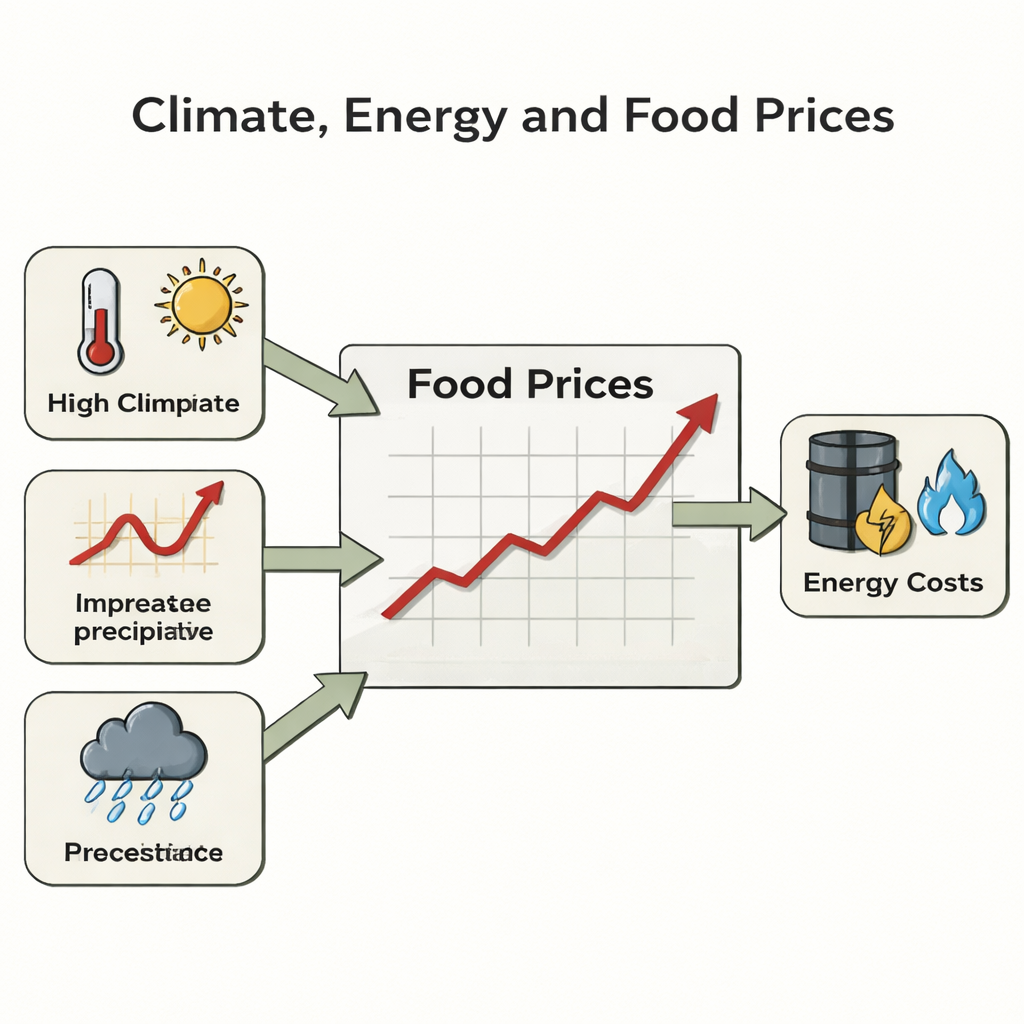
Following the trail from weather and fuel to the dinner table
The researcher assembled a detailed monthly record from July 2010 to March 2025, tracking Bangladesh’s food price index alongside four forces that plausibly push it around: average surface temperature, unusual temperature swings, rainfall, and an energy price index covering electricity, gas, and fuel. Together, these series capture both climate shocks in the fields and the cost of the energy that powers pumps, tractors, storage, and transport. Rather than looking only at simple one-to-one links, the study treats food prices as the end result of many interacting influences that may show up with a delay of several months.
Old-school statistics versus modern machine learning
To predict food inflation, the paper compares four time‑series approaches. A traditional econometric model called SARIMAX serves as the baseline, representing the kind of tool long used by central banks. A decomposable additive model known as Prophet captures smooth trends, seasonal harvest cycles, and holiday effects such as Eid, when meat and sweets become more expensive. Two more advanced methods—time‑delay artificial neural networks (TDANN) and long short‑term memory (LSTM) networks—belong to the machine‑learning family and are designed to learn complex, nonlinear patterns and how current prices depend on conditions several months back. All models are trained on the same data and judged by how closely their forecasts match later, unseen price movements.
Neural networks take the lead
The head‑to‑head comparison is clear: nonlinear machine‑learning models forecast food inflation more accurately than the traditional linear framework. Among them, a relatively simple neural network with six hidden units (TDANN [6]) performs best, explaining about 93% of the variation in food prices and keeping typical forecast errors to just a few index points. LSTM, a deeper sequential network, also does well but slightly underestimates sharp price peaks. SARIMAX and Prophet capture the overall upward trend and seasonal patterns but miss much of the volatility that matters most to vulnerable households. Interestingly, adding extra layers and complexity to the neural network does not help; leaner architectures track the data more faithfully than heavily parameterized ones.
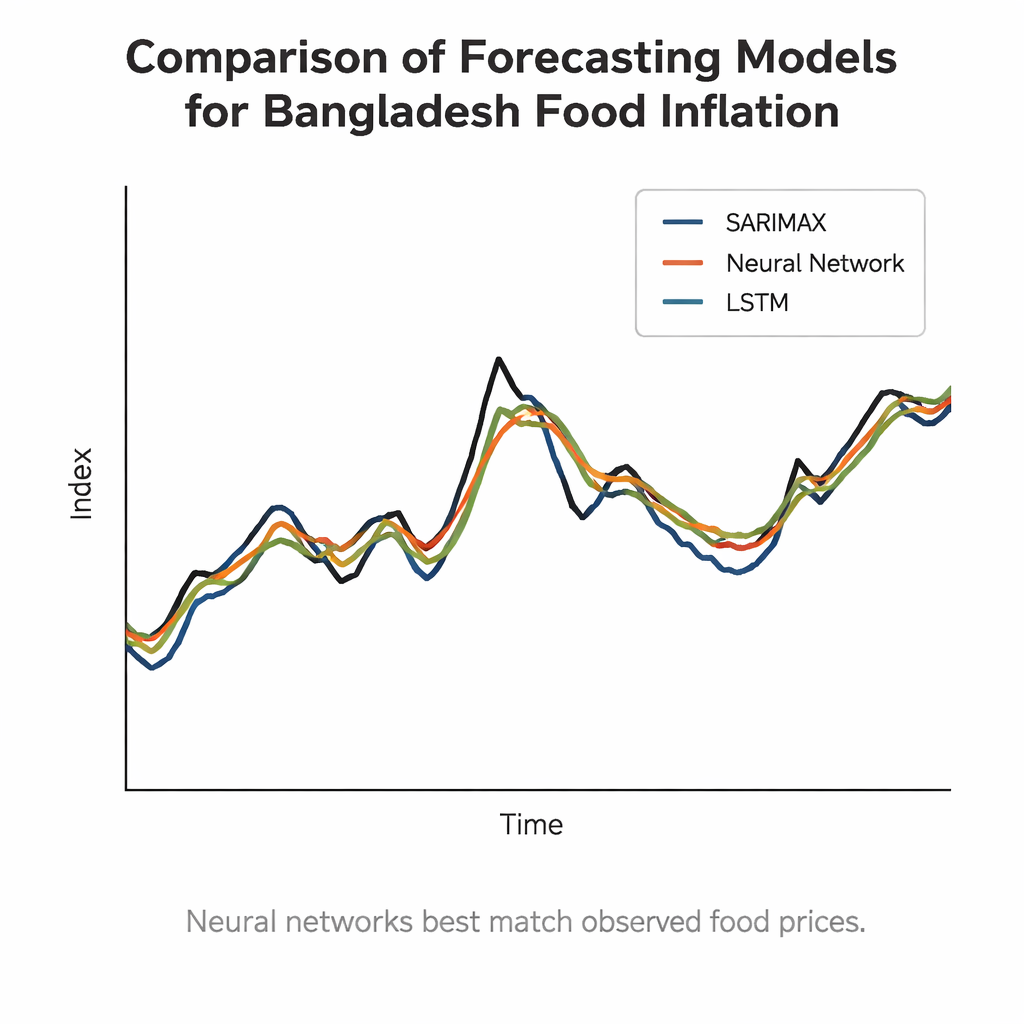
Opening the “black box” to find what truly drives prices
Because neural networks are often criticized as opaque, the study applies Explainable AI tools, especially SHAP values, to see which inputs actually move the model’s predictions. The single most important factor is simply past food prices themselves: once prices rise, they tend to stay high. The second is rainfall from about three months earlier. Both unusually dry and unusually wet periods disrupt planting, harvests, or transport, creating a U‑shaped relationship where extremes on either side tend to push prices up. Energy prices come next, acting as an “inflation amplifier”: when recent food prices are already elevated, high fuel and electricity costs make future price spikes more likely and more severe, while low energy costs help dampen that momentum.
Turning model insight into real‑world action
Translated into everyday terms, the study concludes that Bangladesh’s food inflation is driven by a mix of memory and stress. The memory comes from the strong tendency of prices to persist once they have climbed; the stress comes from climate shocks in the fields and swings in energy costs along the supply chain. Well‑tuned neural‑network models can detect when this combination is building toward trouble with enough lead time for policymakers to react. That means scaling up grain reserves ahead of bad seasons, targeting support to farmers after floods or droughts, and using smart energy and import policies to stop fuel costs from turning routine tightness in markets into full‑blown food crises.
Citation: Javed, A. Benchmarking econometric, decomposable additive, and neural network methods for food inflation prediction featuring policy insights. Sci Rep 16, 5460 (2026). https://doi.org/10.1038/s41598-026-34993-w
Keywords: food inflation, Bangladesh, climate shocks, energy prices, machine learning forecasting