Clear Sky Science · en
Resilience-oriented optimization of hospital microgrids with critical load support using ESS and PV under grid outage conditions
Why hospital power resilience matters
Hospitals are among the few places that simply cannot go dark. Operating rooms, intensive care units, and life-support machines depend on electricity every second. Yet storms, heatwaves, cyberattacks, and aging power lines are making long blackouts more likely. This paper explores how hospitals can use on-site solar panels and advanced batteries, arranged in a smart "microgrid," to keep their most critical services running safely even when the main grid fails.
Hospitals as small power islands
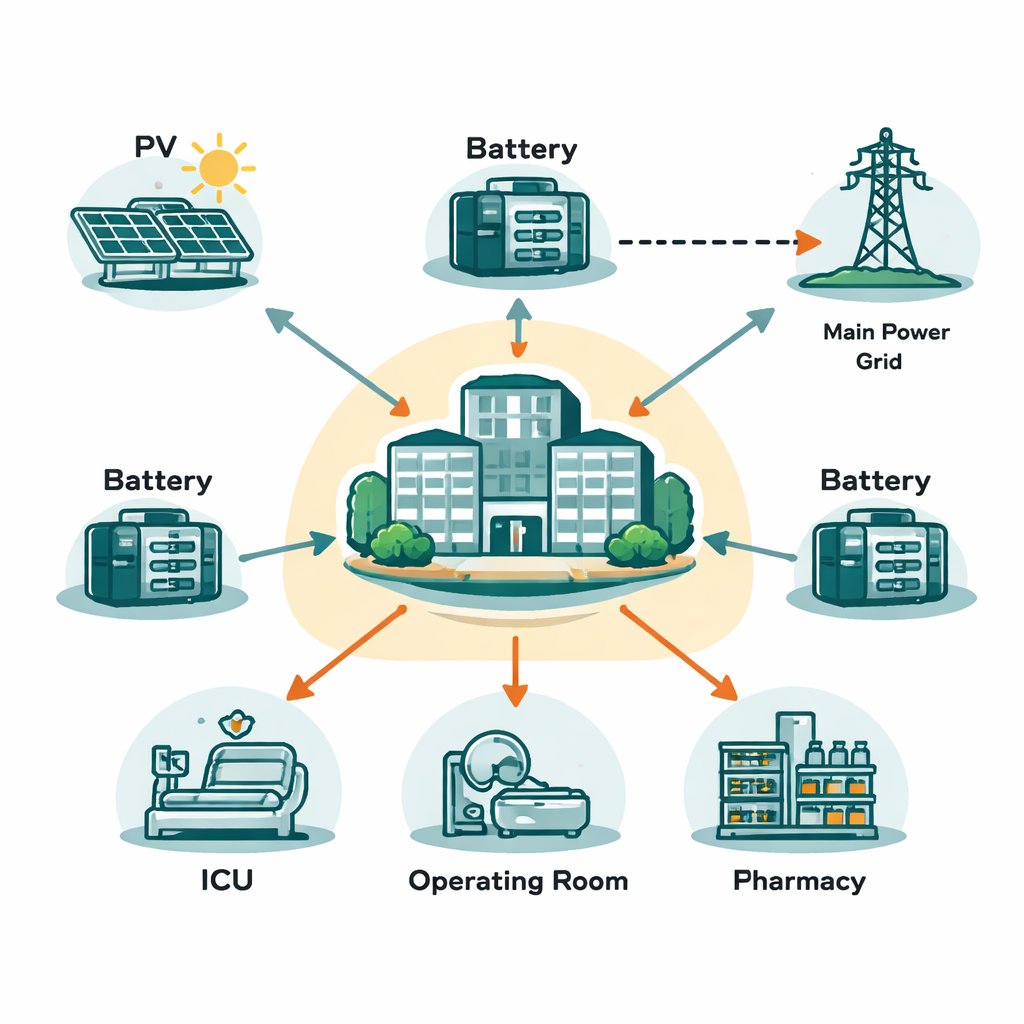
The authors start by treating a hospital and its surrounding buildings as a miniature power system, or microgrid, that can operate either connected to the wider grid or on its own during an outage. In this setup, electricity comes from rooftop solar panels and multiple battery units placed at different points in the network, rather than from a single backup generator. The key idea is that, during a blackout, the hospital does not need to power everything equally. Life-support and emergency rooms must be protected first, while other areas such as offices or some lighting can be reduced or temporarily shut off.
Ranking what must stay on
To reflect real hospital priorities, the study divides electrical demand into three main groups. The first group includes intensive care units, operating rooms, and emergency equipment that must remain powered at almost all times. The second group covers clinical and diagnostic services, like imaging suites and laboratories, which are important but can tolerate short interruptions or partial reductions. The third group involves supportive services—heating, cooling, lighting, and administration—that can be scaled back more aggressively when power is scarce. Each group is assigned a simple "value of lost load," a way of saying how costly it is, in practical and economic terms, if that group loses power. This ranking guides the control system to feed precious stored energy to the most vital areas first.
Testing the microgrid under many outage stories
Rather than assuming a single, neatly defined blackout, the authors generate many random "what if" outage stories using Monte Carlo simulation. In each story, the timing and length of the grid failure, the sunshine available for solar panels, and the hospital’s demand all vary. For every case, a mathematical optimization model decides, hour by hour, how much each battery should charge or discharge, how much solar energy to use or curtail, and which loads to fully supply or partially cut. The model aims to keep critical services running while cutting the total amount of energy that patients and staff go without. To judge performance, the study tracks how often the system fails to meet demand, how much energy is not supplied, and a combined "resilience index" that measures how well important loads are maintained over time.
What smarter batteries and solar can achieve
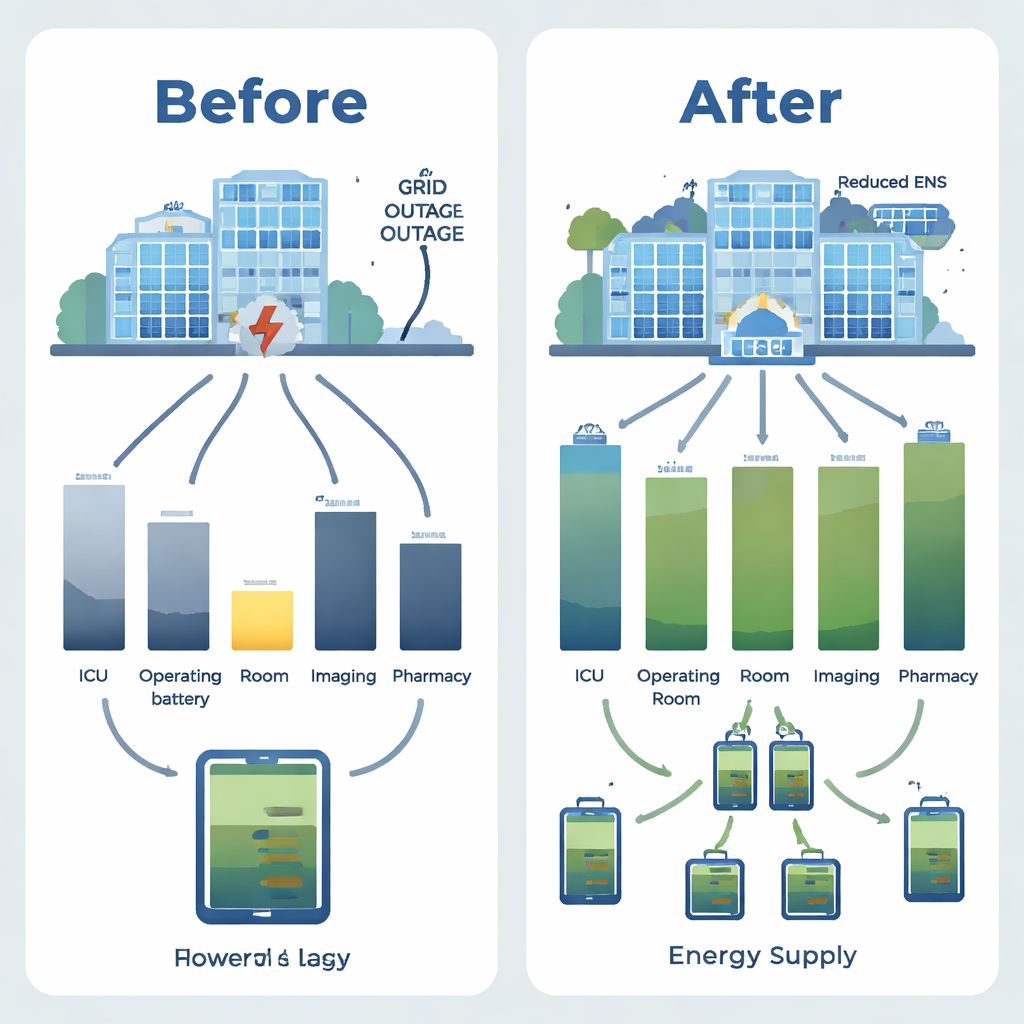
The framework is tested on three standard network layouts representing small, medium, and large hospital grids. In each case, the researchers compare different ways of placing and coordinating the batteries. They find that spreading storage across several locations and managing it jointly makes a major difference. Compared with simpler setups, this coordinated strategy cuts the energy not supplied during outages by about 55 to 63 percent. At the same time, it keeps power available to life-critical areas such as ICUs and operating rooms at or above 95 percent in most of the simulated blackouts. The resilience index also stays relatively stable, even when solar output and outage timing fluctuate, suggesting that the approach is robust to real-world uncertainty. Sensitivity tests show that three factors dominate the results: how much battery capacity is installed, how much solar power is available, and how long the outage lasts.
From complex models to practical guidance
Although the underlying math is sophisticated, the message for planners is straightforward. For hospitals, resilience is not just a matter of owning a big generator—it depends on where and how storage is deployed, how solar and batteries are coordinated, and which loads are protected first. By explicitly ranking medical services, simulating many possible outage patterns, and optimizing battery use across the hospital network, this framework offers a practical tool to design microgrids that keep patients safe when the main grid is down. In plain terms, the study shows that thoughtfully designed solar-and-battery systems can turn hospitals into energy islands that ride through blackouts while keeping the most critical lights—and lifesaving machines—on.
Citation: Nazartalab, P., Alavi-Rad, H. Resilience-oriented optimization of hospital microgrids with critical load support using ESS and PV under grid outage conditions. Sci Rep 16, 5475 (2026). https://doi.org/10.1038/s41598-026-34992-x
Keywords: hospital microgrids, energy storage, solar power, grid outages, critical load resilience