Clear Sky Science · en
Portfolio optimization for industrial cluster defossilization in the Port of Rotterdam
Why cleaning up big industrial ports matters
Behind many everyday products—packaging, fuels, building materials—sit huge industrial clusters that rely on fossil fuels not just for energy, but as raw material. The Port of Rotterdam is one of Europe’s largest petrochemical hubs, and how it chooses to “defossilize” its production could strongly influence climate goals and future investment worldwide. This study asks a practical question: if companies and governments want to swap fossil feedstocks for greener alternatives, what mix of plants and technologies offers the best balance between profit and financial risk?
Rethinking a fossil-based industrial neighborhood
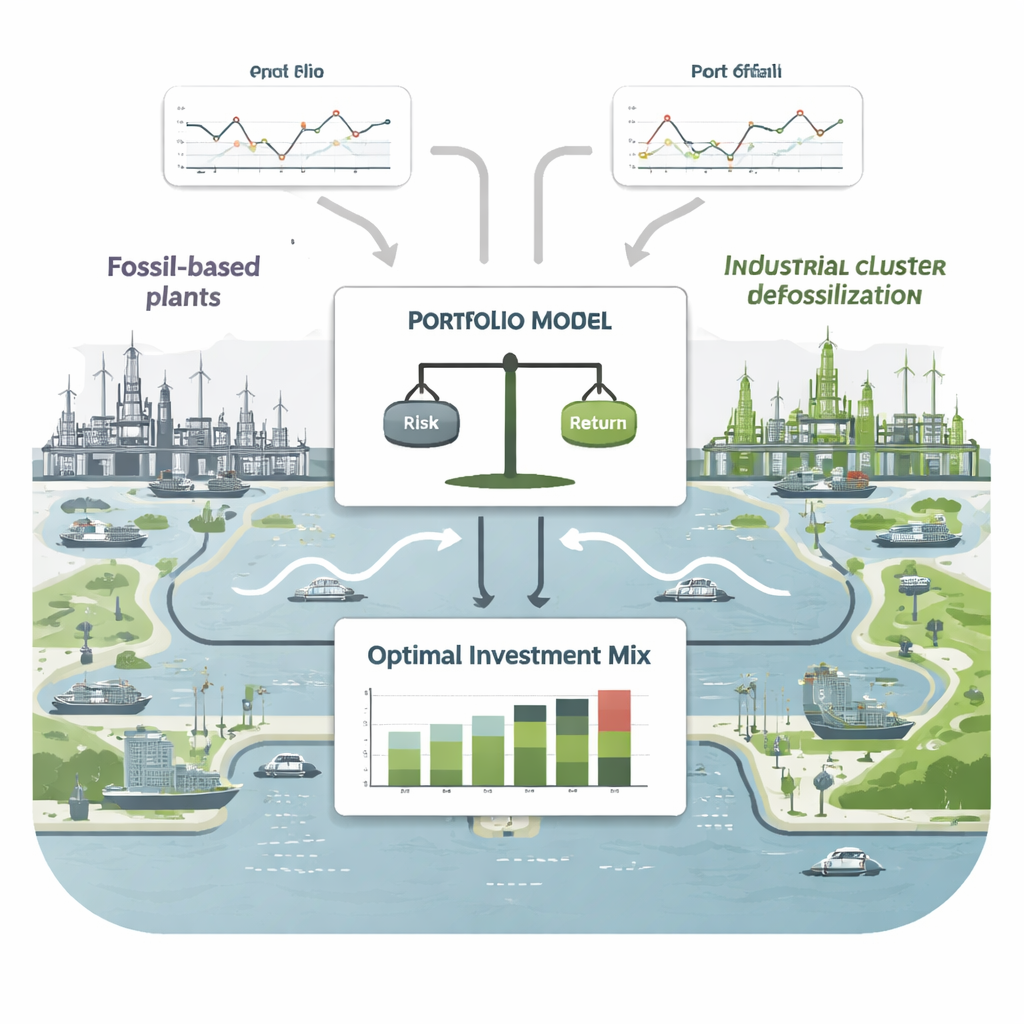
The Port of Rotterdam hosts many interconnected chemical plants that share raw materials, by‑products, and utilities such as steam and electricity. Switching just one plant from fossil feedstocks to an alternative carbon source can ripple through the entire network. The authors focus on replacing fossil‑derived inputs—such as naphtha, butane, and conventional methanol—with alternatives like biomass, recycled plastics, and carbon dioxide turned into chemicals. They treat each plant, whether fossil‑based or using alternative carbon sources (ACS), as an investment option with its own cost, revenue, and exposure to price swings in markets for energy and chemicals.
Borrowing tools from finance
To sort through these options, the study borrows Modern Portfolio Theory from finance, where investors balance expected return against risk across a basket of assets. Here, each “asset” is a chemical plant. Using real monthly price data from 2018–2024, the authors calculate how profitable each plant would have been and how volatile that profit was over time. They then build an optimization model that asks: for a given budget and demand for key products such as ethylene and benzene, what combination of plant capacities yields the highest overall return for a chosen level of risk? The output is a set of “efficient” portfolios that trace out the best possible trade‑off between profit and risk for the cluster.
What happens when green plants are added
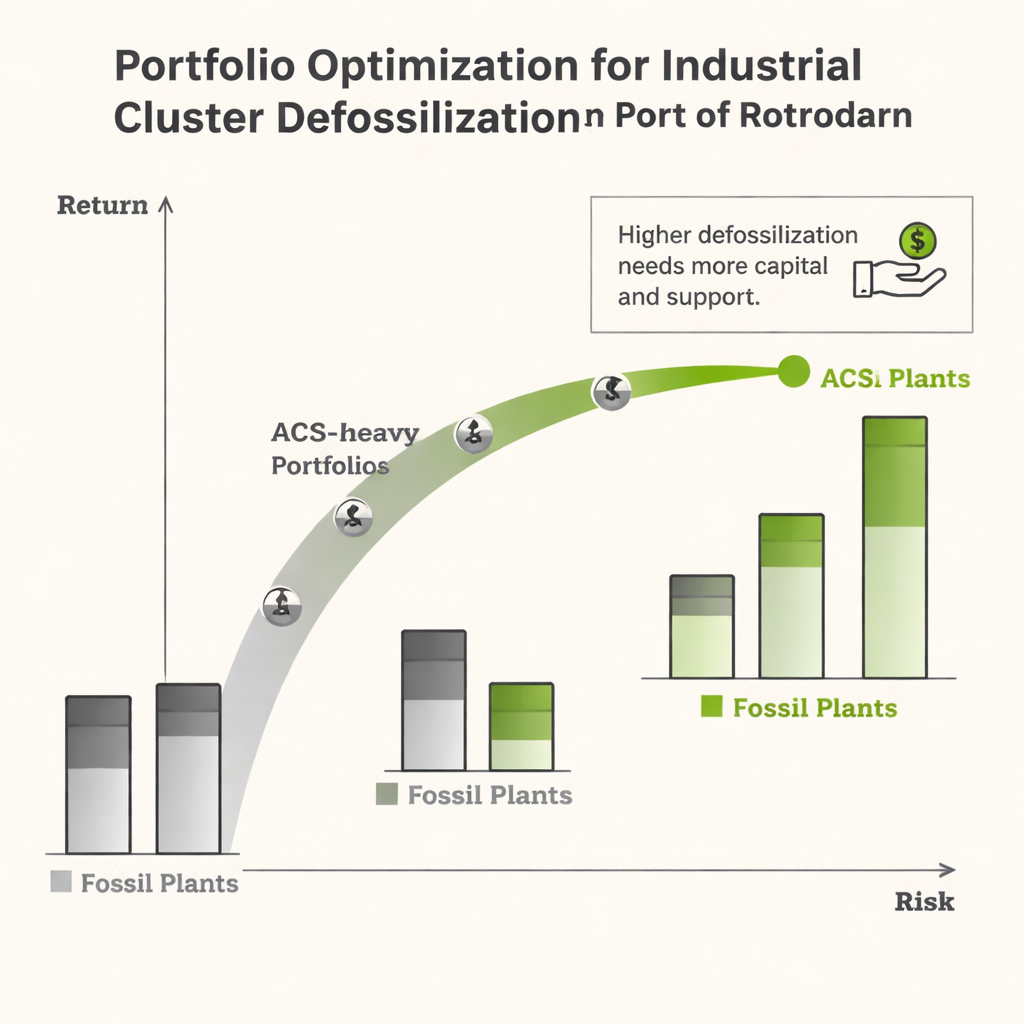
When the model is run with unadjusted market prices, the picture is sobering. Most ACS‑based plants are capital‑intensive and currently deliver lower or even negative returns compared with established fossil plants. Replacing fossil units entirely with ACS options would generally shrink profits while raising risk, making full defossilization unattractive to investors. In several scenarios—such as replacing a major olefins plant that feeds many other processes—the model finds that only partial adoption of ACS technologies is economically sensible, even when investors tolerate higher risk.
How policy support changes the game
To explore the role of public policy, the authors introduce a re‑costing method that mimics government support. They increase the effective selling prices of products from ACS plants so that their value‑added margins resemble those of their fossil‑based counterparts. This can be interpreted as targeted subsidies, price guarantees, or similar incentives. Under these adjusted prices, ACS plants begin to show positive returns, and the optimized portfolios include significantly more low‑carbon technologies. For key feedstocks like ethylene, the model identifies portfolios where roughly a third to a half of fossil inputs can be replaced, at acceptable risk levels, provided sufficient financial support is available. Still, even with re‑costed prices, fully eliminating fossil feedstocks across the cluster remains economically out of reach within the modeled constraints.
What this means for the path to cleaner chemicals
For a lay reader, the main message is that cleaning up large industrial hubs is not just a technical challenge but also a financial one. In the Port of Rotterdam case, today’s market conditions make many promising low‑carbon technologies too expensive and too risky to roll out at full scale. However, by combining them carefully with existing plants—much like diversifying a financial portfolio—and by using smart policy tools to close the profitability gap, substantial steps toward defossilization become realistic. The study provides a quantitative roadmap showing how much fossil feedstock can be replaced at different levels of profit and risk, helping governments and investors design phased transitions rather than hoping for an abrupt, and currently uneconomic, full switch.
Citation: Moradvandi, A., Ramírez, A.R. Portfolio optimization for industrial cluster defossilization in the Port of Rotterdam. Sci Rep 16, 5470 (2026). https://doi.org/10.1038/s41598-026-34990-z
Keywords: industrial decarbonization, chemical clusters, portfolio optimization, alternative carbon feedstocks, energy transition policy