Clear Sky Science · en
Phenolic content and biological activities of Lenzites betulina extracts obtained by ultrasonic-assisted optimization approaches
Why a wood‑rotting mushroom matters for health
Mushrooms growing quietly on fallen trees might not look like medicine, but many are packed with natural chemicals that can protect our cells, support brain function, and even slow the growth of cancer cells in the lab. This study focuses on Lenzites betulina, a bracket‑shaped fungus found on wood, and asks a practical question: if we want to turn this mushroom into useful health products, what is the best way to extract its beneficial compounds without damaging them?
A fungus with hidden healing potential
Lenzites betulina is already known to contain a variety of valuable molecules, including sugars, plant‑like fats, and especially phenolic compounds—small, plant‑style chemicals that act as powerful antioxidants. Previous work has suggested that extracts from this fungus can reduce inflammation, slow tumor growth, help control blood sugar in animals, and support industrial processes such as breaking down plant waste or making eco‑friendly nanoparticles. The current study builds on this background by treating L. betulina not just as an interesting mushroom, but as a serious candidate for future pharmaceutical and nutritional products.
Tuning temperature, time, and solvent like a recipe
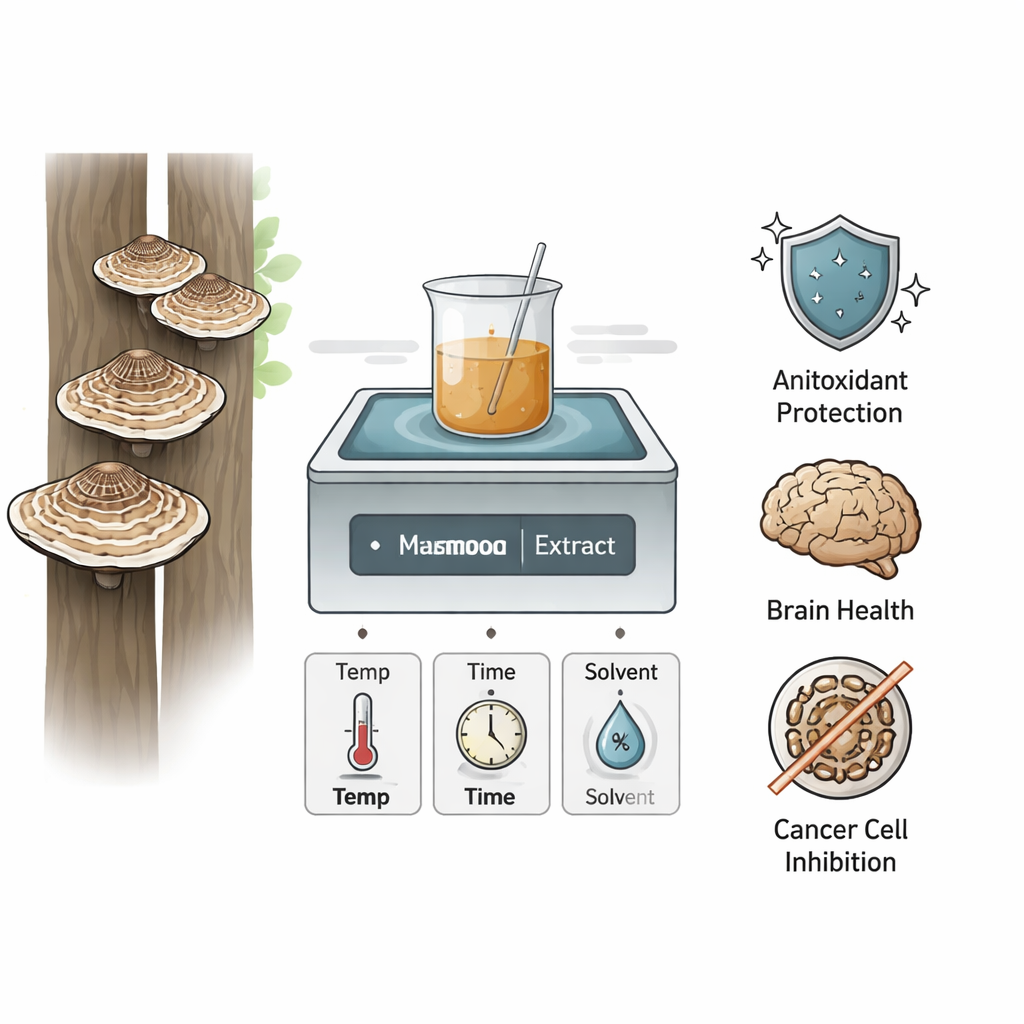
To unlock the mushroom’s full potential, the researcher did not simply soak it in alcohol or hot water and hope for the best. Instead, dried and ground samples were extracted in an ultrasonic bath—a device that uses sound waves to speed up the release of chemicals from solid material. Three key “knobs” were adjusted: the temperature (from mild warmth to 60 °C), the extraction time (30 to 60 minutes), and the mixing ratio of ethanol and water as the solvent. Twenty‑seven different combinations of these conditions were tested. The main yardstick for success was total antioxidant status, a measure of how strongly each extract could neutralize damaging oxidants. The data showed that moderate conditions—around 45 °C, 45 minutes, and a 50% ethanol–water mix—gave the strongest antioxidant results, while higher temperatures and longer times tended to damage sensitive compounds.
Comparing smart optimization tools
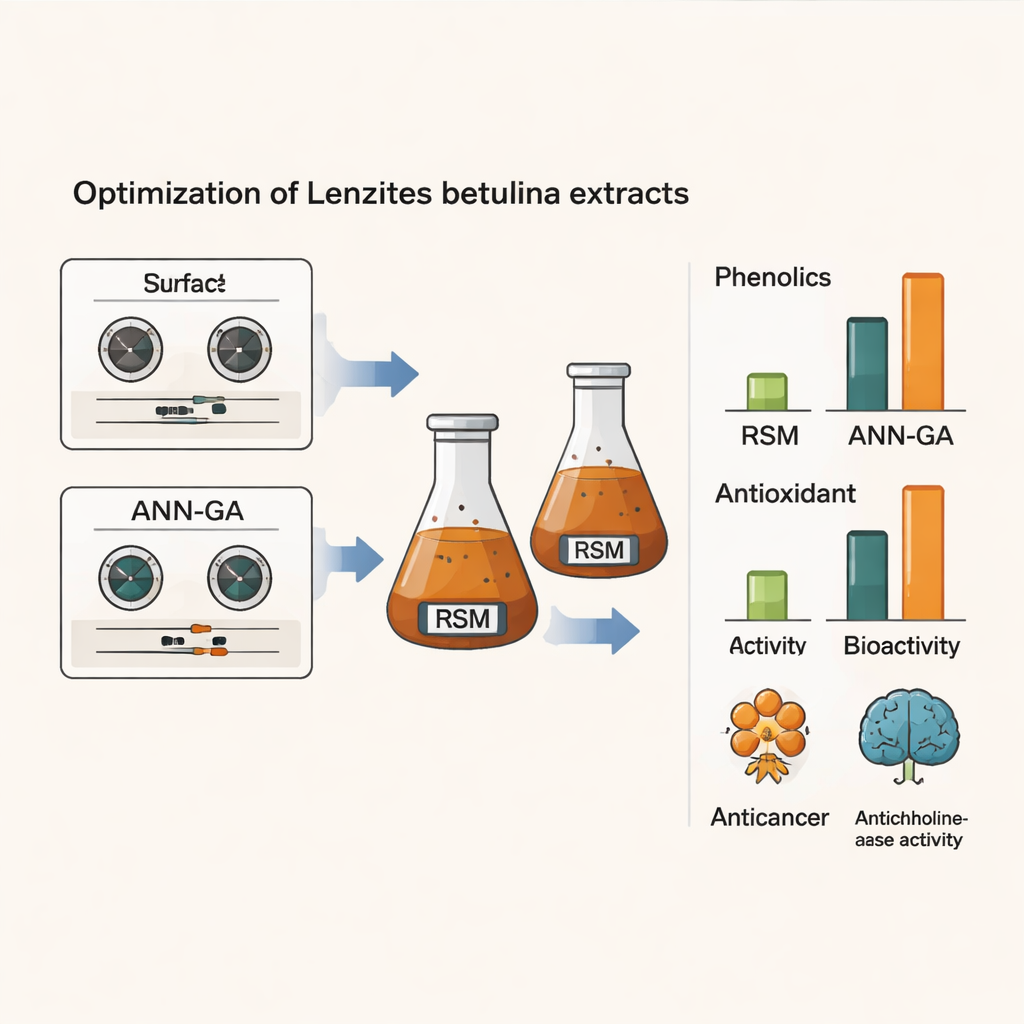
Rather than rely on trial and error alone, the study used two advanced mathematical approaches to find the best extraction conditions. The first, called response surface methodology (RSM), builds an equation that describes how temperature, time, and solvent mixture together influence antioxidant capacity, then searches that “surface” for the sweet spot. The second approach combined artificial neural networks with a genetic algorithm (ANN–GA), a form of artificial intelligence designed to learn complex patterns and then “evolve” toward better solutions. Both methods suggested slightly different “optimal” conditions, which were then tested head‑to‑head in the lab.
What the optimized extracts actually did
Once the best conditions from each method were chosen, the resulting extracts were put through a battery of tests. The RSM‑optimized extract consistently outperformed the ANN–GA one. It showed higher antioxidant power in multiple assays, a better balance between protective and harmful oxidant compounds, and stronger ability to block enzymes (acetylcholinesterase and butyrylcholinesterase) linked to memory and nerve signaling. In cancer‑cell experiments using lung, breast, and prostate cell lines, both extracts reduced cell growth in a dose‑dependent way, but again the RSM extract was more effective, even though none of the tested doses cut cell growth by half. Chemical analysis revealed why: the RSM extract contained substantially more phenolic compounds, including well‑known health‑related molecules like gallic acid, protocatechuic acid, caffeic acid, quercetin, and vanillic acid.
From lab bench to future products
For a non‑specialist, the key message is that “how” you extract compounds from a natural source can be as important as “what” you extract. In Lenzites betulina, carefully chosen ultrasonic conditions guided by response surface methodology produced extracts richer in protective phenolic compounds and with stronger antioxidant, brain‑related enzyme, and cancer‑cell‑suppressing activities in vitro. While these are early‑stage, lab‑based findings that still need to be tested in living organisms, they show that this humble wood‑rotting fungus could become a valuable ingredient in future nutraceuticals, functional foods, or supportive medical products—provided its extraction recipe is optimized with the right tools.
Citation: Karaltı, I. Phenolic content and biological activities of Lenzites betulina extracts obtained by ultrasonic-assisted optimization approaches. Sci Rep 16, 4737 (2026). https://doi.org/10.1038/s41598-026-34988-7
Keywords: medicinal mushrooms, antioxidant extracts, Lenzites betulina, phenolic compounds, ultrasonic extraction