Clear Sky Science · en
Brolucizumab versus aflibercept in treating exudative age-related macular degeneration: a 12-month pro re nata regimen
Why this matters for aging eyes
As people live longer, more of us face age-related macular degeneration (AMD), a disease that damages the light‑sensing center of the eye and can steal sharp, central vision. Many patients with the “wet” or exudative form of AMD must return to the clinic again and again for injections into the eye, which is stressful, time‑consuming, and costly. This study asks a question that matters directly to patients and families: can a newer drug, brolucizumab, control the disease as well as the established drug aflibercept, while possibly reducing the number of injections over a year?
Two medicines, one shared goal
Wet AMD is driven by leaky, fragile blood vessels that grow under the retina and ooze fluid or blood, blurring vision. Modern treatments use drugs that block a signaling protein called VEGF to dry up this leakage. Aflibercept is a widely used standard, while brolucizumab is a newer, smaller‑molecule medicine designed to pack more drug into each injection. In this real‑world study from a Japanese eye clinic, doctors followed 339 people who had never been treated for wet AMD or a related condition called polypoidal choroidal vasculopathy. Everyone first received three monthly injections of either aflibercept or brolucizumab, then came back each month for a year and got additional injections only if signs of leakage or bleeding reappeared.
Vision and eye structure after a year
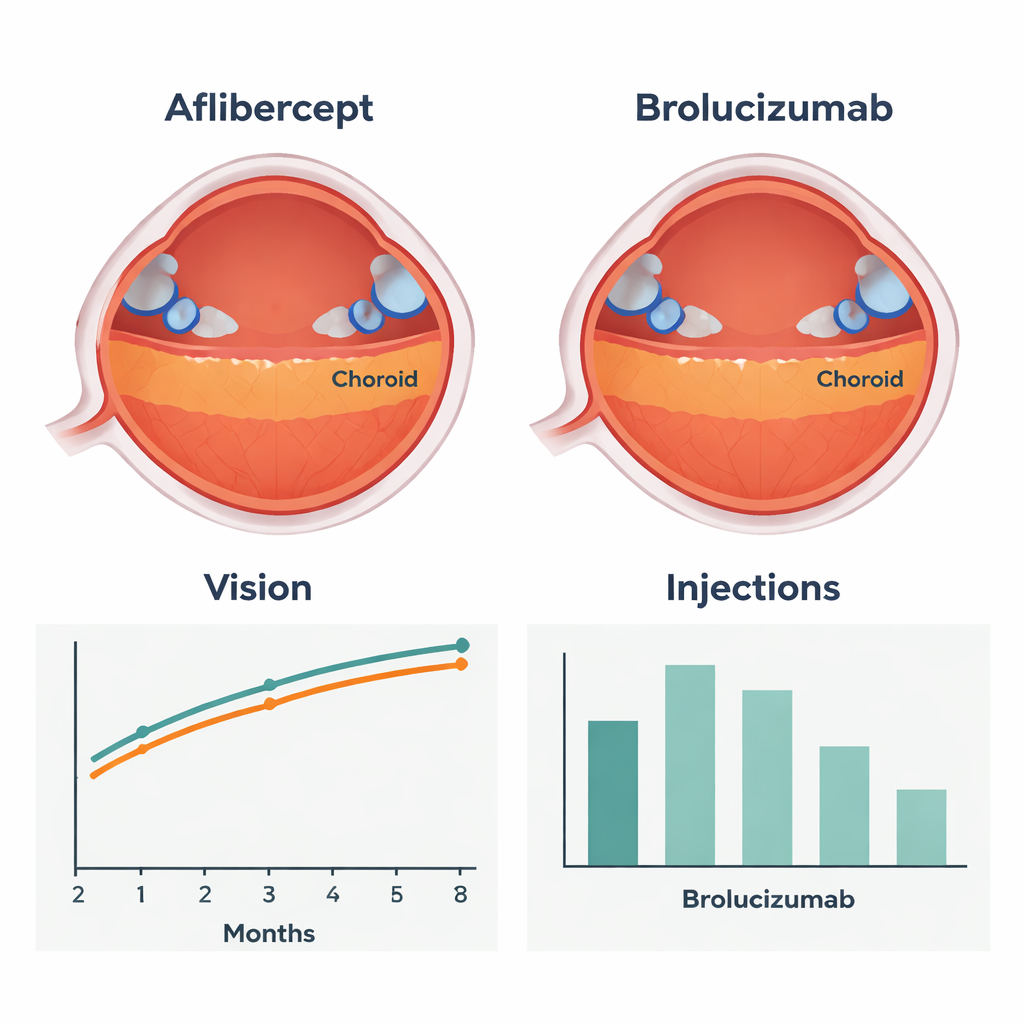
Both medicines performed similarly well at protecting sight. On average, patients in each group could see more clearly at 12 months than at the start of treatment, and there was no meaningful difference between the two drugs in this improvement. Scans of the back of the eye showed that the central retina became thinner in both groups as fluid was absorbed, and the underlying layer rich in blood vessels also thinned somewhat. These changes, which doctors interpret as the eye drying out and stabilizing, were again comparable between aflibercept and brolucizumab users. Younger age, better starting vision, and less swelling at the beginning were linked to better vision a year later, regardless of which drug was used.
How often treatment had to be repeated
Even with powerful medicines, wet AMD tends to flare up. In this study, about two‑thirds of patients in both groups had at least one recurrence of leakage or bleeding during the year and needed extra injections. Roughly one‑third in each group went the whole 12 months without any additional shots after the first three. When the researchers counted all extra injections, people receiving brolucizumab needed slightly fewer on average than those getting aflibercept, but this difference fell just short of statistical certainty. A genetic factor linked to AMD, a variant in the ARMS2 gene, along with older age and greater initial swelling in the retina, was associated with earlier recurrences, hinting that a person’s DNA and starting eye condition can influence how long the disease stays quiet.
Safety signals and side effects
Any medicine injected into the eye must be carefully monitored for safety. In this study, no serious eye infections or retinal detachments occurred among patients treated with brolucizumab, and none of the aflibercept‑treated patients experienced intraocular inflammation. However, about 5% of those receiving brolucizumab developed eye inflammation ranging from bothersome floaters to blood vessel irritation inside the eye. All these patients recovered with observation or steroid treatment and did not lose vision, but a few others had already stopped or switched drugs earlier because of similar problems and were not counted in the final analysis. These findings echo earlier clinical trials showing that brolucizumab works well but carries a small, real risk of inflammation that requires prompt attention.
What this means for patients and doctors
For people newly diagnosed with wet AMD, this study suggests that brolucizumab can preserve and often improve vision over a year just as well as aflibercept, and it may modestly reduce how often injections are needed. At the same time, the slightly higher chance of inflammation with brolucizumab means that careful follow‑up and rapid treatment of any new floaters, pain, or blurred vision are essential. Because genetics, age, and the eye’s starting condition also influence how the disease behaves, the “best” drug and schedule will differ from person to person. In practice, these results give retina specialists another proven option to tailor treatment, balancing visits, comfort, and safety to help patients keep reading, driving, and recognizing faces for as long as possible.
Citation: Kikushima, W., Sakurada, Y., Fukuda, Y. et al. Brolucizumab versus aflibercept in treating exudative age-related macular degeneration: a 12-month pro re nata regimen. Sci Rep 16, 4739 (2026). https://doi.org/10.1038/s41598-026-34984-x
Keywords: age-related macular degeneration, brolucizumab, aflibercept, anti-VEGF injections, retinal disease