Clear Sky Science · en
Shared breath of joy enhances empathy through breathing synchronization
Why Sharing a Breath Matters
Anyone who has sung in a choir, laughed with friends until you’re all gasping, or chanted at a sports game knows the feeling of suddenly being “in sync” with others. This study asks a surprisingly simple question about that feeling: can literally sharing the same breathing rhythm with someone who looks happy make us feel closer to them and understand their joy more deeply?
How the Study Brought Breathing into Focus
To explore this, researchers invited adults into a lab and seated them in front of a screen showing faces expressing different basic emotions: neutral, joy, surprise, anger, fear, and sadness. Sometimes the faces were still images. Other times, the shoulders on the image rose and fell in a subtle “breathing” motion that either matched the viewer’s own breathing or moved in a different, unrelated pattern. A high-precision millimeter-wave radar device quietly monitored each participant’s chest movements in real time, allowing the on-screen “breathing” to line up perfectly with their inhales and exhales—without anyone needing to wear sensors or being told about the trick. 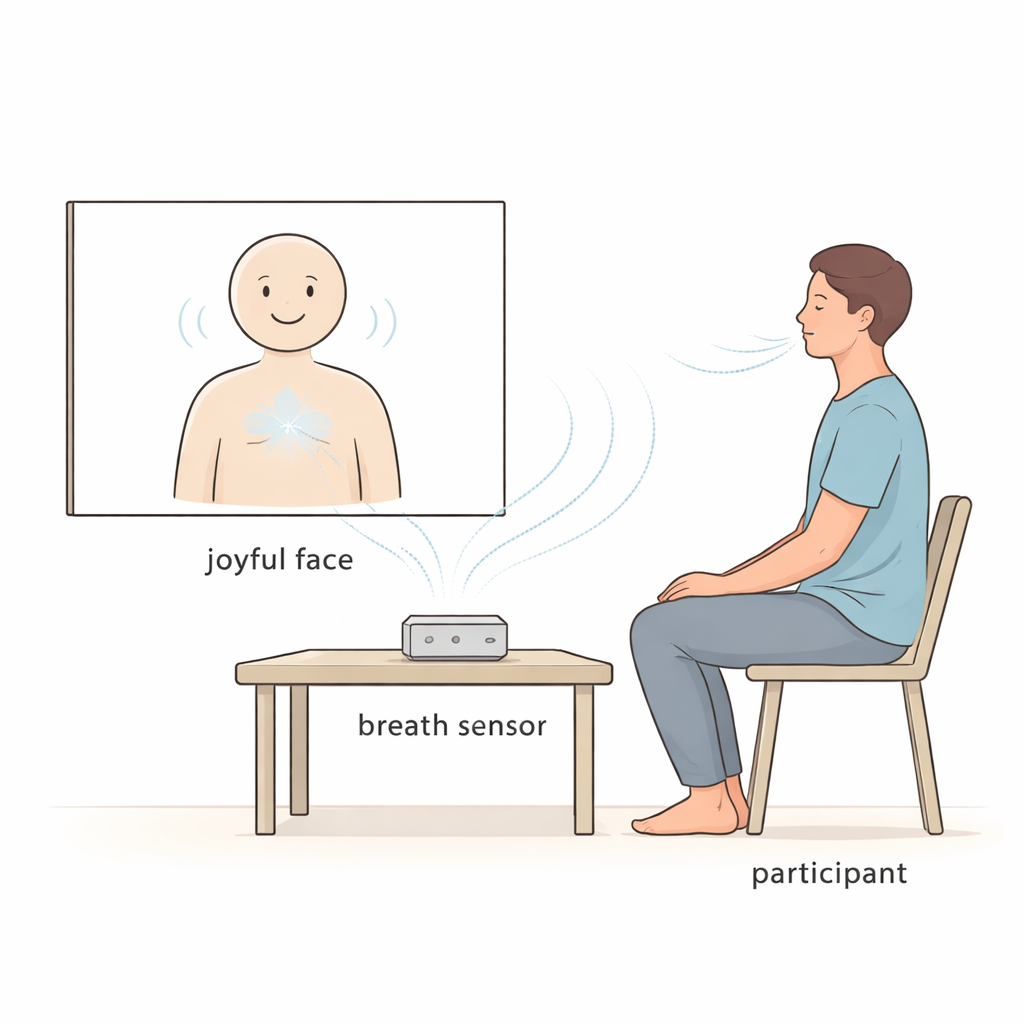
What the Researchers Measured
After viewing each face for half a minute, participants rated how emotionally stirred up they felt, how familiar the face seemed, how much empathy they felt (how much they shared and understood the emotion), and how favorable their impression of the person was. At the same time, the scientists tracked breathing rate and heart rate to see whether any effects were part of a broad bodily shift or were more specific to how people breathed. By comparing scores across emotion types and across the three viewing conditions—static, mismatched breathing, and synchronized breathing—they could tease apart whether moving in rhythm really changed how people connected to what they saw.
Joy Stands Out When Breaths Align
The standout result was that synchronized breathing with joyful faces boosted both empathy and a sense of familiarity more than any other combination of emotion and condition. When the on-screen shoulders rose and fell in time with a participant’s own breath, people reported feeling more in tune with the smiling faces and felt as if they “knew” them better. This did not happen for anger, fear, or sadness, even though those emotions did speed up breathing overall. In other words, negative expressions influenced how fast people breathed, but matching breathing rhythms did not make viewers feel extra empathy for those emotions. Heart rate barely budged across conditions, suggesting the key changes were tied specifically to breathing, not to a general stress response. 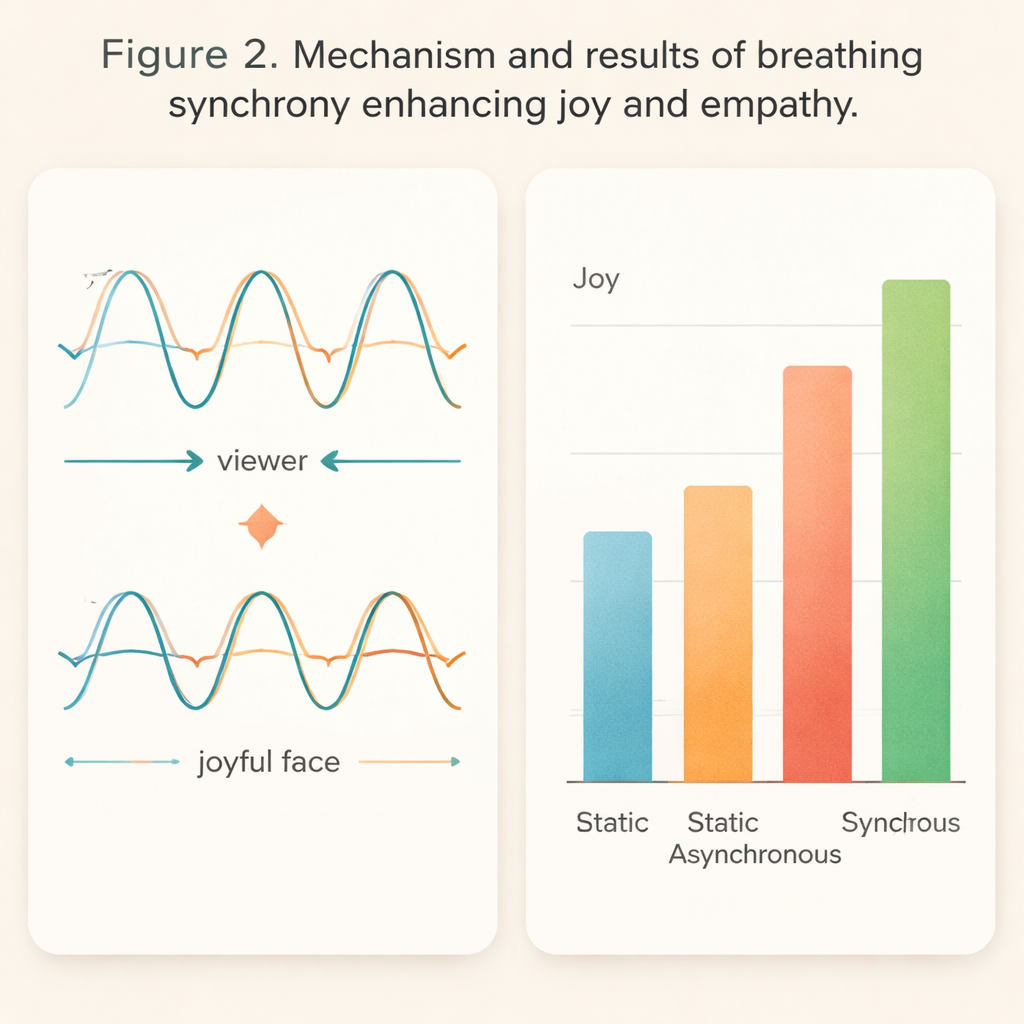
From Familiarity to Empathy
Further analysis hinted at how this works. The researchers modeled the relationships between people’s ratings and found that, for joyful faces, synchrony seemed to strengthen a chain: synchronized breathing made the faces feel more familiar, and that increase in familiarity, in turn, was strongly linked to higher empathy. Even when people already felt quite empathetic toward joyful faces in the static condition, breathing in sync nudged their scores even higher. This pattern fits with other work showing that we more easily share the feelings of those who seem familiar or close to us, and suggests that the body’s quiet rhythms can help create that sense of closeness.
What This Means for Everyday Connection
To a layperson, the takeaway is that “feeling on the same wavelength” with someone may be more than a figure of speech: literally breathing together can deepen how we share in another person’s happiness. The effect was specific—joyful expressions became more relatable and familiar when breaths matched, without simply making people more excitable or more favorable overall. This helps explain why activities that rely on shared breathing, like group singing, chanting, or laughing, are so powerful for bonding. By aligning our breaths, we may be giving our bodies a simple, built-in way to strengthen positive emotional ties.
Citation: Masaoka, Y., Honma, M., Nakayama, M. et al. Shared breath of joy enhances empathy through breathing synchronization. Sci Rep 16, 4754 (2026). https://doi.org/10.1038/s41598-026-34981-0
Keywords: empathy, breathing synchrony, joy, social bonding, emotional connection