Clear Sky Science · en
Physical model study on the mechanism of floor heave for the deep-buried roadway excavated in soft rock of gently inclined thin strata
Why mine tunnel floors suddenly rise
Deep underground, the floors of some mine tunnels slowly bulge upward, squeezing out rails and equipment and threatening worker safety. This puzzling “floor heave” is costly to repair and difficult to predict, especially in soft, layered rock common in coal mining regions. The study behind this article uses large-scale physical and computer models to reveal how stresses inside gently tilted thin rock layers can fracture and lift the tunnel floor, offering insight that can help design safer and more stable underground roadways.
A closer look at rising tunnel floors
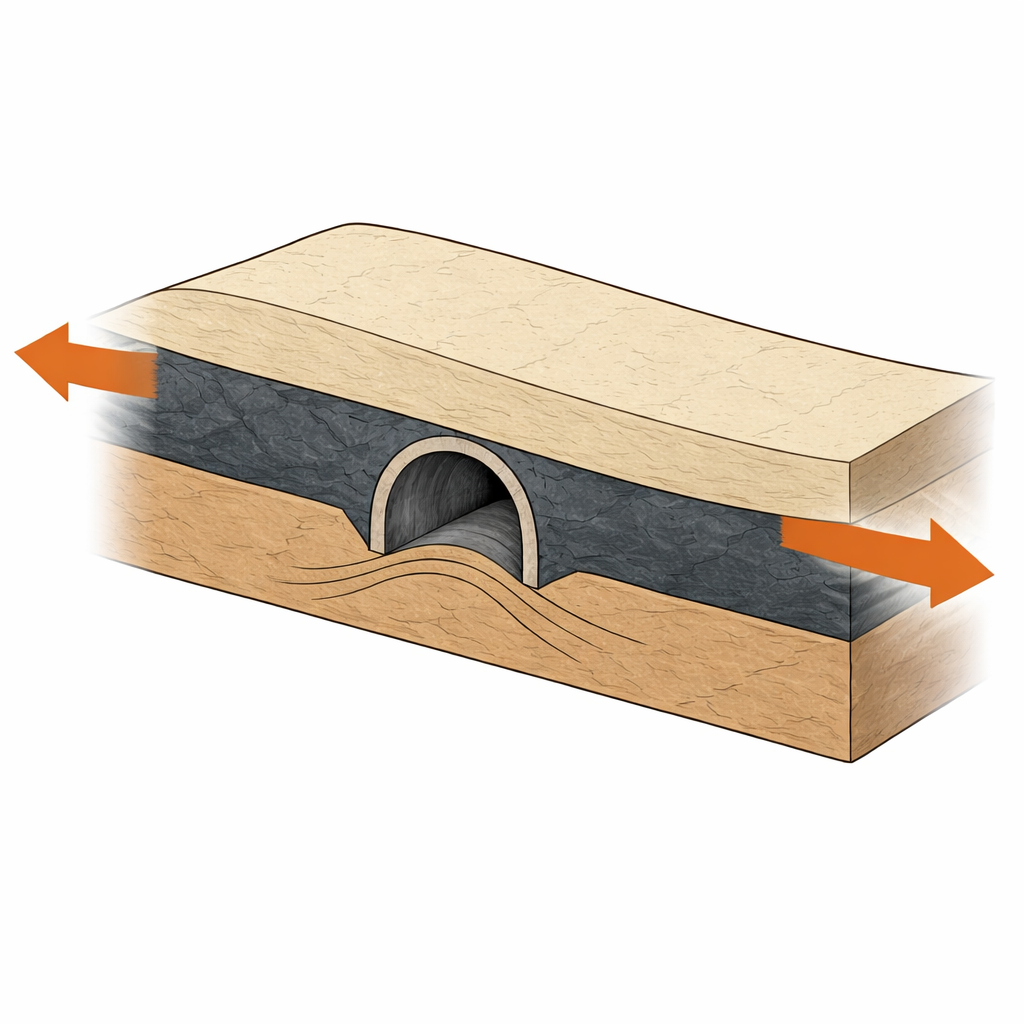
In western China and many other mining areas, coal is extracted from depths of hundreds of meters, where the weight of overlying rock creates huge pressures. Many of these tunnels are dug through soft rocks arranged in thin layers—mudstone, coal, and siltstone—set at a gentle angle rather than lying flat. Engineers have long observed that, under these conditions, the tunnel floor can arch upward dramatically over time. Earlier explanations focused on vertical forces from the roof, water swelling, or slow creep of the rock, but the specific role of the layered structure and sideways squeezing of the rock mass was still unclear.
Building a tunnel in the laboratory
To unravel this mechanism, the researchers constructed a large physical model based on a real roadway in a coal mine in Yunnan, China, located about 750 meters below ground in strata tilted roughly ten degrees. They recreated the three main rock types using carefully mixed powders that matched the real rocks’ density and strength at a reduced scale. The layered block, about the size of a large tabletop, contained a small tunnel carved through the “coal” layer. Using hydraulic loading, they applied pressures equivalent to those deep underground, with equal vertical and horizontal stresses, and then simulated excavation and additional loading in controlled stages.
Watching the rock strain and break
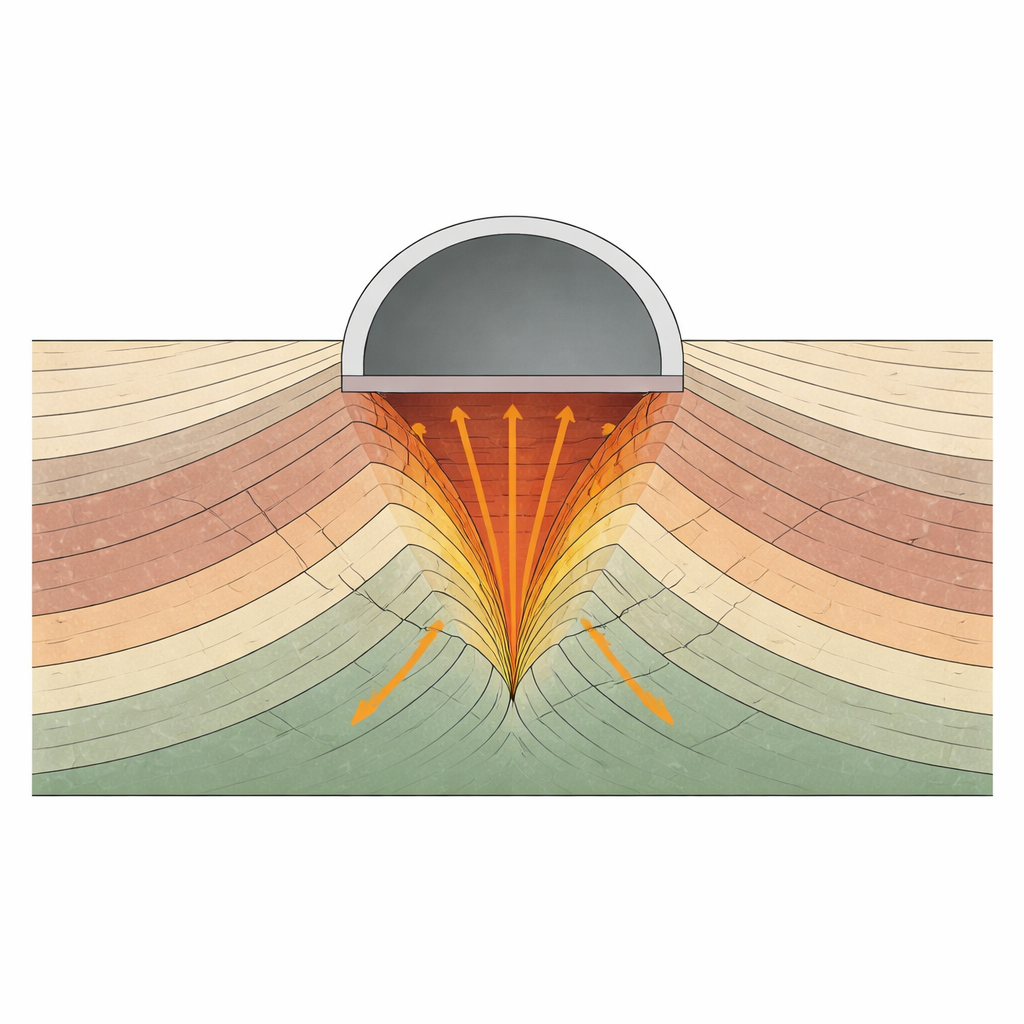
During loading, a high-resolution camera system tracked tiny surface movements, while dozens of strain gauges measured deformation inside the block. As the pressure increased, the first noticeable changes appeared beneath the roadway floor. A funnel-shaped zone of rising strain formed directly under the tunnel, growing stronger as loading continued. Eventually the thin layers below the roadway separated from those underneath, cracked, and lifted upward, creating clear floor heave. The strongest measured deformation was concentrated in a region extending to about half the tunnel’s width into the floor, and the equivalent strain in this area rose to a high peak value, signaling severe damage. The analysis showed that horizontal squeezing of the soft, thin layers was the dominant driver of this uplift.
Hidden tension and compression around the tunnel
The team also mapped how the rock around the tunnel shifted between stretching and squeezing as the floor failed. Within a distance comparable to the tunnel diameter, zones of tensile (pulling) and compressive (pushing) stress alternated around the opening. After the floor heaved, the rock closest to the roadway experienced strong tension, especially in the corners and along the roof and floor, while compressive zones formed farther out. This pattern explains why cracks tend to initiate at specific points and then propagate into a characteristic failure shape around the tunnel.
Checking the findings with computer models
To confirm that the observed behavior was not unique to one experiment, the researchers built a three-dimensional numerical model using established rock mechanics software. They reproduced the same geometry, layered structure, and boundary conditions as in the physical test. The simulated tunnel showed similar displacement patterns: the floor near one side of the tunnel bent upward sharply and fractured, while the roof sagged slightly. Key measurement points in the simulation moved by almost the same amounts as in the laboratory model, with differences of only a few millimeters at the experimental scale. This close agreement strengthens confidence in the identified mechanism.
What this means for safer underground tunnels
For non-specialists, the takeaway is straightforward: in deep, soft, thinly layered rock, sideways squeezing of the ground can be just as important as vertical weight in driving tunnel floor heave. The gently inclined layers act like stacked, weak plates that buckle, crack, and peel upward under horizontal stress, especially beneath the roadway. Knowing that the most critical damage concentrates in a funnel-shaped zone directly under the tunnel and within about one tunnel width around it helps engineers plan targeted reinforcements, such as floor anchors or improved support in specific regions rather than blanket overdesign. While the study focuses on a particular mine, its insights offer a clearer physical picture that can guide more reliable design and control of deep underground roadways worldwide.
Citation: Chen, F., Wang, E., Miao, C. et al. Physical model study on the mechanism of floor heave for the deep-buried roadway excavated in soft rock of gently inclined thin strata. Sci Rep 16, 9557 (2026). https://doi.org/10.1038/s41598-025-95299-x
Keywords: floor heave, soft rock roadway, deep mining, tunnel stability, rock strata