Clear Sky Science · en
Co-speciation and host-switching drives diversity of picornaviruses and sapoviruses in Malagasy fruit bats
Why Bat Viruses Matter to Us
Bats have an uncanny knack for living comfortably with viruses that can be dangerous to other animals, including people. Understanding how these viruses evolve and move between hosts is key to anticipating future disease threats. This study explores a hidden world of intestinal viruses carried by fruit bats in Madagascar and shows how ancient partnerships between bats and viruses, along with occasional host jumps, have created a rich and highly structured viral ecosystem.
Island Bats and Their Invisible Passengers
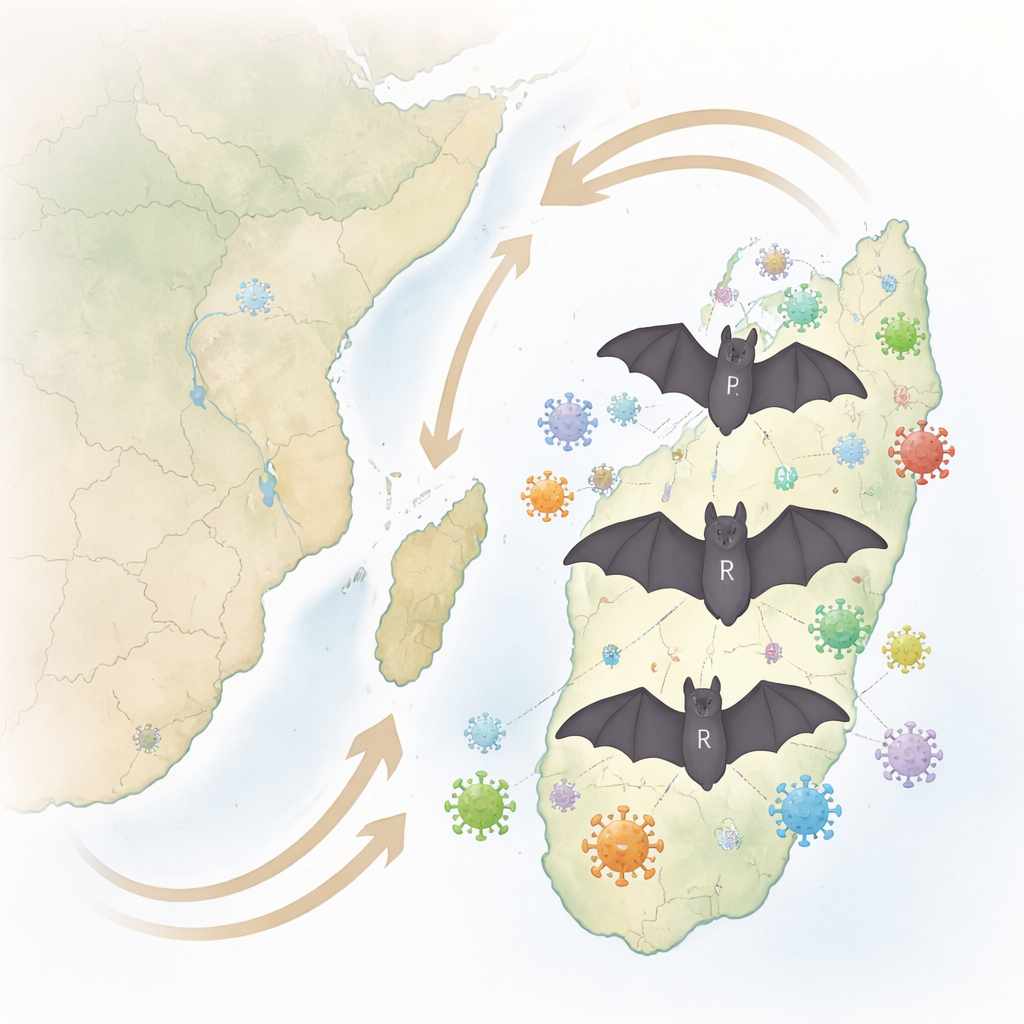
Madagascar is famous for its unusual wildlife, shaped by tens of millions of years of isolation from mainland Africa. That same isolation has likely molded the viruses that live in its animals. The researchers focused on three fruit bat species found only in Madagascar and asked a simple question: which intestinal viruses are they carrying, and how are those viruses related to ones already known from African bats and other animals? They concentrated on two virus families, picornaviruses and sapoviruses, which can cause gut and liver disease in many mammals but have been far less studied in bats than headline-makers like coronaviruses.
Reading Viral Genomes from Bat Droppings
Over several years, the team collected more than 800 fecal and urine samples from bats at caves and roost sites around Madagascar. Instead of searching for one virus at a time, they used a broad, DNA-style “metagenomic” scan that reads all genetic material in a sample and then uses powerful computer tools to identify which pieces belong to which viruses. From this, they reconstructed 13 complete viral genomes and 38 partial ones. These sequences belonged to a surprisingly wide range of viral types, including several kinds of picornaviruses—such as hepatoviruses and kobuviruses—as well as sapoviruses, all circulating quietly in Malagasy fruit bat colonies.
Family Trees Across Oceans
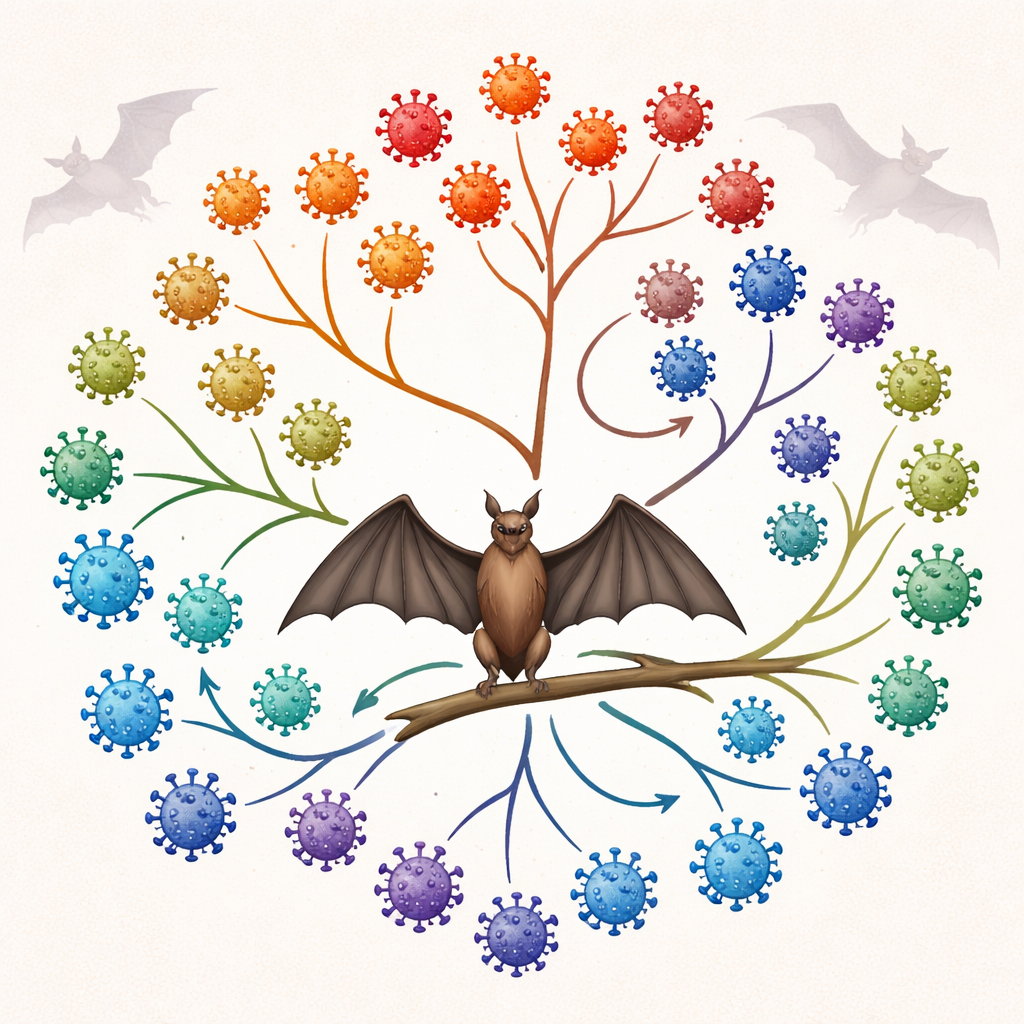
To understand where these viruses came from, the scientists built evolutionary “family trees” comparing the new genomes with hundreds of reference viruses from around the world. Again and again, they found that viruses in Malagasy bats were most closely related not to those in humans or livestock, but to viruses found in closely related bat species on mainland Africa. For example, viruses from Malagasy Eidolon and Rousettus bats clustered next to viruses from their African sister species, Eidolon helvum and Rousettus aegyptiacus. This suggests that viral lineages have tracked bat lineages over long periods, a pattern known as co-speciation, rather than constantly jumping between many different hosts.
When Viruses Jump Ships
The story is not one of strict fidelity, however. By comparing viral and host trees and scanning genomes for signs of mixing, the team detected footprints of host-switching and recombination—moments when a virus moved into a new host species or swapped genetic segments with a related virus. These events were especially evident in certain genome regions known to influence how viruses interact with the host immune system and which species they can infect. Interestingly, even though some of the Malagasy bat species share caves and feeding grounds, the researchers saw little evidence that the same viral strains circulate freely between them today. Instead, each bat species tends to harbor its own suites of viruses, hinting that most cross-species jumps happened in the deeper past or across the Mozambique Channel between African and Malagasy bats.
What This Means for Human Health
For now, the viral lineages uncovered in these bats are distant from those known to infect humans. They appear to specialize in particular bat hosts, shaped by long-term co-evolution with only occasional jumps. That does not mean they pose no risk—people in Madagascar and parts of Africa hunt bats for food, and recombination events can sometimes precede the emergence of new, more adaptable viruses. But the main message of this work is that most diversification in these bat viruses comes from slow, shared evolutionary history rather than constant, chaotic spillover. Mapping that hidden history is a crucial step in judging which viral groups are more likely to cross into humans and which are content to remain part of the bats’ unique island microbiome.
Citation: Kettenburg, G., Ranaivoson, H.C., Andrianiaina, A. et al. Co-speciation and host-switching drives diversity of picornaviruses and sapoviruses in Malagasy fruit bats. Sci Rep 16, 6583 (2026). https://doi.org/10.1038/s41598-025-34969-2
Keywords: bat viruses, Madagascar, virus evolution, host switching, zoonotic risk