Clear Sky Science · en
Fuel-driven hybrid deep learning model for forecasting finger millet prices
Why grain prices and fuel costs matter to everyone
Food prices shape daily life, especially for families who depend on staple grains. In southern India, finger millet (also called ragi) is an affordable, highly nutritious cereal that can be stored for years. If farmers can anticipate how its price will change, they can choose when to sell their harvest and improve their income. This study explores how modern computer models, combined with information about fuel costs, can help forecast finger millet prices more accurately, with potential benefits for farmers, traders, and policy makers.
A hardy grain with growing demand
Finger millet has long been a rural staple in Asia and Africa, valued for being cheap, filling, and easy to store. In recent years it has also become popular in cities because of its health benefits, including support for weight control, cholesterol management, and bone strength. It is sold as flour, ready-to-eat mixes, and other processed foods. Because the grain can be safely stored for years, farmers do not need to sell immediately after harvest. Instead, they can wait for a favorable market price—if they have some guidance about where prices are headed.
From simple trends to smarter forecasts
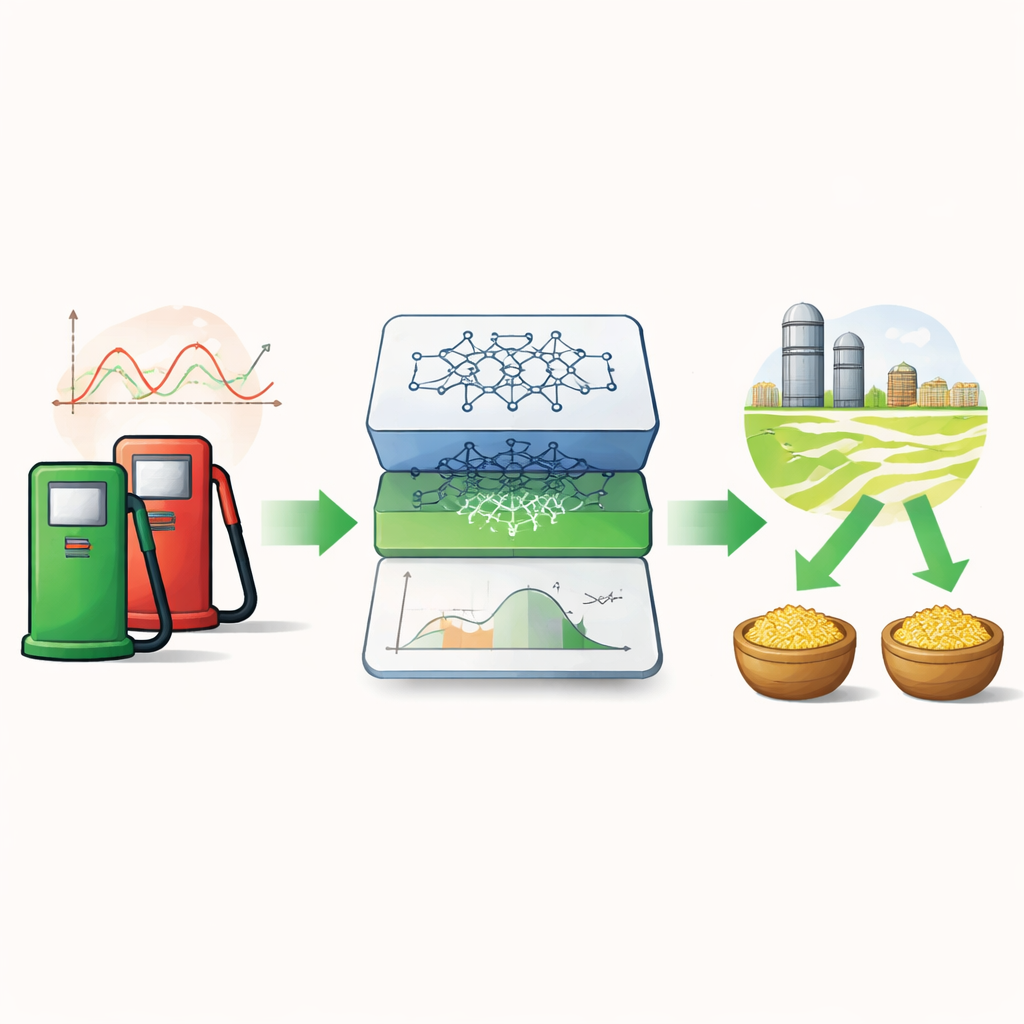
Earlier efforts to predict finger millet prices mostly relied on looking at past prices and the amount of grain arriving in markets. These approaches, while useful, ignored other real-world factors that influence what consumers ultimately pay. The authors of this study were particularly interested in the role of fuel costs. Diesel prices affect the cost of transporting grain from farms to markets, which in turn can raise or lower food prices. To capture these relationships, the researchers designed a forecasting system that uses multiple streams of information: how much millet was brought to market, the prices it fetched, and how diesel prices changed over time.
How the hybrid prediction engine works
The team combined several advanced methods that are commonly used for analyzing time-based data. They tested three deep learning models—GRU, 1D-CNN, and LSTM—alongside a traditional statistical method called vector autoregression, which is well suited for examining how several time series influence one another. Building on this, they proposed a hybrid model that first applies the statistical method and then feeds its output into a stacked LSTM network. This design lets the model capture both straightforward and more tangled patterns in the data, such as abrupt changes during the COVID-19 pandemic years.

What the data reveal about fuel and food prices
The researchers assembled monthly records from six major millet-growing districts in Karnataka, India. They used government market reports to obtain information on millet arrivals and prices, and an online portal to track diesel prices. They examined two time windows: three-year blocks and five-year blocks of past data used to forecast prices for 2019 and 2022. The accuracy of each model was judged by how far its forecasts deviated from real prices. Across many tests, the hybrid model that combined the statistical step with stacked LSTM layers produced the most stable and accurate forecasts. In particular, when it relied on three years of diesel and price information, its typical error in some regions was around one percent. A separate interpretability tool showed that diesel prices, together with recent millet prices, were the most influential factors in the model’s decisions, while fluctuations in the quantity of grain arriving at market were more erratic and less helpful.
How better forecasts can help farmers
In everyday terms, this work suggests that fuel costs are a powerful lever behind what farmers and consumers ultimately pay for finger millet. By combining fuel prices with recent market data in a carefully designed prediction engine, the authors were able to forecast monthly millet prices with high accuracy, even through turbulent years. Such a system, if turned into a simple mobile tool, could offer farmers timely guidance on whether it is a good month to sell or to wait, helping them secure better returns while giving policy makers clearer insight into how energy costs ripple through the food system.
Citation: Chaitra, B., Meena, K. Fuel-driven hybrid deep learning model for forecasting finger millet prices. Sci Rep 16, 7821 (2026). https://doi.org/10.1038/s41598-025-34947-8
Keywords: finger millet prices, fuel and food costs, deep learning forecasts, agricultural markets, time series modeling