Clear Sky Science · en
In-situ efficiency and parameter estimation for induction motors using heuristic optimization
Why smarter motors matter
Hidden inside factories, pumps, and ventilation systems, electric motors quietly swallow most of the world’s industrial electricity. Even small improvements in how efficiently these machines turn electricity into motion can save large amounts of energy and cut greenhouse gas emissions. Yet checking how well a motor is really performing usually means stopping production and hauling the machine into a lab—something many plants simply cannot do. This paper introduces a way to estimate a motor’s efficiency while it keeps running on the factory floor, using only standard electrical measurements and advanced search algorithms borrowed from artificial intelligence.

The problem with checking big workhorse motors
Three-phase induction motors are the rugged workhorses of industry because they are simple, cheap, and durable. However, most installed motors operate below their ideal load, which wastes energy and money over time. Official test standards, such as IEEE 112, define very accurate ways to measure efficiency, but they require special test rigs, braking machines, and direct torque measurements. Those tests are expensive, intrusive, and often impossible for large motors already built into production lines. Nameplate values from manufacturers also cannot always be trusted, especially after a motor has aged or been repaired. Industry therefore needs a way to “audit” motors in place, without shutting them down or installing extra mechanical sensors.
A new way to read a motor’s true health
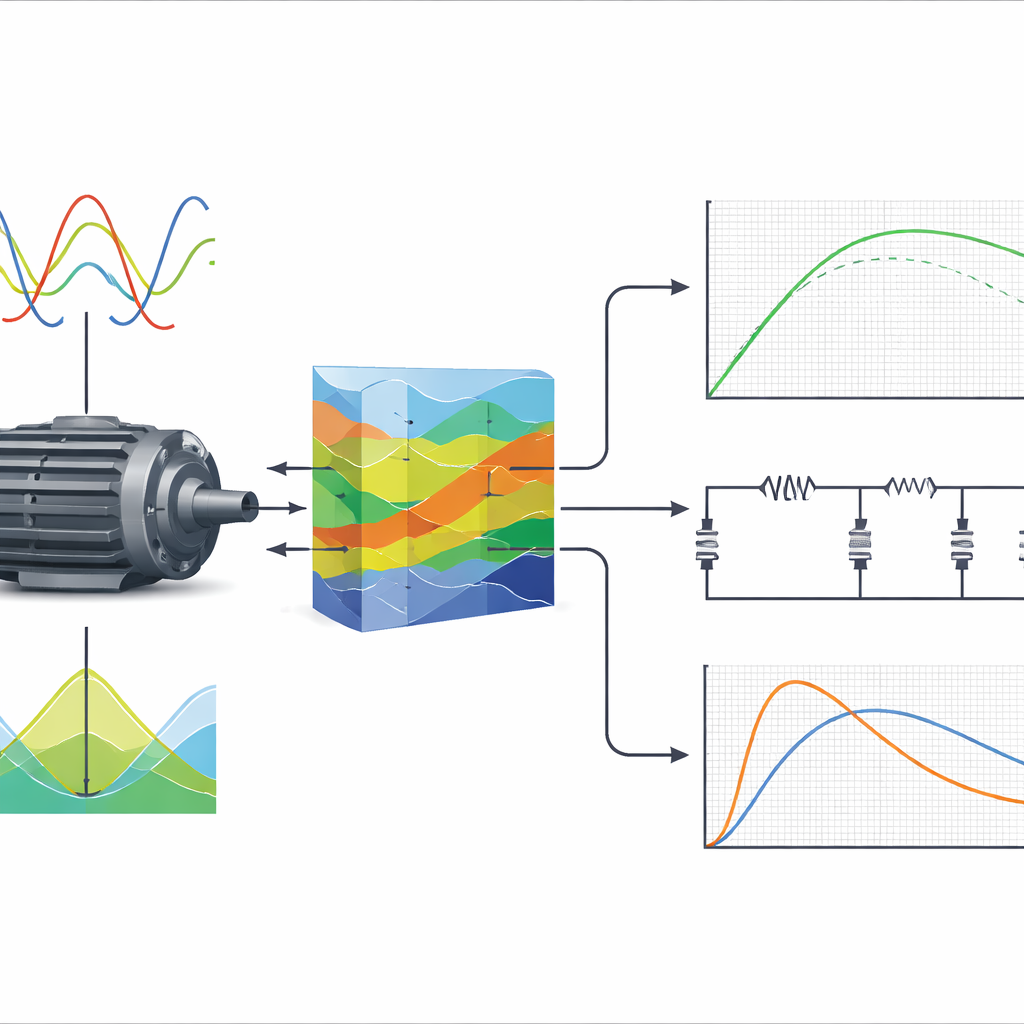
The authors tackle this challenge by treating the motor as an electrical puzzle. Instead of measuring every loss directly, they focus on a simplified electrical model of the motor, built from a small set of key internal parameters such as resistances and reactances. If these parameters are known, efficiency and torque can be calculated across different loads. The key idea is to look only at quantities that are easy to measure in the field—line voltage, current, input power, and speed—and then let computer-based search methods adjust the hidden model parameters until the model’s behavior matches the measurements. Once the model fits, the same standard equations used in laboratory testing can be applied to compute efficiency, but now in situ.
Letting nature-inspired algorithms do the searching
Finding the right combination of internal parameters is tricky because the search space is large and the parameters interact in complicated ways. To handle this, the study uses eight “heuristic” optimization algorithms inspired by natural behaviors: flocks of birds, packs of wolves, hunting hawks, wandering whales, and more. Each algorithm starts with many trial solutions and nudges them toward better fits over hundreds of iterations. The authors also introduce a physics-based way to narrow the allowed range for each parameter, using nameplate data, manufacturer information, and electrical test relationships. This prevents unrealistic solutions and helps the algorithms converge faster and more reliably, especially for sensitive quantities like rotor resistance.
Testing on real motors of many sizes
The method was tested on six industrial motors, ranging from 1.1 kilowatts to 132 kilowatts, at four load levels between one-quarter and full load. Two estimation schemes were used. In Method I, the algorithms relied only on field measurements, ignoring the nameplate output power so that they would be robust to inaccurate labels. In Method II, the rated power was added as an extra constraint. For each motor and load, the estimated efficiencies were compared with values obtained from the official IEEE 112 procedures using full laboratory setups. Across all motors, the average error at full load stayed below about 0.7 percent, and several algorithms—especially particle swarm optimization, whale optimization, and differential search—showed both high accuracy and stable, repeatable results. Errors rose at very light load, mainly because standard motor models treat some losses as constant even when the motor is barely working.
What this means for factories and energy savings
To a lay reader, the main takeaway is that factories can now estimate how efficiently their motors are running without stopping production or installing complex mechanical sensors. By reading only electrical signals that are already monitored in many plants, this method can track efficiency over time, flag underperforming or degraded machines, and support energy audits and maintenance planning. While the approach is less precise at very low loads and can be sensitive to bad nameplate data, the authors show that, under typical operating conditions, it comes very close to gold-standard laboratory tests. In practical terms, this means companies can get near-lab-quality insight into the health of their most power-hungry equipment, at low cost and without disruption—a useful tool for cutting energy bills and reducing environmental impact.
Citation: Göztaş, M., Sahman, M.A. & Çunkaş, M. In-situ efficiency and parameter estimation for induction motors using heuristic optimization. Sci Rep 16, 9643 (2026). https://doi.org/10.1038/s41598-025-34932-1
Keywords: induction motor efficiency, in-situ monitoring, heuristic optimization, industrial energy savings, motor parameter estimation