Clear Sky Science · en
Bioinspired 8‑hydroxyquinoline-Fe3O4 nanostructures from Citrullus colocynthis exhibit strong antibacterial, antifungal, and anticancer effects
Why a Desert Fruit and Tiny Particles Matter
As drug‑resistant infections and cancer continue to challenge modern medicine, scientists are looking to nature and nanotechnology for fresh answers. This study combines an old medicinal plant, the bitter desert fruit Citrullus colocynthis, with ultra‑small iron particles to create a new material that can kill harmful microbes and damage cancer cells—using a greener, less toxic manufacturing route than many conventional drugs.
Turning a Bitter Fruit into a Healing Tool
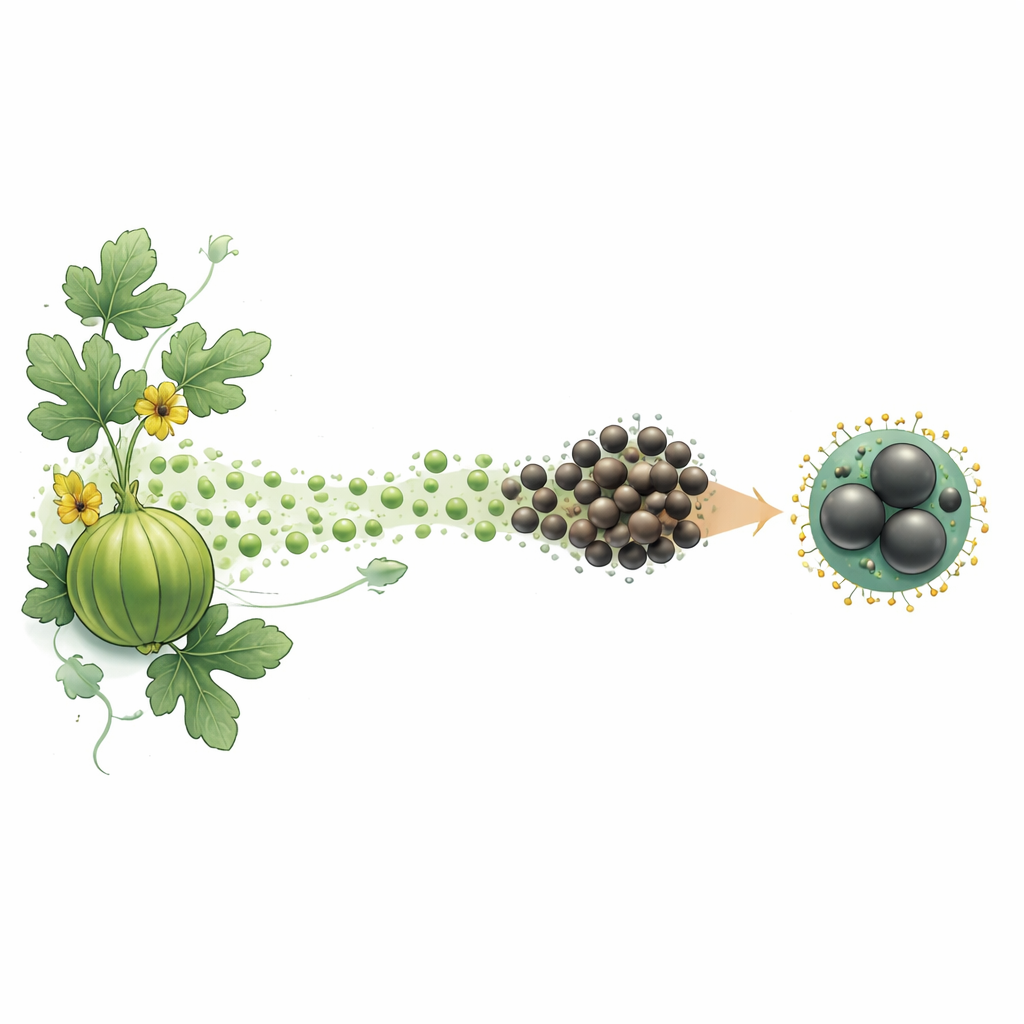
Citrullus colocynthis, sometimes called bitter apple, has long been used in traditional medicine for its antimicrobial and anti‑inflammatory effects. Its fruits contain potent natural chemicals such as flavonoids and cucurbitacins, which can influence inflammation, blood sugar, and even tumor growth. In this work, the researchers used an extract of the plant’s seeds as both a natural "factory" and protective coating to build iron oxide nanoparticles. Instead of harsh industrial chemicals, the plant extract acts as a gentle reducing and stabilizing agent, aligning with the growing push for eco‑friendly or "green" chemistry in drug development.
Building a Dual‑Action Nano Weapon
The team first created iron oxide nanoparticles using either standard chemical methods or the greener plant‑based process. They then coated these particles with 8‑hydroxyquinoline, a small molecule known for binding metals and triggering cell death in tumors. The final product—called 8HQ@CCE‑ION—consists of a magnetic iron core wrapped in layers of plant‑derived compounds and 8‑hydroxyquinoline. Sophisticated imaging and analytical tools showed that these particles are predominantly spherical and only tens of billionths of a meter wide, with a uniform mix of iron and organic material. Measurements of particle size, surface charge, and structure confirmed that the green‑synthesized versions are especially stable in watery, body‑like environments, an important feature for any material intended for medical use.
Fighting Germs that Threaten Human Health
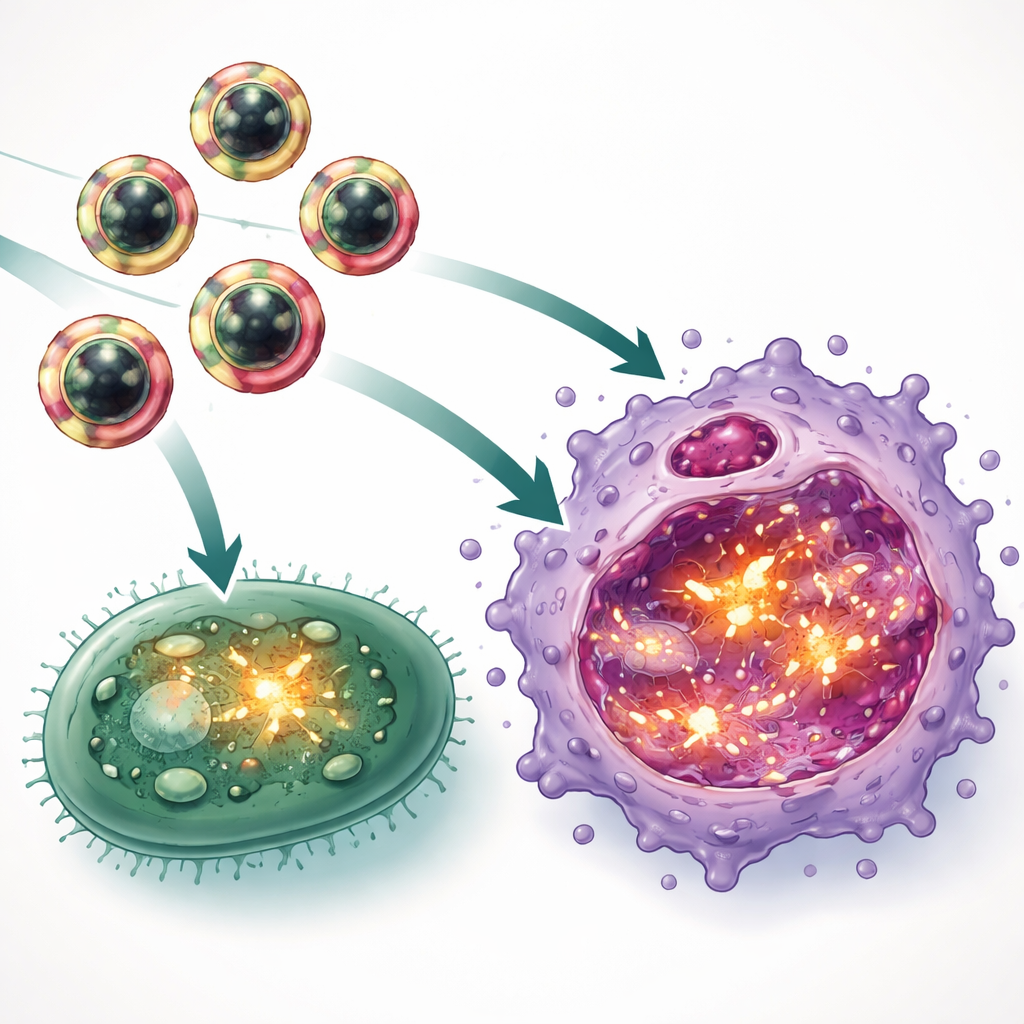
To test their new material as an antimicrobial agent, the researchers challenged a panel of disease‑causing microbes: two common Gram‑positive bacteria (Staphylococcus aureus and Enterococcus faecalis), two Gram‑negative strains (Escherichia coli and Pseudomonas aeruginosa), and the yeast Candida albicans. Using standardized microplate tests, they tracked how different concentrations of the particles affected microbe growth. The plant‑made iron particles (CCE‑ION) showed clearly stronger antibacterial and antifungal effects than plain, chemically produced iron particles or the plant extract alone. Pseudomonas aeruginosa and E. coli were especially sensitive, with growth strongly suppressed at relatively low doses. These results suggest that the combination of tiny particle size, magnetic iron, and plant chemicals helps the material attach to, penetrate, and disrupt microbial cell membranes, likely also boosting harmful oxidative stress inside the microbes.
Targeting Cancer Cells with the Same Platform
The team next asked whether the same nanostructures could damage cancer cells. They exposed two human cancer cell lines—breast cancer (MCF‑7) and liver cancer (Hep‑G2)—to either the plant extract alone or the 8HQ‑coated, plant‑derived iron nanoparticles. A standard color‑change test that tracks living cells showed that both treatments became strongly toxic at higher doses, but the nano‑formulation retained its killing power at lower concentrations than the extract alone, especially against liver cancer cells. At certain doses, more than 80% of cancer cells died when treated with the nanocomposite. The authors propose that the iron core promotes the formation of reactive oxygen species that stress and damage tumor cells, while 8‑hydroxyquinoline and plant molecules help trigger programmed cell death and disrupt the cell cycle—together producing a stronger, "synergistic" effect.
What This Could Mean for Future Treatments
Overall, the study introduces a promising dual‑purpose material that can both fight harmful microbes and attack cancer cells, all made through an environmentally friendly process that leans on a traditional medicinal plant. Although these findings are from laboratory tests, they show that carefully engineered, plant‑based nanoparticles can pack multiple therapeutic functions into a single, stable platform. With further research in animals and, eventually, humans, such green nanomedicines could become part of future strategies to tackle antibiotic‑resistant infections and difficult‑to‑treat cancers while reducing reliance on harsh chemicals.
Citation: Gholami, A., Mohkam, M., Omidifar, N. et al. Bioinspired 8‑hydroxyquinoline-Fe3O4 nanostructures from Citrullus colocynthis exhibit strong antibacterial, antifungal, and anticancer effects. Sci Rep 16, 8405 (2026). https://doi.org/10.1038/s41598-025-34899-z
Keywords: green nanotechnology, medicinal plants, iron oxide nanoparticles, antimicrobial therapy, cancer nanomedicine