Clear Sky Science · en
Minimization of outage probability and energy consumption by deep learning-based prediction in D2D mm wave communication
Why your phone’s shortcuts matter
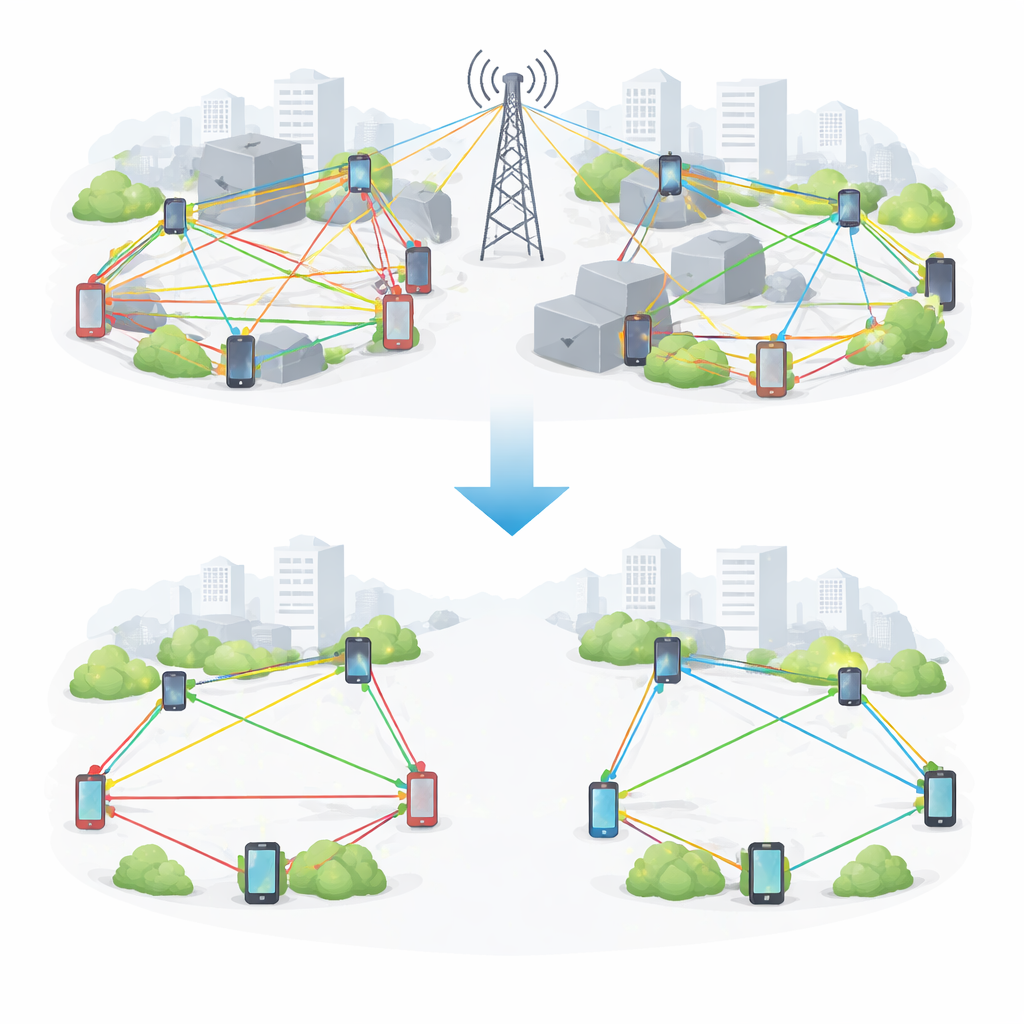
When two nearby phones talk directly to each other instead of routing everything through a distant cell tower, downloads get faster and batteries last longer. This form of shortcut, called device‑to‑device communication, is especially attractive at the super‑high radio frequencies known as millimeter waves, which can carry huge amounts of data. But these links are fragile: walls, people, and even moving objects can interrupt the signals, causing sudden connection “outages” and wasting power. This paper explores how a blend of nature‑inspired search strategies and brain‑like neural networks can make such direct links both more reliable and more energy‑efficient.
Direct talk between nearby gadgets
In upcoming 5G and beyond‑5G systems, phones, sensors, and vehicles will increasingly talk straight to each other over short distances. Skipping the base station cuts delay, reduces network congestion, and can be crucial in emergencies when infrastructure is damaged. Millimeter‑wave bands offer wide open airwaves for this traffic, but they come with a catch: signals fade quickly, are easily blocked, and suffer from fluctuating interference. Engineers describe the risk that a link will dip below a usable quality level as its “outage probability.” At the same time, every extra bit of transmit power drains batteries and heats up crowded networks. The challenge is to keep outage low while also trimming the energy each device spends on talking.
Mapping a crowded wireless neighborhood
The authors first build a mathematical picture of a busy wireless scene. Base stations, ordinary cellular users, and specialized device‑to‑device pairs are sprinkled across an area according to realistic spatial patterns that form natural clusters of nearby devices. Within this layout, they study three ways to describe coverage: a “coherent” view where detailed location and channel information is known; a “non‑coherent” view that uses only long‑term statistics; and a “single‑cluster” view that focuses on interference generated within one group. For each case, they derive formulas that relate key quantities such as signal‑to‑interference‑and‑noise ratio to the chance that a link remains above a chosen quality threshold. These formulas serve as the playground in which optimization and learning methods can search for better power settings.
Learning from flamingos, elk, and spikes
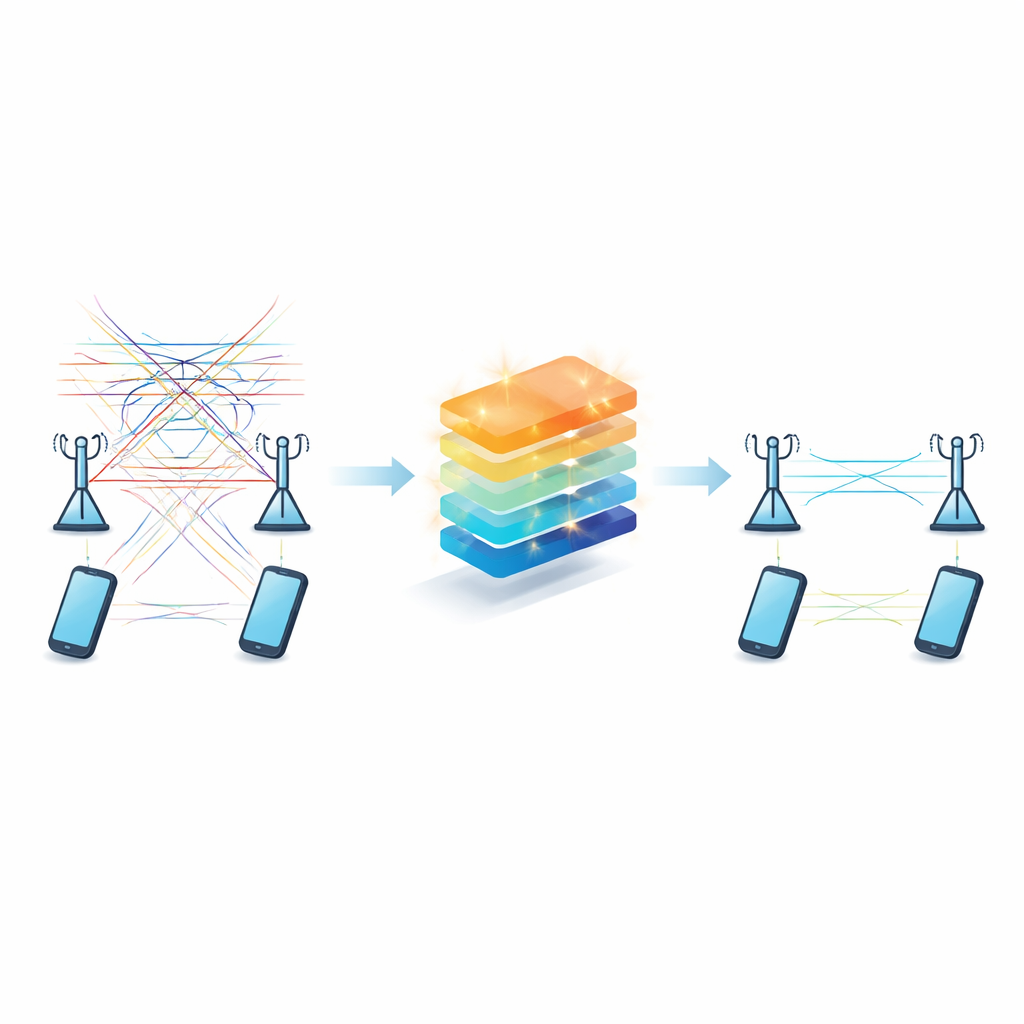
To reduce outages, the paper introduces a hybrid search method called Flamingo Elk Herd Optimization (FEHO). It mimics two animal behaviors: flamingos exploring large regions when they forage and elk fine‑tuning their positions within a herd. By blending wide‑ranging exploration with precise local adjustment, FEHO searches for transmit power levels for all device pairs that jointly minimize the chance of links failing. In parallel, the authors turn to a Deep Spiking Neural Network (DSNN) to tackle energy use. Instead of working with smooth signals, this network processes information as bursts, or spikes, closer to how biological neurons operate. It observes patterns of outages over time and learns a smart power threshold: a level that keeps coverage acceptable while cutting back unnecessary transmission strength. Together, FEHO proposes candidate power settings and the DSNN supplies adaptive thresholds that reflect real channel conditions.
Putting the new method to the test
The team evaluates their combined framework, dubbed FEHO+DSNN, through extensive computer simulations under two common wireless scenarios: Rayleigh channels, which model heavily scattered environments without a clear line of sight, and Rician channels, which include a dominant direct path. They vary the number of users and the signal‑to‑noise ratio to mirror dense urban deployments. Against several recent techniques—including other swarm‑based optimizers, learning‑aided power control, and caching‑based schemes—the new approach consistently converges faster and reaches better trade‑offs. In many cases it cuts the average transmit power by tens of decibels while keeping outage probability at or below competing methods, and it does so with inference times short enough for real‑time use in live networks.
What this means for future wireless systems
For a layperson, the message is straightforward: this work shows that clever algorithms can let nearby devices talk more directly, more reliably, and with less battery drain, even in the finicky millimeter‑wave bands. By combining a search strategy inspired by animal group behavior with a neural network that learns from spike‑like events, the authors design a system that balances staying connected with saving energy. Their results suggest that future phones, sensors, and even vehicles could maintain strong short‑range links without constantly blasting maximum power. As wireless networks grow denser and more complex, such adaptive, energy‑aware strategies will be key to keeping our digital conversations smooth, fast, and sustainable.
Citation: Bilal, N.M., Velmurugan, T. Minimization of outage probability and energy consumption by deep learning-based prediction in D2D mm wave communication. Sci Rep 16, 9006 (2026). https://doi.org/10.1038/s41598-025-34846-y
Keywords: device-to-device communication, millimeter-wave networks, outage probability, energy-efficient wireless, deep spiking neural networks