Clear Sky Science · en
Early surrogates of functional outcome after thrombectomy for MCA-M2 occlusions
Why this stroke study matters
When someone has a stroke, families and doctors urgently want to know: will the patient be able to live independently again, and how soon can we tell? This study looks at a specific kind of stroke in a smaller brain artery and asks whether a simple bedside test, done just 24 hours after a clot-removal procedure, can reliably forecast how well patients will function three months later.
A closer look at a smaller brain artery
Most headlines about stroke treatment focus on large, main brain arteries. But up to 40% of strokes actually occur in medium and smaller branches. This paper zooms in on blockages in the M2 segment of the middle cerebral artery, a relatively small but important branch that supplies areas crucial for movement and language. Doctors increasingly use mechanical thrombectomy—threading a device into the brain’s blood vessels to pull out the clot—for these strokes, even though big clinical trials have not clearly shown that this approach is always better than the best medicines alone. Understanding which early signals tell us a patient is on track for recovery could help refine when thrombectomy really benefits people with these more distal blockages. 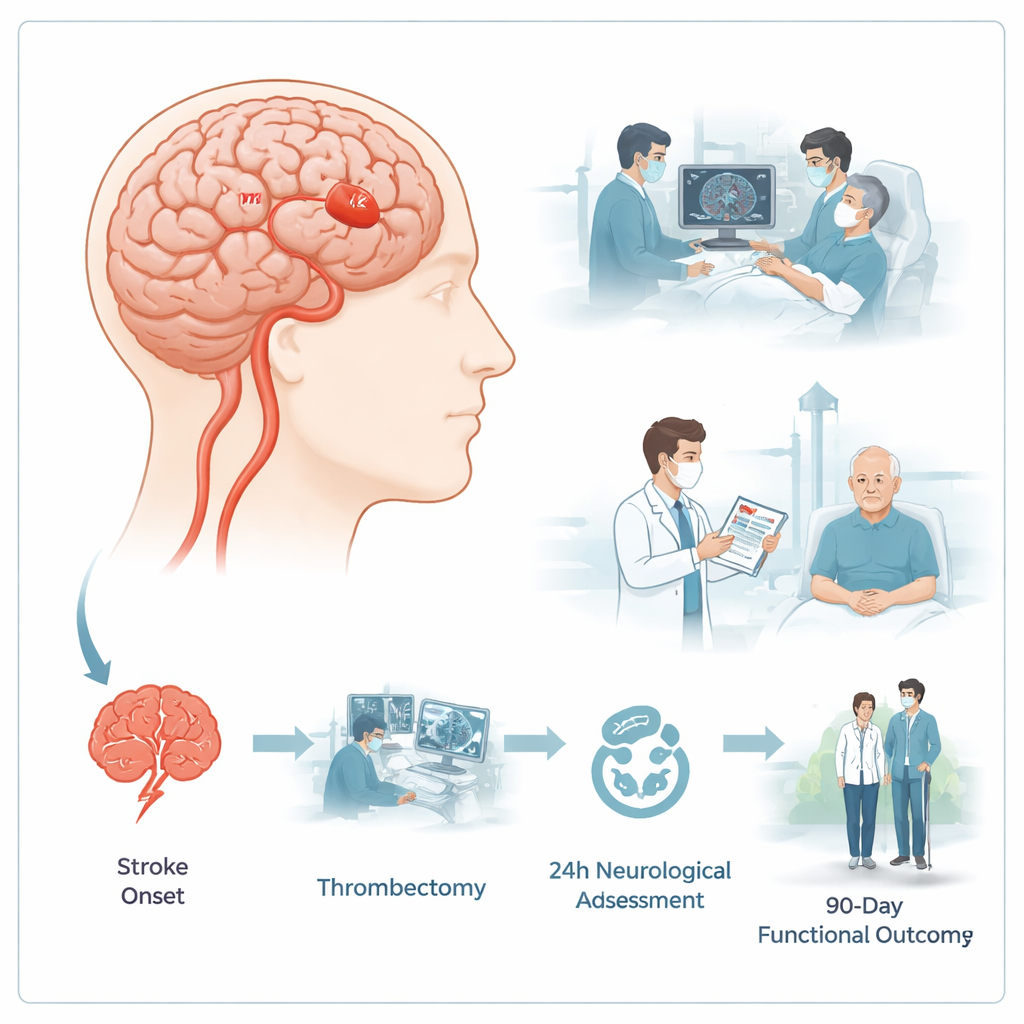
How the researchers tested early warning signs
The team analyzed 1,268 adults from the German Stroke Registry who had an isolated M2 blockage treated with thrombectomy between 2015 and 2021. They focused on the National Institutes of Health Stroke Scale (NIHSS), a standard exam that scores stroke severity based on speech, movement, and other functions. Doctors recorded NIHSS when patients arrived at the hospital and again 24 hours after treatment. The researchers then compared these early scores, as well as several definitions of “early neurological improvement,” with patients’ independence at 90 days, measured by a widely used disability scale called the modified Rankin Scale. “Good” outcome meant being able to walk and manage most daily tasks with at most slight help; “excellent” outcome meant essentially no meaningful disability.
Twenty-four hours that tell a long-term story
Among all the early measures they tested, the single best predictor of how patients would be doing three months later was the NIHSS score at 24 hours. Patients whose score was 8 or lower at that point had a high chance of achieving good functional outcome at 90 days, and those at 7 or lower were most likely to reach excellent outcome. Statistically, this 24‑hour score outperformed both the score at admission and more complex measures based on how much the score changed after treatment. Roughly 45% of all patients in the study were living independently at three months, and the 24‑hour score captured this future fairly accurately, echoing earlier findings from larger artery strokes and suggesting that the same simple rule of thumb applies in this smaller-vessel setting.
When the early score gets it wrong
However, the 24‑hour exam was not perfect. About 30% of patients who looked promising at 24 hours (score of 8 or less) still ended up with significant disability at three months, and the mismatch was even higher for the stricter “excellent outcome” category. The study dug into why this happens. Older age, being less independent before the stroke, needing more device passes to remove the clot, and having diabetes all made it more likely that a patient would decline after an initially encouraging 24‑hour exam. These factors may reflect more fragile blood vessels, higher risk of complications, or ongoing brain injury that the early score cannot yet detect. 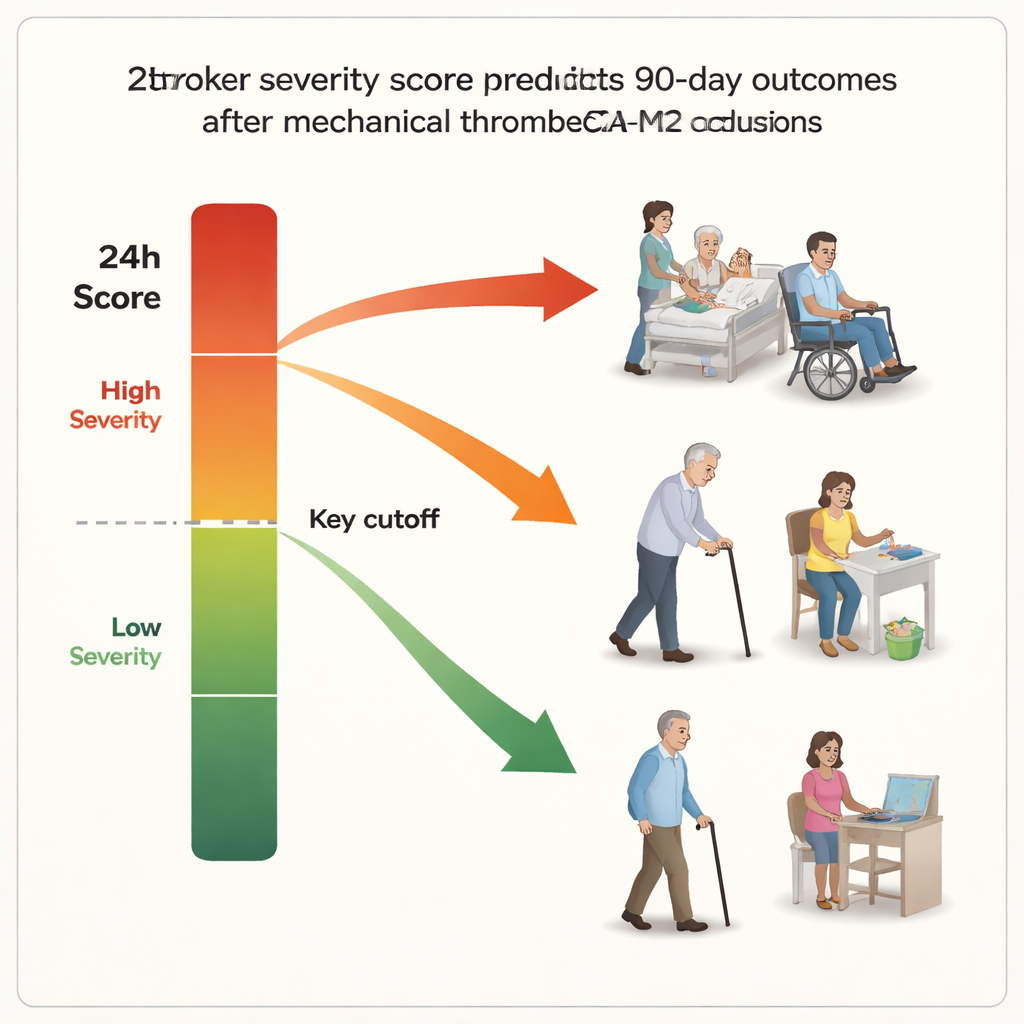
What this means for patients and families
For people with this specific type of stroke, the message is twofold. First, a careful neurological exam 24 hours after thrombectomy provides a powerful, easy-to-use snapshot of likely recovery, giving doctors and families a grounded basis for early planning and rehabilitation. If the score is 8 or below, the chances of regaining independence are generally good; if it is higher, more intensive support may be needed. Second, age, prior disability, and conditions like diabetes can blunt the optimism that a good early score might suggest. In other words, the 24‑hour test is a strong early guide but not a crystal ball, and long-term outcome still depends on overall health, the quality of recovery care, and events in the weeks after the stroke.
Citation: Kniep, H.C., Meyer, L., Broocks, G. et al. Early surrogates of functional outcome after thrombectomy for MCA-M2 occlusions. Sci Rep 16, 6662 (2026). https://doi.org/10.1038/s41598-025-34777-8
Keywords: stroke, thrombectomy, M2 occlusion, prognosis, NIHSS