Clear Sky Science · en
Multimode OAM antenna with reduced beam divergence for 6G networks
Why future wireless needs a new twist
Streaming, cloud gaming, autonomous cars, and billions of connected gadgets are pushing today’s wireless networks to their limits. Engineers are now exploring unusual properties of radio waves to carry more information without using extra frequency bands. This study focuses on one such property—how a radio wave can twist as it travels—and shows how to tame that twist so signals can go farther and stay stronger, an ability that could be vital for tomorrow’s 6G networks.

Twisted radio waves as extra data lanes
Most of us think of radio signals as simple ripples moving through space. In reality, these ripples can also spin around their direction of travel, carrying what is known as orbital angular momentum (OAM). Different twists—clockwise, counterclockwise, or none at all—behave like independent channels that can share the same frequency without interfering. This means several data streams can ride on the same slice of spectrum, promising higher capacity links for high-speed connections and precise navigation. The catch is that OAM beams naturally spread out into a cone as they propagate, which weakens the signal and limits useful range.
Blending two antenna ideas into one
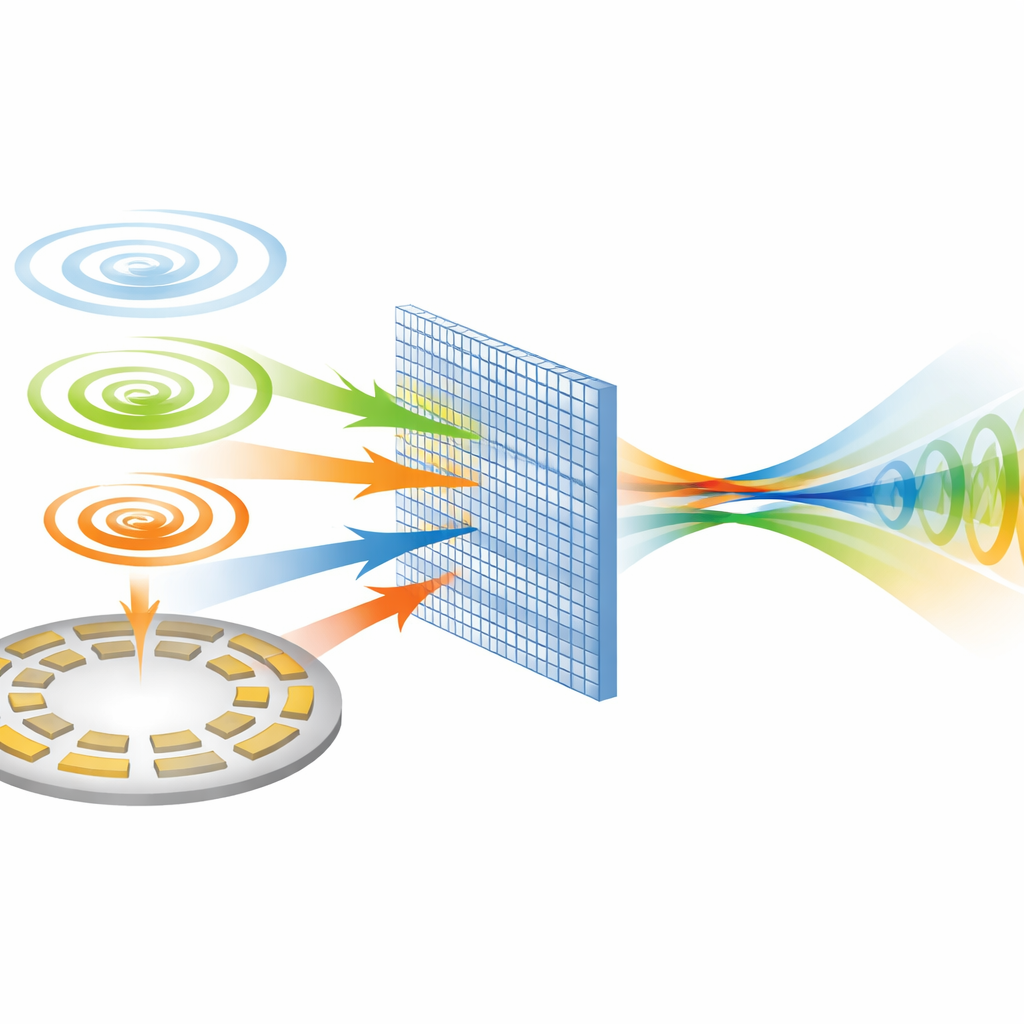
Two main hardware approaches exist for producing these twisted beams. Uniform circular arrays of small antennas are easy to reconfigure and can switch between different twists, but their beams tend to spread widely. Metasurfaces—thin patterned layers that can steer and reshape waves—can create narrow, powerful OAM beams, yet are harder to manufacture and to reconfigure once built. The authors of this paper combine the strengths of both: they start with a circular array that can generate three basic OAM modes (no twist, left-handed twist, and right-handed twist) and then place a specially designed, transparent metasurface in front of it to act like a flat lens that reins in the spreading beams.
How the flat lens focuses the twist
The circular array uses small, L-shaped slot antennas arranged in a ring and fed in such a way that changing which port is driven flips the handedness of the twist or removes it. In front of this ring, the researchers mount a two-layer metasurface made of a 10 by 10 grid of “spider-net”-shaped metal patterns etched on circuit boards. Each tiny pattern delays the passing wave by a different amount, chosen so that together they mimic an optical element called an axicon, which nudges the wavefronts toward a more focused path while preserving their twisting nature. Although the same lens is used for every twist pattern, the combination of the lens’s radial shaping and the beam’s own spiral structure results in a distinct focused wavefront for each mode.
Putting the new antenna to the test
To see if the design works in practice, the team fabricated both the circular array and the metasurface using standard circuit-board techniques and measured them inside a radio-quiet chamber with a precise scanning system. They compared the behavior of the array alone with that of the array plus lens, looking at how the beam intensity and phase changed in space. The measurements confirmed that the antenna reliably produced the three desired twist modes, each showing the characteristic doughnut-shaped intensity and spiral phase. When the metasurface lens was added, those patterns became noticeably narrower, with the main cone of energy squeezed into a smaller angle while remaining centered and well formed, albeit with slightly higher side lobes and a modest decrease in twist purity.
Sharper beams for next-generation links
For all three twist settings, the new antenna system cut the beam’s spreading angle roughly in half—from about 18 degrees to around 8–10 degrees—and increased the peak gain, meaning more of the transmitted power stayed concentrated in the useful direction. To a non-specialist, this means the radio waves carry their twisted information farther and more efficiently, making OAM-based links more practical outside of short laboratory distances. By integrating a versatile circular array with a compact, flat lens, the work points toward smaller, smarter antennas that could help 6G systems move beyond today’s capacity limits while using the same spectrum more cleverly.
Citation: Rao, M.V., Bhattacharyya, B., Ram, G.C. et al. Multimode OAM antenna with reduced beam divergence for 6G networks. Sci Rep 16, 8382 (2026). https://doi.org/10.1038/s41598-025-34745-2
Keywords: 6G wireless, orbital angular momentum, metasurface lens, antenna design, beam focusing