Clear Sky Science · en
Effect of short-duration microwave treatments on flower development and secondary metabolite production in Agastache rugosa
How a Kitchen Technology Could Shape Future Medicines
Microwave ovens are usually associated with reheating leftovers, not growing healthier medicinal herbs. Yet this study shows that very short bursts of microwave energy can gently “stress” a popular Asian herb, Agastache rugosa, in ways that make it produce more flowers and higher levels of health‑promoting compounds. For anyone interested in nutritious foods, herbal remedies, or sustainable farming, this work hints at a surprisingly simple tool for boosting plant quality without genetic modification or heavy chemical use.
A Fragrant Herb with Powerful Natural Defenses
Agastache rugosa, sometimes called Korean mint, is a mint-family herb widely used as a flavoring and traditional remedy in Korea, Vietnam, China, and Japan. It contains a suite of natural chemicals—such as rosmarinic acid, tilianin, and acacetin—that have been linked in laboratory studies to anti-inflammatory, antioxidant, heart-protective, and anticancer effects. Like many herbs, the plant naturally ramps up these protective molecules when it encounters stress. The researchers wondered whether a carefully controlled, very short microwave treatment could act as a mild, non-lethal stress signal, nudging the plant to invest more in flowers and in these valuable compounds while still growing well.
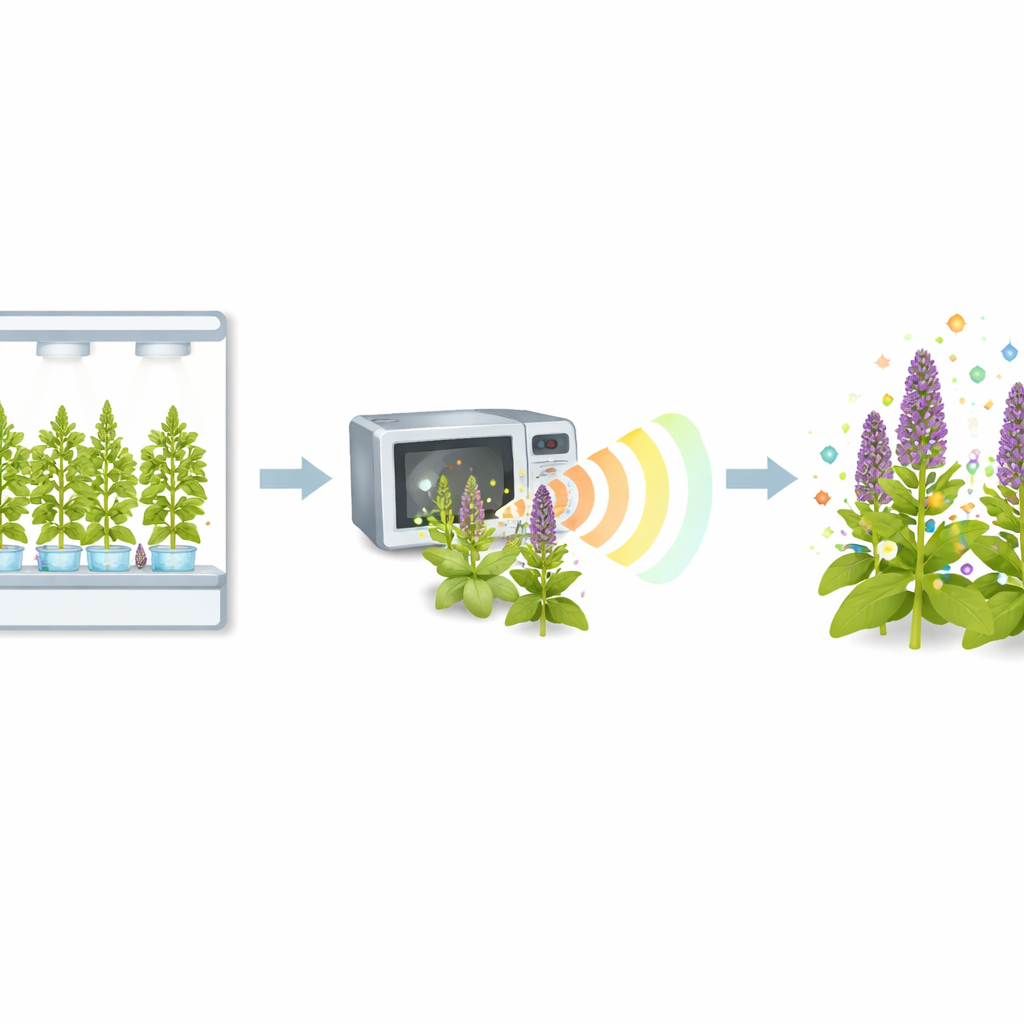
Gentle Microwave Pulses in a High-Tech Greenhouse
To test this idea, the team grew Agastache plants in a deep-flow hydroponic system—essentially a plant factory where roots sit in circulating nutrient solution under controlled light, temperature, and humidity. At two points early in growth, they placed whole plants into a standard microwave oven set to 200 watts for just 5, 10, 15, 20, or 25 seconds; another group received no treatment. Afterward, all plants were returned to the hydroponic system and allowed to grow for 20 more days before being analyzed. The scientists measured not only height, leaf size, and biomass, but also photosynthesis, pigment levels, overall antioxidant activity, and the amounts of many specific phenolic compounds and flavonoids in roots, stems, leaves, and flowers.
More Flowers and Stronger Color Chemistry
The brief microwave bursts left basic plant size largely unchanged: stem length, root length, and total dry weight were similar across all groups. The big difference appeared in reproduction and chemical makeup. Plants exposed for 15, 20, or 25 seconds produced 9–15% more flower branches and up to 24% more flower biomass than untreated plants, even though their leaf weight dropped. In other words, the plants shifted resources from leaves toward flowers. At the same time, photosynthesis became more efficient, especially at the longer exposure times: the rate at which leaves converted carbon dioxide into sugars increased by up to 53%, and the main green pigment chlorophyll a rose by about 12%. These changes suggest that a mild heat-like signal from the microwaves made the plants’ energy factories work harder rather than shutting them down.
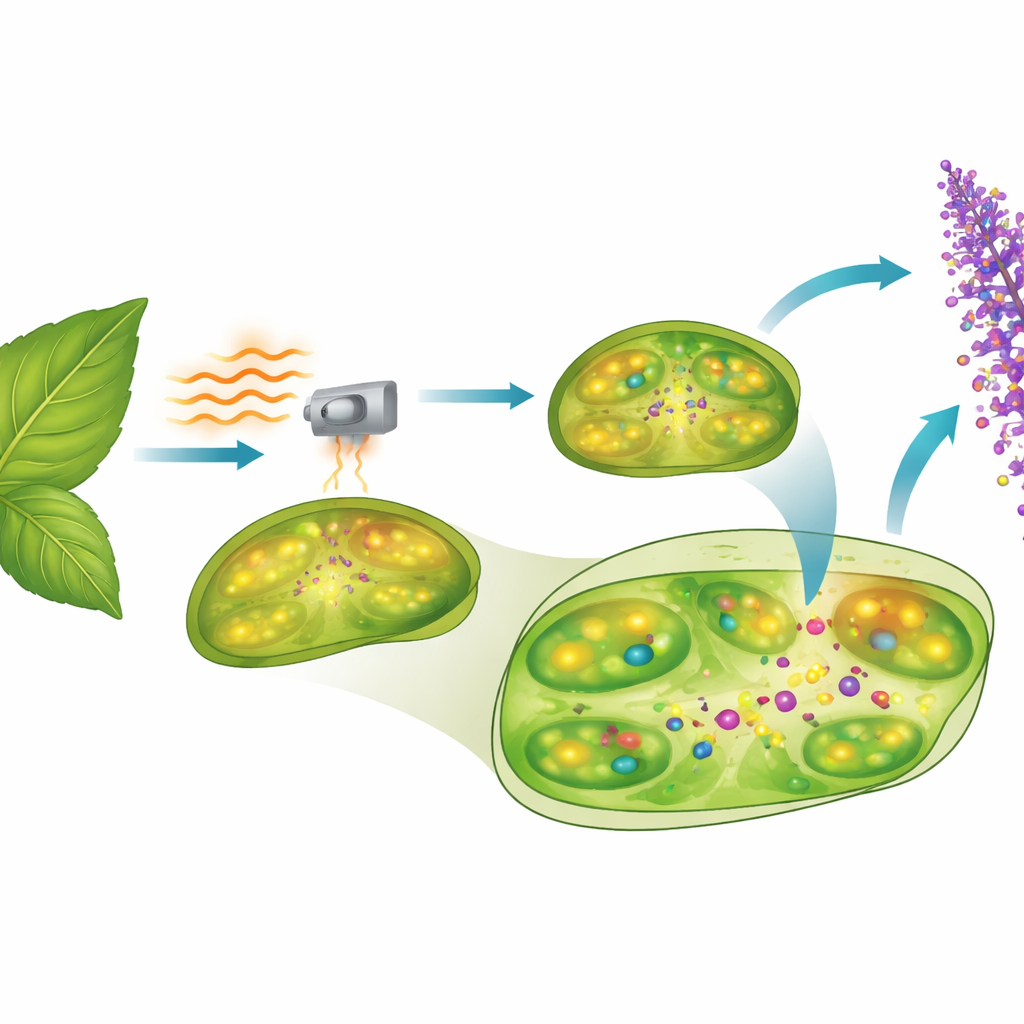
Stress Sparks a Surge in Protective Molecules
The chemical response inside the plants was even more striking. Total phenolic compounds—one major family of antioxidant molecules—rose by 43–85% in all microwave-treated plants. Total flavonoids, another protective group, increased by up to 11% at the longer exposure times. Individual compounds responded in distinct ways: chlorogenic acid jumped as high as 7.3-fold, kaempferol increased, and the signature molecules tilianin and rosmarinic acid climbed strongly, particularly at 15–25 seconds. For example, whole plants treated for 20 seconds showed 42% more rosmarinic acid content than controls. Enzymes that detoxify harmful reactive oxygen species, including superoxide dismutase, peroxidase, and catalase, also became much more active, indicating that the microwaves triggered a controlled oxidative challenge that the plant met by boosting its natural defenses.
Tuning Plant Chemistry with Seconds of Energy
When all measurements were considered together, the sweet spot lay between 15 and 25 seconds of microwave exposure. In this range, plants kept normal overall growth while producing more flowers and substantially richer mixtures of beneficial compounds in their tissues. The authors propose that such ultra-short microwave treatments act as an "elicitor"—a safe nudge that switches on stress-response pathways without causing real damage. For growers of medicinal herbs or functional foods, this approach could become a low-input, energy-efficient way to increase both yield and quality in indoor farms and greenhouses. In everyday terms, a few seconds of carefully applied microwave energy may help a common culinary herb become a more potent natural pharmacy.
Citation: Lam, V.P., Loi, D.N., Bok, G. et al. Effect of short-duration microwave treatments on flower development and secondary metabolite production in Agastache rugosa. Sci Rep 16, 9632 (2026). https://doi.org/10.1038/s41598-025-34712-x
Keywords: medicinal herbs, microwave treatment, plant antioxidants, hydroponic cultivation, secondary metabolites