Clear Sky Science · en
Modelling the evolution of the European high-speed rail infrastructure network
Why fast trains across Europe matter
For many people in Europe, long trips still mean choosing between flying or driving, with rail often feeling slow, fragmented, or inconvenient—especially across borders. This study asks a simple question with big consequences: if Europe really wants a fast, climate‑friendly rail system that can rival planes, how should new high‑speed lines be added over the next few decades, and in what order, so that money is spent where it does the most good?
A new way to grow the rail web
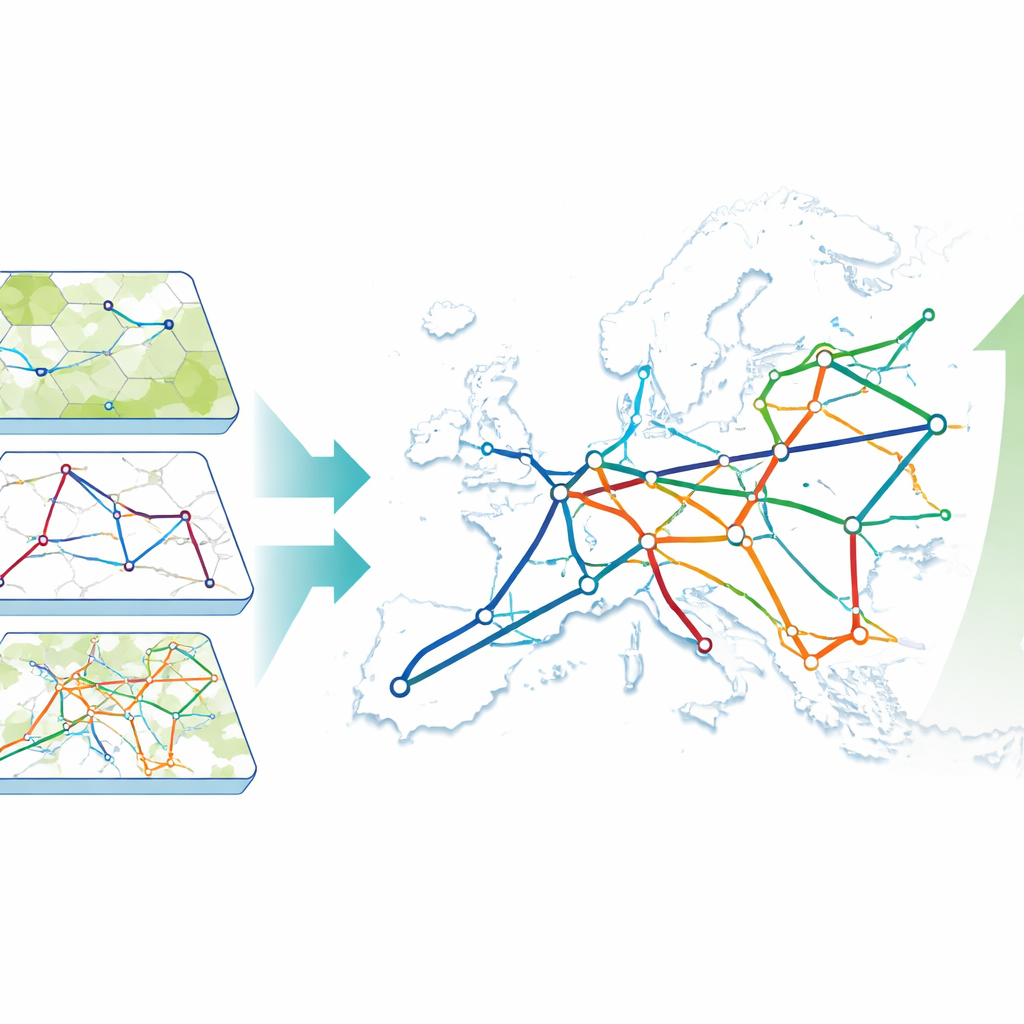
The authors develop a planning tool called ENGINEER that treats the high‑speed rail network as something that grows step by step rather than appearing all at once in a target year. Instead of deciding on a final map and assuming it can somehow be built, the model asks, each year, which new stretch of track offers the best balance between what it costs to build and how much time, money, and pollution it saves travelers. It combines a detailed, ground‑level picture of Europe’s terrain and construction costs with a bird’s‑eye view of travel between major cities, and it respects a realistic annual budget so that only affordable projects move ahead.
How the model weighs choices
Under the hood, ENGINEER first maps out where people live and how often they travel between city pairs by car, train, or plane, based on factors such as population, income, borders, and language. It then estimates how new or faster rail links would change trip times and how many travelers would switch from other modes once a high‑speed line is in place. On the cost side, the model uses a fine hexagonal grid laid over Europe, including height and land‑use information, to estimate how expensive it would be to lay tracks on the surface, bore tunnels, or cross seas and mountains in different regions. For each potential connection, the tool calculates expected lifetime benefits and compares them with building and upkeep costs, focusing on projects that deliver strong value for money.
What the future network could look like
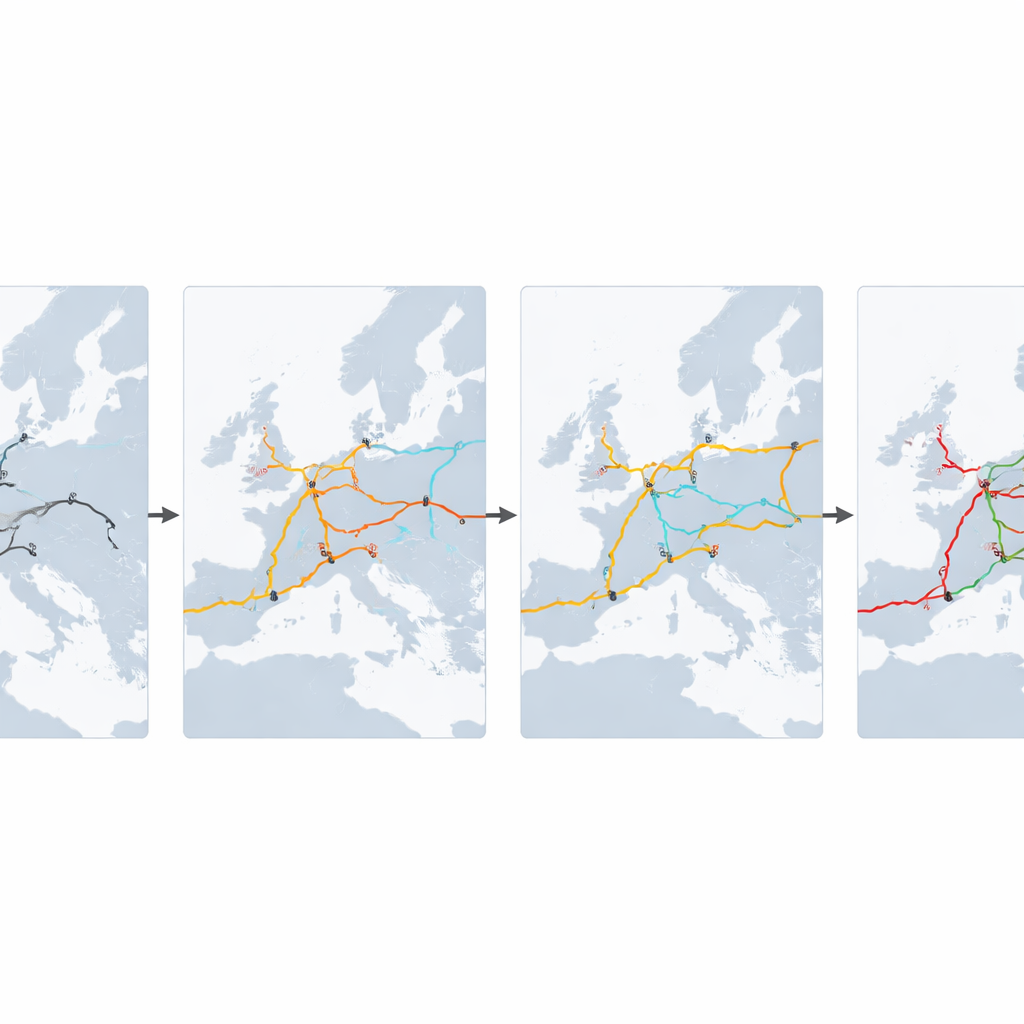
Applying ENGINEER to 28 European countries, including the UK, Switzerland and Norway, the authors let the network grow from today’s mix of existing and already‑planned high‑speed lines. Between 2023 and 2065 the model suggests adding about 13,200 kilometers of new links on top of roughly 11,000 kilometers in place today, creating a more continuous web of fast corridors. Early investments mostly connect large cities and close gaps between national systems. Later stages stretch further across the continent and then fill in shortcuts and backup routes around busy hubs. Some areas that already have dense high‑speed lines, such as Spain, receive few or no new investments, while central Europe—including Germany, Poland, the Czech Republic, Austria, Switzerland and the UK—sees strong growth because they either host heavy demand or sit between many popular origin‑destination pairs.
Why cross‑border links punch above their weight
A striking pattern in the results is that some of the biggest jumps in rail use occur when new tracks cross borders, for example between France and Italy or among Germany, Austria, Poland, and the Czech Republic. These links unlock faster routes across several countries at once, boosting passenger flows and improving the business case for follow‑up projects along the same corridor. Overall, the model predicts that, with historically realistic investment levels—about €269 billion in 2023 money—the share of long‑distance trips taken by rail could rise from 13 percent in 2023 to 27 percent by 2065, and that the benefits would outweigh costs by roughly three to one. At the same time, some wealthier countries might pay more into a pooled budget than they get back directly, raising political questions about how to share costs and gains fairly.
How this differs from today’s political plans
The study also compares its economically driven growth path with the official European blueprint known as TEN‑T, which sketches out a very extensive high‑speed network to 2050. Whereas TEN‑T emphasizes broad coverage, cohesion, and strategic goals—even where demand is modest or construction costs are high—ENGINEER tends to focus on corridors where many people already travel or are likely to do so once service improves. As a result, its proposed network is more compact and centered on the busiest regions, and it leaves out some expensive or lightly used stretches that appear in political plans, while adding other cross‑border routes that TEN‑T does not prioritize.
What this means for travelers and policymakers
For non‑experts, the key message is that building a truly connected European high‑speed rail system is not just about laying more tracks, but about choosing the right links in the right order. A coordinated, Europe‑wide approach that weighs costs, demand, and knock‑on effects over time could roughly double rail’s role in long‑distance travel and still pay for itself many times over. Yet reaching the European Union’s more ambitious goals would require faster and larger investments than history suggests, along with careful attention to how benefits are shared among countries. Tools like ENGINEER give decision‑makers a way to explore these trade‑offs transparently, helping turn today’s patchwork of national lines into a faster, greener network that works for the continent as a whole.
Citation: Borgogno, F., Massobrio, R., Grolle, J. et al. Modelling the evolution of the European high-speed rail infrastructure network. Sci Rep 16, 8683 (2026). https://doi.org/10.1038/s41598-025-34669-x
Keywords: high-speed rail, transport planning, European mobility, infrastructure investment, modal shift