Clear Sky Science · en
Sustainable soil stabilization with Nano-Silica and polypropylene fibers mechanical properties durability and microstructural analysis
Why stronger soils matter
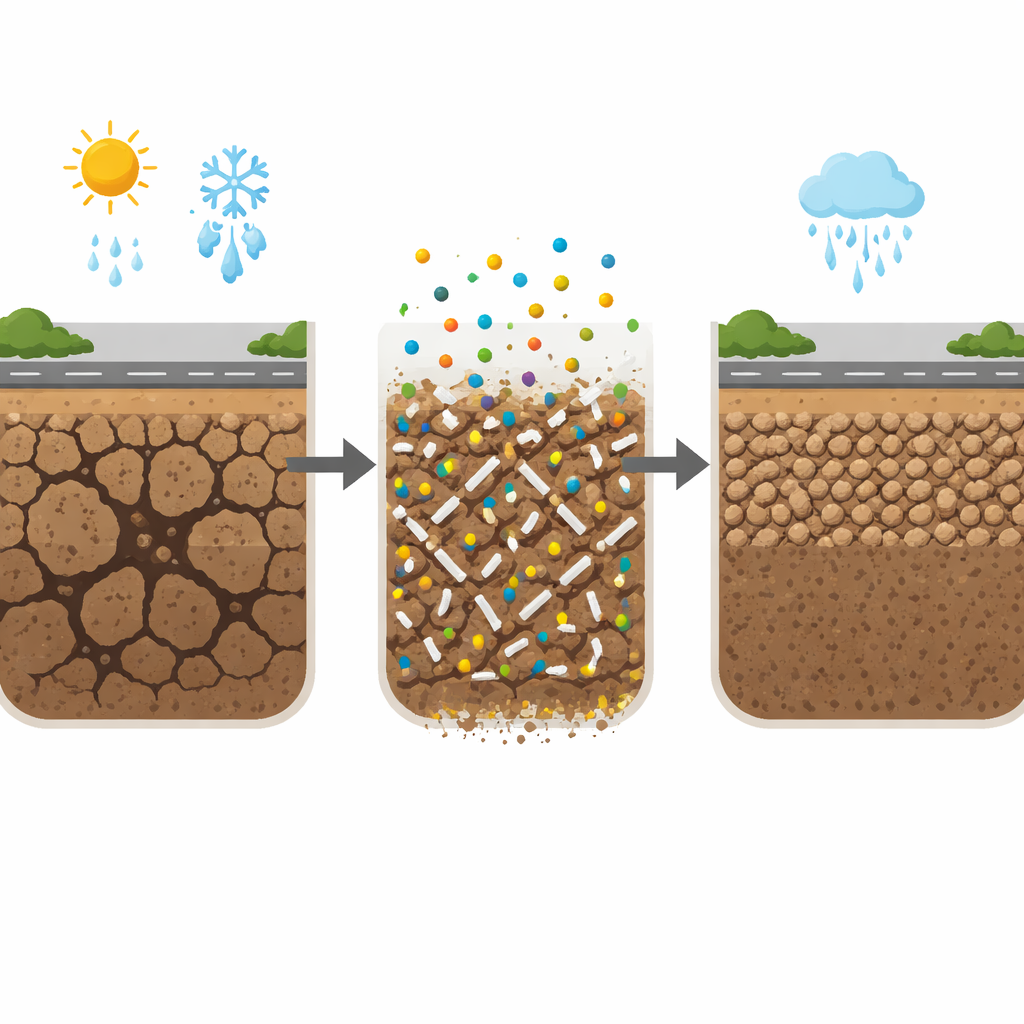
Roads, railways, buildings, and pipelines all rely on the ground beneath them to stay firm and stable for decades. Engineers often harden weak soils with cement or lime, but making these materials consumes a lot of energy and releases large amounts of carbon dioxide. This study explores a cleaner approach: mixing tiny mineral particles called nano-silica with thin plastic fibers to create tougher, longer-lasting soils that can better survive cycles of drying, soaking, freezing, and thawing.
New helpers for tired ground
The researchers started with a natural clay soil from a construction site in Tibet and asked a simple question: can we make this soil stronger and more durable using small amounts of nano-silica and polypropylene fibers instead of traditional cement-like additives? Nano-silica consists of ultra-fine grains of silica, far smaller than common sand, which can slip into tiny gaps between soil particles. Polypropylene fibers are hair-like pieces of a common plastic that can act like miniature reinforcing bars. Together, they promise both tighter packing of the soil and a flexible internal skeleton that resists cracking.
Putting the new mix to the test
To test these ideas, the team prepared hundreds of small cylindrical soil samples. Some were left untreated, some were mixed with only nano-silica, some with only fibers, and others with both at different percentages by weight. After carefully adding water and compacting each sample, they measured how much squeezing force the cylinders could withstand before crumbling. They also subjected selected samples to repeated dry–wet and freeze–thaw cycles that mimic harsh weather, then re-measured their strength. Finally, they used two powerful imaging tools—nuclear magnetic resonance (NMR) and scanning electron microscopy (SEM)—to look inside the soil, gauging its pore sizes and observing how particles, pores, and fibers were arranged.
What each ingredient does
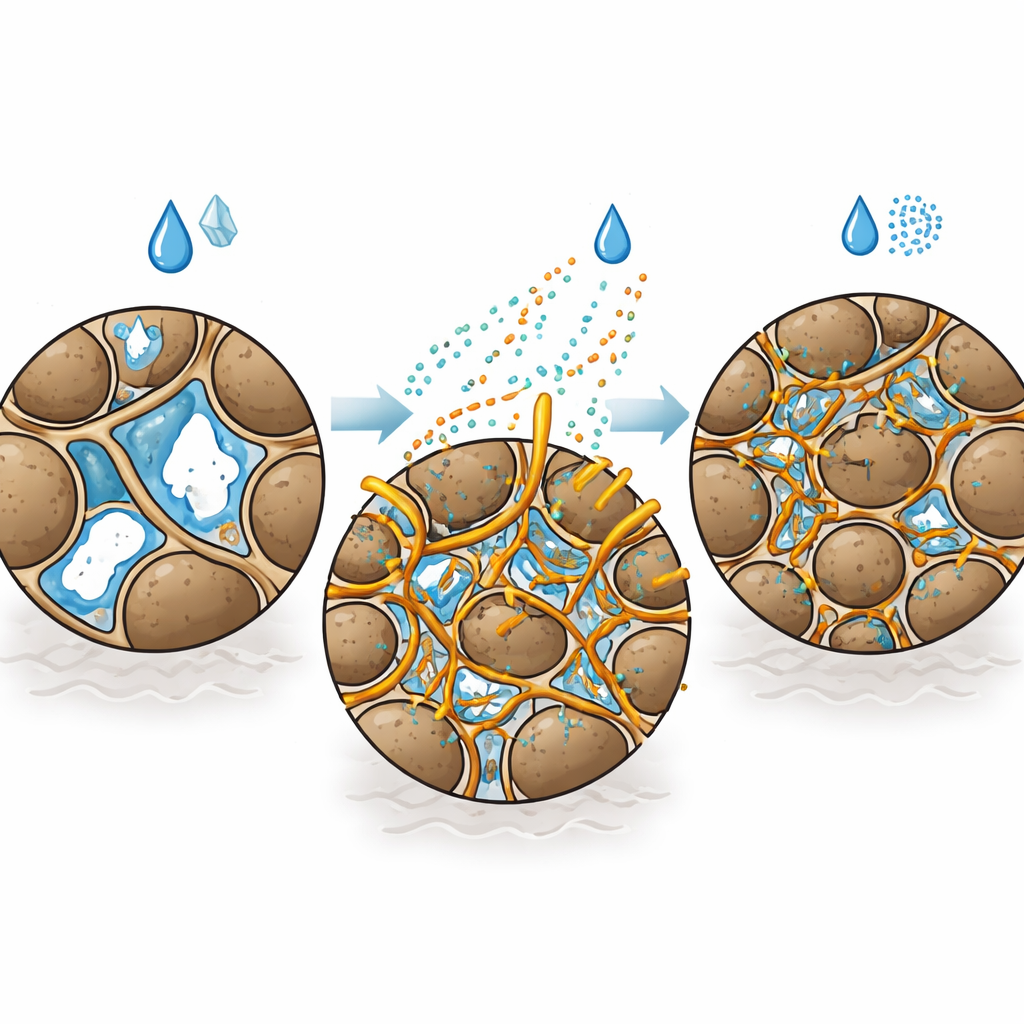
On their own, both additives helped, but in different ways. Nano-silica steadily increased the soil’s compressive strength as its dosage rose to 2 percent, mainly by filling pores and tightening the structure, although the benefit grew smaller at the highest doses. Fibers had an even stronger effect: as fiber content increased, the soil could take several times more load before failure, thanks to a web of strands that gripped the soil and bridged developing cracks. However, neither nano-silica nor fibers alone fully addressed all durability issues, and very high amounts could become less efficient or cause clumping.
Working better together
The real breakthrough came when nano-silica and fibers were used together. A mix containing 2 percent nano-silica and 2 percent fibers achieved more than seven times the strength of the untreated soil, far higher than either additive alone could provide. When exposed to ten rounds of drying–wetting or freezing–thawing, the improved soil kept over half of its original strength, while untreated soil fell to roughly one-third. NMR measurements showed that the combined treatment greatly reduced the amount and size of pores, especially the larger ones that let water in and foster damage. SEM images revealed that nano-silica coated and glued the soil grains while fibers formed a three-dimensional mesh, locking everything together and blocking crack growth.
What this means for future building
For non-specialists, the takeaway is clear: by blending very small mineral particles with short plastic fibers, engineers can turn weak, crack-prone soils into a more solid, sponge-like material that stands up better to weather. This approach can cut down on the use of cement and lime, lowering carbon emissions while still providing the strength and durability needed for foundations, embankments, and slopes in demanding climates. In effect, the study shows a promising, more sustainable recipe for making the ground beneath our infrastructure both tougher and greener.
Citation: Chen, Z., Ji, Y., Jiang, S. et al. Sustainable soil stabilization with Nano-Silica and polypropylene fibers mechanical properties durability and microstructural analysis. Sci Rep 16, 9634 (2026). https://doi.org/10.1038/s41598-025-34568-1
Keywords: soil stabilization, nano-silica, polypropylene fibers, geotechnical engineering, freeze-thaw durability