Clear Sky Science · en
A thinking innovation strategy based Northern goshawk optimizer enhanced extreme learning machine for bankruptcy prediction problems
Why predicting business trouble matters
When a company suddenly goes bankrupt, workers lose jobs, investors lose money, and banks absorb painful losses. If we could spot financial trouble years in advance, lenders, regulators, and managers would have more time to react. This paper presents a new way to predict which firms are likely to fail, using a blend of fast machine learning and a nature-inspired search strategy modeled on the hunting behavior of a bird of prey.
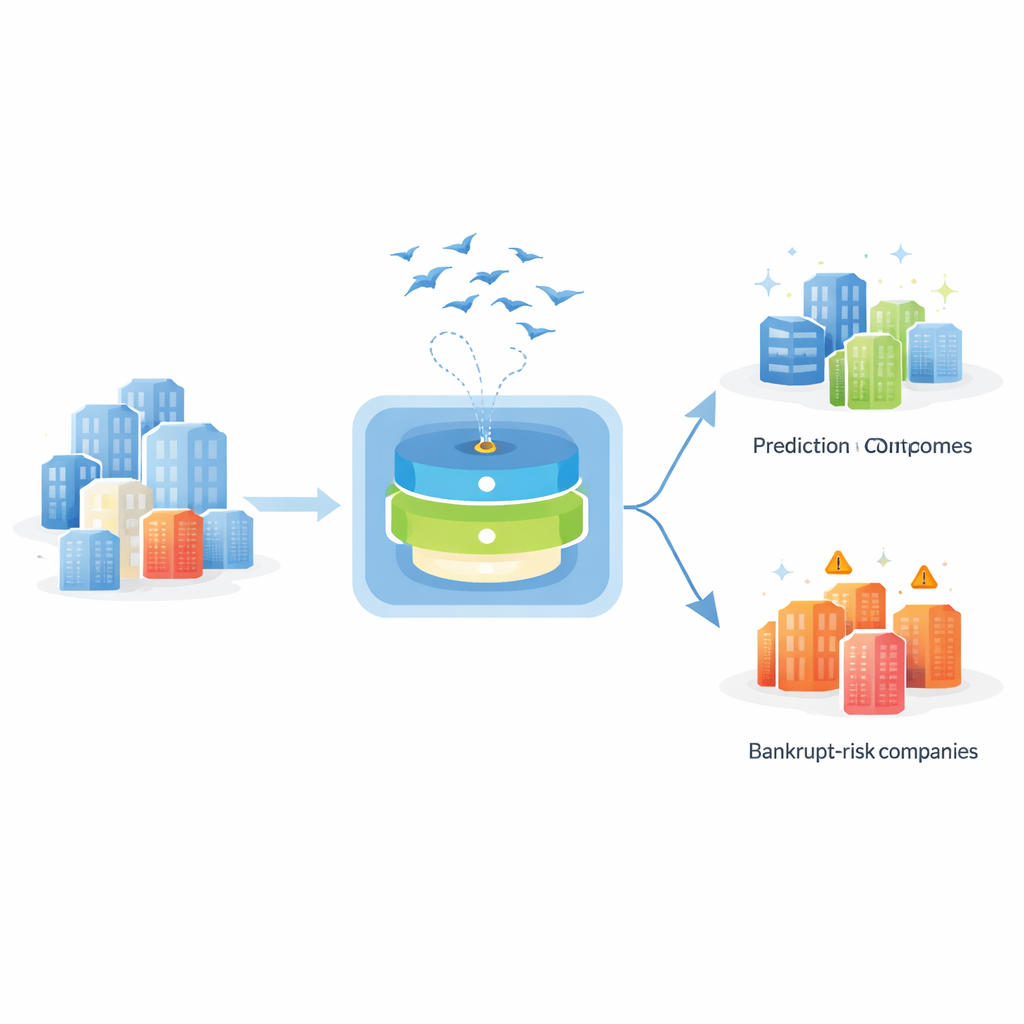
Turning balance sheets into early warning signals
The authors focus on a task that banks and auditors face every day: deciding whether a firm looks financially healthy or close to collapse, based on detailed numerical records. This is treated as a yes-or-no decision problem: each company is classified as either bankrupt or non-bankrupt. Modern artificial intelligence methods such as neural networks and support vector machines already perform this kind of task, but they can be slow to train and very sensitive to how their internal settings are chosen. A newer method called Kernel Extreme Learning Machine (KELM) can learn much faster and handle tangled, non-linear patterns in financial ratios, but its accuracy still depends heavily on two key internal settings that are hard to tune by hand.
Learning from a bird's hunt
To tune these hidden settings, the researchers turn to a recent class of search techniques known as metaheuristic algorithms. Instead of trying every possibility, these methods roam the landscape of options more intelligently, often copying strategies seen in nature. Here, the team builds on the Northern goshawk optimizer, inspired by how these hawks locate and chase prey. In the basic version, a swarm of candidate solutions explores the search space, attacking and pursuing "prey" that represent promising parameter choices. However, like many such algorithms, the original version can wander too randomly at first and then settle too quickly on a mediocre solution.
Adding thinking, variation, and boundary sense
The paper introduces an upgraded variant called TIS_NGO, which adds three layers of "smarts" to the hawk-inspired search. First, a thinking innovation strategy keeps track of what has been tried and learned so far, so the swarm does not waste time re-evaluating essentially the same points and can draw on a growing "depth of knowledge" as the search progresses. Second, a new prey attack strategy borrows from differential evolution: instead of moving based only on its own position and one target, each candidate also considers differences among several neighbors, which injects fresh variation and helps the swarm escape local dead ends. Third, a centroid-based boundary control gently nudges any candidate that drifts outside the allowed range back toward the center of the active search region, reducing time spent in unhelpful parts of the landscape.
Putting the smarter search to the test
Before applying their method to real companies, the authors pit TIS_NGO against a suite of standard optimizers on demanding mathematical test problems used in international competitions. Across dozens of such functions from the CEC2017 and CEC2022 benchmarks, the new algorithm finds better solutions more often, converges faster, and shows less run-to-run variability than rivals such as Particle Swarm Optimization, Grey Wolf Optimizer, Whale Optimization Algorithm, and the original Northern goshawk method. Importantly, it does this while keeping overall computing cost in the same order of magnitude. The team then combines TIS_NGO with KELM to form a complete bankruptcy prediction system and evaluates it on two real financial datasets, including a classic Polish dataset with 30 financial ratios for 240 firms over several years.

Sharper warnings with fewer false alarms
On these real-world datasets, the TIS_NGO–KELM model delivers higher accuracy, better balance between catching troubled firms and avoiding false alarms, and more stable performance across repeated tests than both traditional models (such as support vector machines and popular gradient-boosting methods) and other optimized KELM variants. Its Matthews correlation scores—a measure that is especially informative when bankrupt firms are rare—are consistently higher, indicating stronger discrimination between healthy and failing businesses. In plain terms, the method is better at spotting genuine distress early while not unduly labeling healthy firms as unsafe. The authors argue that this blend of a fast learner and a more "thoughtful" search process offers a practical new tool for financial early-warning systems, and they outline future plans to expand it to larger, more diverse datasets and to incorporate broader economic signals.
Citation: Jiang, K., Zhao, X., Li, Y. et al. A thinking innovation strategy based Northern goshawk optimizer enhanced extreme learning machine for bankruptcy prediction problems. Sci Rep 16, 9628 (2026). https://doi.org/10.1038/s41598-025-34452-y
Keywords: bankruptcy prediction, financial risk, machine learning, metaheuristic optimization, early warning systems