Clear Sky Science · en
Nanocellulose reinforced sustainable polyvinyl alcohol and pectin based nanocomposite films embedded with AgO/ZnO nano structures for wound dressing applications
Turning Plant Waste into Healing Materials
Most people think of plant leftovers and plastic wraps as trash, not tools for healing. This study shows how everyday plant waste and a common plastic can be transformed into a soft, transparent film that both protects wounds and gently disappears back into nature. By weaving ultra-thin fibers from an underused shrub together with a familiar biodegradable plastic and tiny metal particles that fight germs, the researchers create a smart bandage material designed to keep wounds moist, clean, and environmentally friendly.
From Wild Shrub to Tiny Building Blocks
The journey begins with Sida rhombifolia, a tough roadside shrub long used in traditional medicine. Instead of harvesting big, costly crops, the team takes its stems, soaks and treats them with heat and safe chemicals to strip away unwanted components like lignin and hemicellulose. What remains is nearly pure cellulose, the same natural substance that stiffens plants and trees. They then break this cellulose down into nanofibers—threads thousands of times thinner than a human hair—using intense mixing and sound waves. Tests using advanced imaging and spectroscopy confirm that these nanofibers are clean, highly ordered, and strong, making them ideal as a reinforcing “skeleton” inside new materials.
Blending a Gentle Plastic with Natural Fibers
Next, the researchers mix these plant-based nanofibers into a blend of polyvinyl alcohol (PVA), a well-known, water-loving plastic already used in medical products, and pectin, a fruit-derived gelling agent familiar from jams. On its own, this blend can form soft films, but it may lack enough strength and durability for demanding uses like wound dressings. Adding small amounts of the cellulose nanofibers—up to 1% by weight—turns the blend into a tighter, more resilient network. Laboratory tests show that the reinforced films become more mechanically robust and slightly more water-repellent on the surface, while still allowing water vapor to pass at rates considered ideal for moist wound healing. 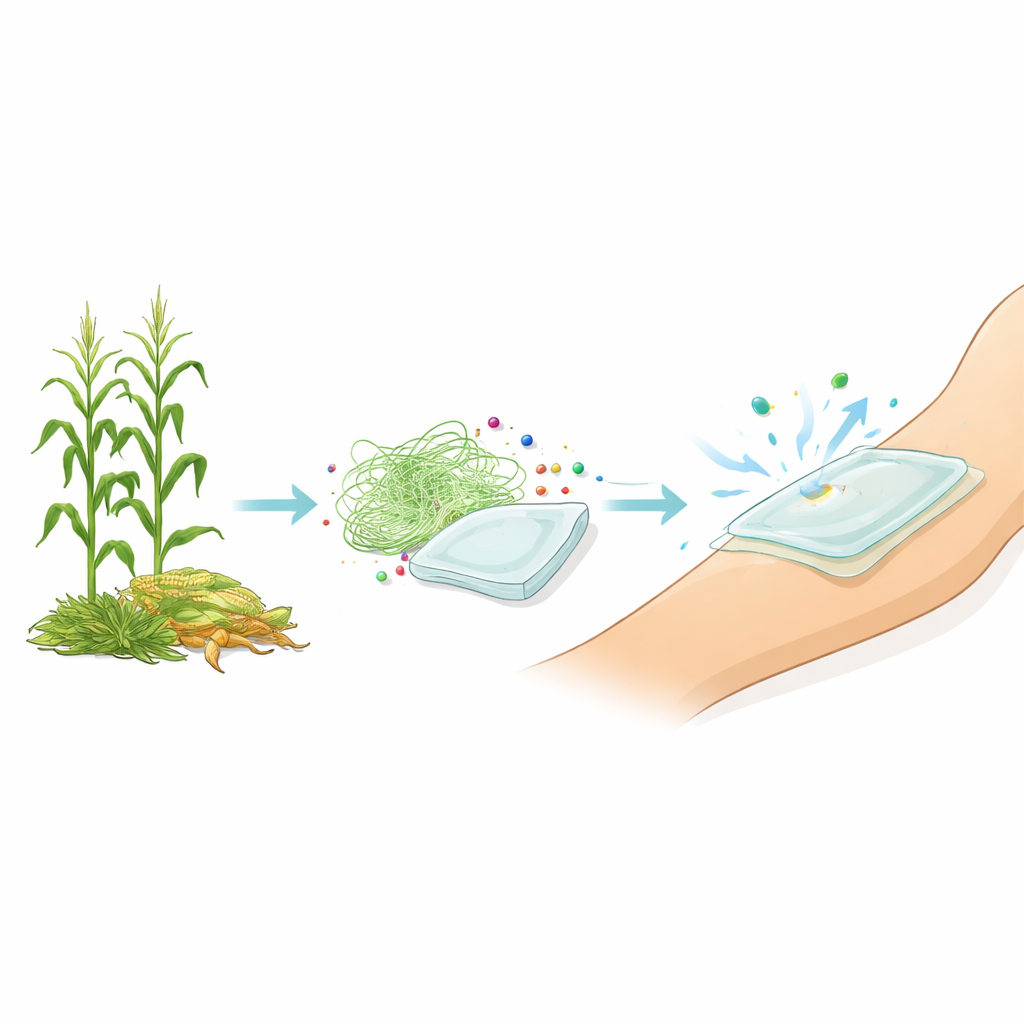
Built-In Germ Fighters at the Nanoscale
To tackle infection risk, the team introduces another ingredient: tiny particles made from zinc oxide doped with silver oxide. Both zinc and silver are known for their ability to damage bacterial cells at very low doses. The researchers carefully synthesize and characterize these nanostructures, then embed them into the PVA/pectin–nanocellulose film. In tests against common problem microbes, including Escherichia coli, Staphylococcus aureus, and Pseudomonas aeruginosa, films containing the metal nanostructures slash bacterial survival to a fraction of that seen on unprotected surfaces. The effect is attributed to a combination of reactive molecules, metal ions, and direct contact that collectively weaken and rupture microbial cells while they remain safely locked within the film.
Safe for Cells, Kind to the Environment
Any material that touches open skin must be gentle to human cells. Using a standard cell-viability test with fibroblasts—the connective tissue cells that help close wounds—the team finds that their composite films do not harm cells, even across a wide range of concentrations. Under the microscope, cells remain plentiful and healthy-looking on and around the material. At the same time, when the films are buried in soil under controlled conditions, they gradually break down rather than persist like conventional plastics. The presence of nanocellulose slows this decay just enough to provide useful lifetime in use, while still ensuring that the films ultimately return to the environment without long-term buildup. 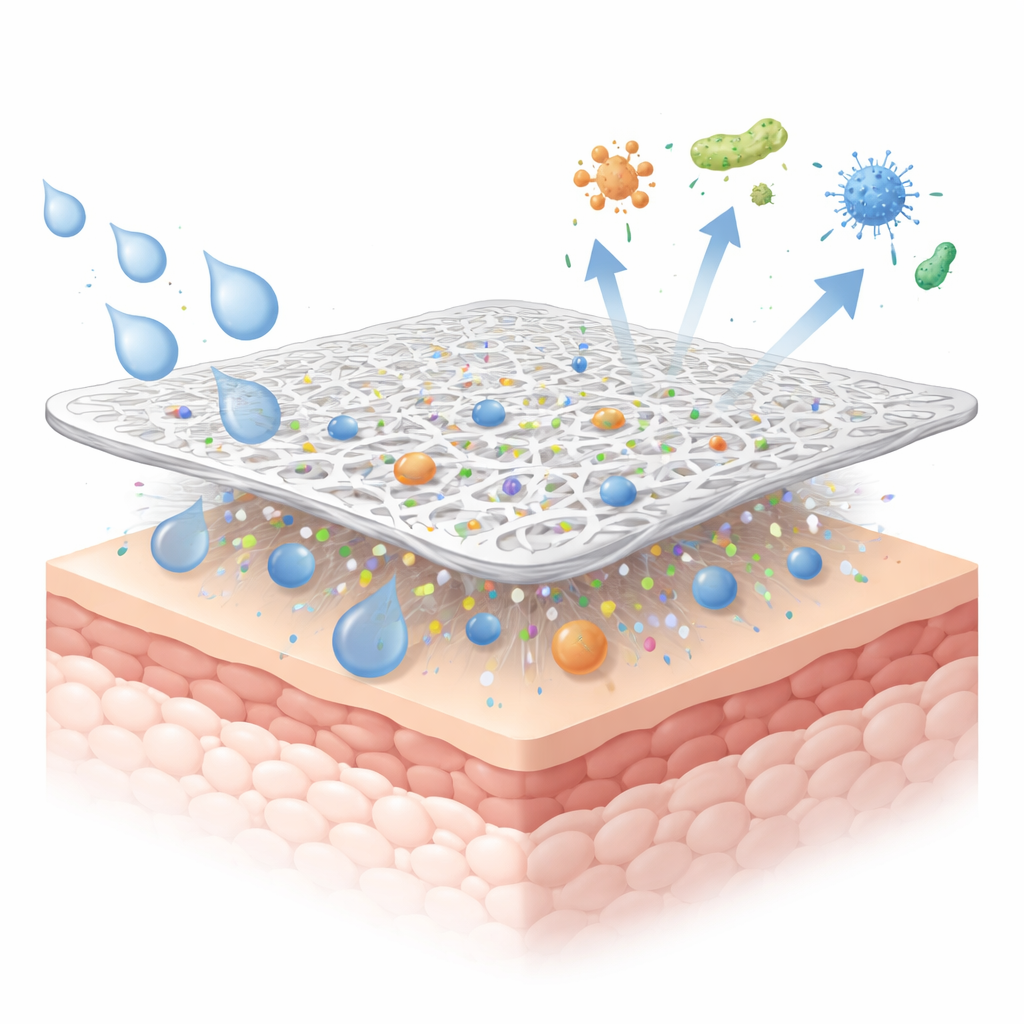
Toward Smarter, Greener Bandages
Altogether, the study presents a new kind of wound dressing material that starts with low-value plant biomass and ends as a high-performance, biodegradable film. By combining a familiar medical plastic with fruit-derived pectin, plant nanofibers, and germ-fighting metal particles, the researchers create a bandage that is strong, breathable, antibacterial, and friendly to both living tissue and the planet. While further work is needed to test these films in living organisms and tailor them for specific medical uses, the findings point toward a future where the bandages that protect our skin are themselves grown from nature and safely return to it after use.
Citation: Koshy, J.T., Sangeetha, D. Nanocellulose reinforced sustainable polyvinyl alcohol and pectin based nanocomposite films embedded with AgO/ZnO nano structures for wound dressing applications. Sci Rep 16, 8343 (2026). https://doi.org/10.1038/s41598-025-34411-7
Keywords: nanocellulose, wound dressing, biodegradable polymers, silver zinc nanoparticles, sustainable biomaterials