Clear Sky Science · en
Experimental characterization of particle migration regimes in unsaturated gap-graded soils: density-dependent patterns under rainfall infiltration
Why rain can quietly weaken the ground
When we picture erosion, we often think of rivers carving canyons or storms stripping away topsoil. But some of the most dangerous erosion happens out of sight, as rainwater seeps into the ground and quietly rearranges the grains of soil. This hidden churning can weaken slopes, embankments, and dams, helping trigger landslides and other disasters. The study described here looks inside this process grain by grain, asking a simple but crucial question: how tightly the soil is packed may decide whether rainfall gently passes through or slowly tears the ground apart.
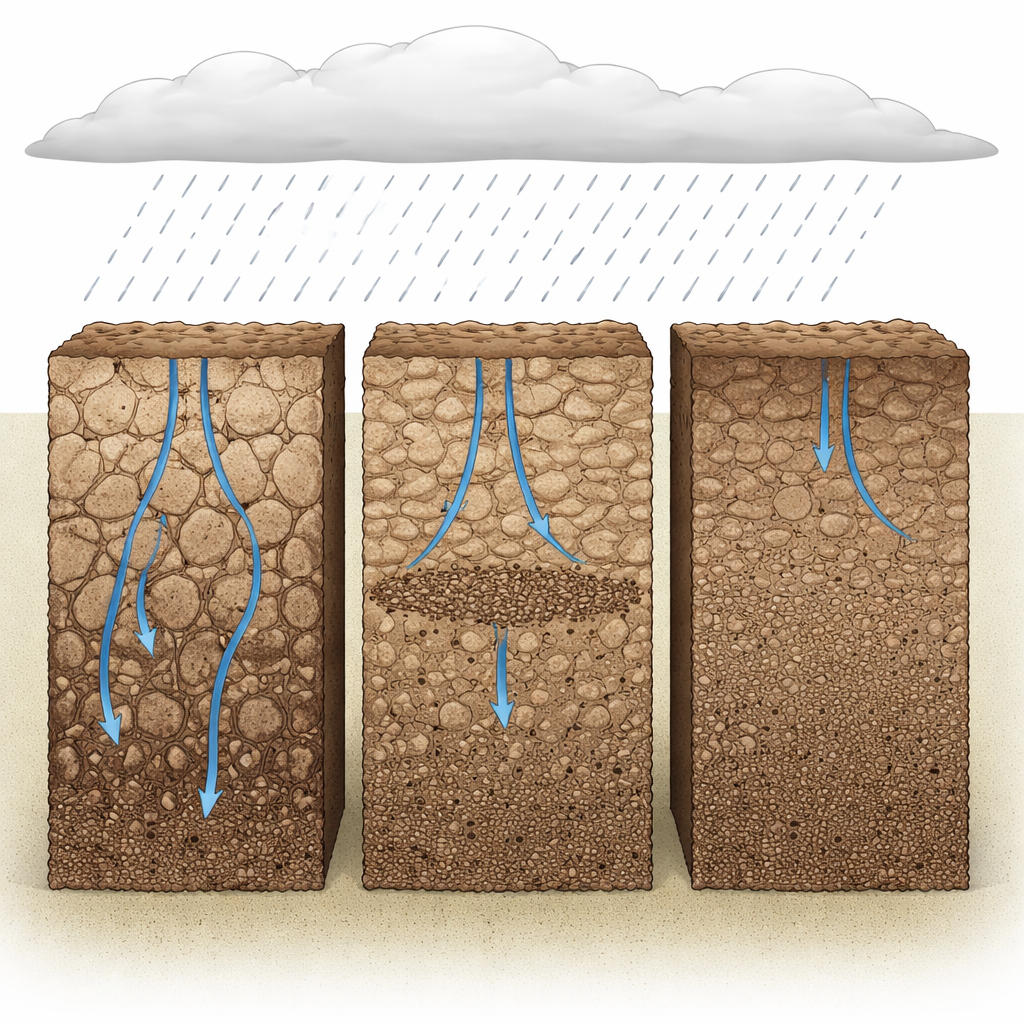
Looking inside a special kind of soil
The researchers focused on "gap-graded" soils—mixtures with big grains forming a skeleton and much smaller grains filling the gaps, with few grains in between. Many man-made fills and natural slopes have this structure. In such soils, water flowing through the gaps can pick up the smaller particles and carry them deeper, a process known as internal erosion or suffusion. Over time, this can hollow out parts of the soil, reduce its strength, and set the stage for failure. Understanding when and how this happens is key for safer slopes, roads, railways, and dams in rainy climates.
Rainfall experiments in a clear soil column
To watch the hidden movement, the team built a tall transparent cylinder, filled it with a carefully mixed sand–clay blend, and rained on it from above using a calibrated sprinkler. They prepared nine different tests combining three soil "tightness" levels (dry densities of 1.7, 1.8, and 1.9 grams per cubic centimeter) with three steady rainfall rates (60, 90, and 120 millimeters per hour). After two hours of artificial rain, they sliced the column into layers and measured how much of each grain size—coarse, medium, and very fine—remained at each depth. This allowed them to reconstruct how particles had migrated up or down inside the column during infiltration.
How tight packing changes particle journeys
The results show that how densely the soil is packed is more important than how hard it rains. In loosely packed and medium-packed soils, medium-sized grains (between about 2 millimeters and 0.075 millimeters) were strongly mobilized by the infiltrating water. Their mass-versus-depth curves often took on shapes with one or two distinct peaks, meaning these grains tended to collect in preferred bands below the surface. In the densest soils, by contrast, the grains scarcely moved at all. The curves became nearly straight or showed only surface-skewed shapes, signaling that a tightly locked skeleton of coarse grains left little room for particles to be dragged along by the flow.
Four simple patterns of hidden change
By comparing all nine test conditions, the authors grouped the vertical grain distributions into four easy-to-recognize patterns. An "m-shaped" curve shows two enrichment zones at different depths, while an "n-shaped" curve shows a single bulge where particles accumulate. A nearly straight line marks a more uniform, migration-free condition, and a "hooked" shape signals enrichment only very close to the surface. These patterns reflect the tug-of-war between flowing water, which pulls grains along, and the internal contact network—or force chains—between grains, which resists rearrangement. Medium-sized grains were most mobile at low and medium densities, while the very finest grains enriched only at the intermediate density where pores were neither too wide nor too constricted.
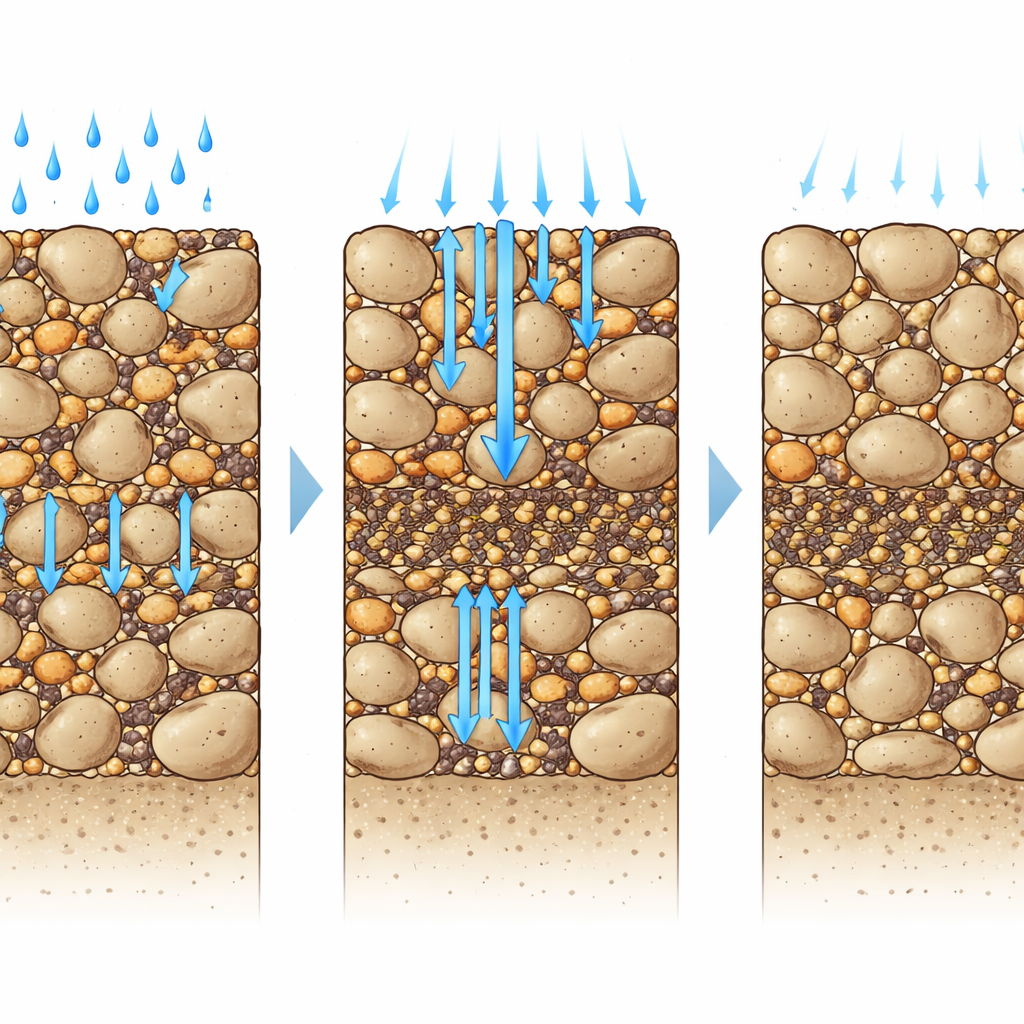
From lab columns to safer slopes
For non-specialists concerned about landslides or embankment failures, the key message is straightforward. When gap-graded soils are compacted to a high density near the surface, they become far more resistant to rainfall-driven internal erosion. Loose or moderately compacted fills, in contrast, allow rainwater to sort and shift grains at depth, gradually undermining stability even if the slope looks unchanged from the outside. The four distribution patterns identified in this study provide a simple diagnostic language for engineers to interpret borehole samples and judge internal erosion risk. In practical terms, packing the top soil layer tightly—rather than merely shaping and covering it—can be one of the most effective defenses against rainfall quietly weakening the ground from within.
Citation: Shu, Z., Teng, H., Li, X. et al. Experimental characterization of particle migration regimes in unsaturated gap-graded soils: density-dependent patterns under rainfall infiltration. Sci Rep 16, 8816 (2026). https://doi.org/10.1038/s41598-025-34315-6
Keywords: rainfall-induced erosion, suffusion, gap-graded soil, slope stability, soil compaction