Clear Sky Science · en
Specific wavelengths of light modulate honey bee locomotor activity
Why the Color of Light Matters to Bees
Honey bees don’t just see the world in color; different colors of light can actually speed them up or slow them down. This study explores how specific shades—from invisible ultraviolet to familiar green—change how much bees move over the course of a day. Understanding this subtle link between light and behavior can help scientists design better bee experiments, and beekeepers create healthier indoor environments for colonies that are increasingly important to our food supply.
How Bees See Their Colorful World
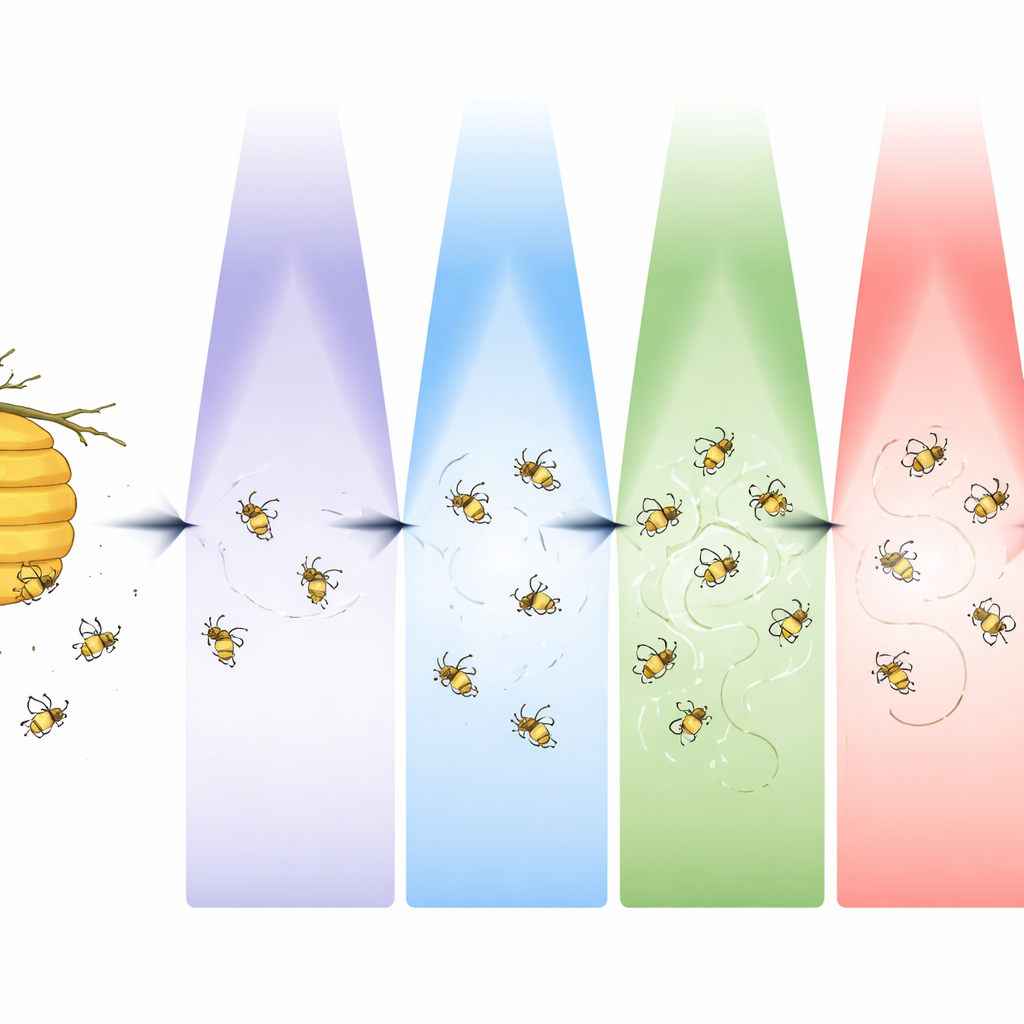
Bees rely on color vision to find flowers, navigate using the sky, and coordinate their busy workday. Their eyes contain three main types of light-sensitive cells tuned to ultraviolet, blue, and green light. Signals from these cells travel through layers of the bee brain that separately process these colors before combining them to guide movement and orientation. Because each color channel plays a different role—green is especially important for motion and edges, while ultraviolet helps with navigation and sky patterns—the researchers suspected that shining different colors of light on bees would change how active they are and when they choose to move.
Putting Bees in a Carefully Lit Test Chamber
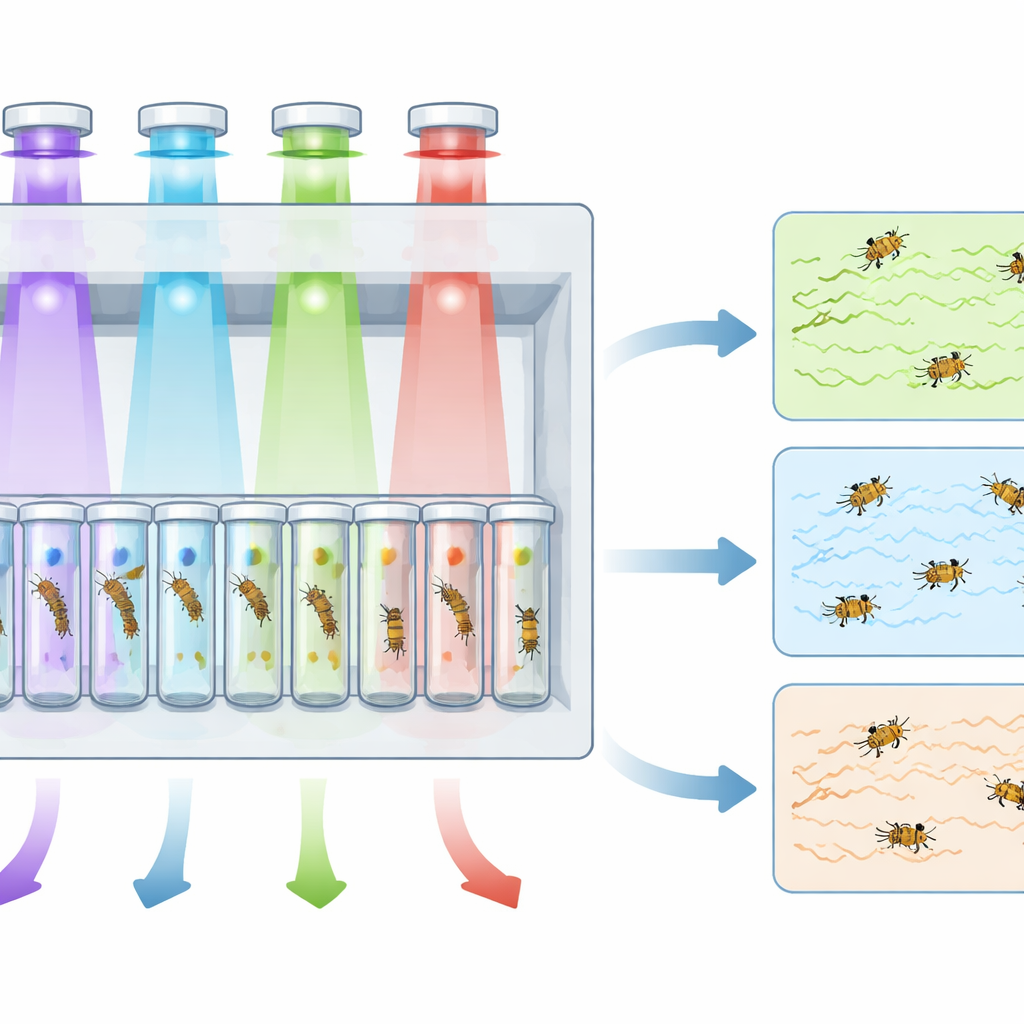
To test this idea, the team placed individual forager bees into narrow glass tubes inside a climate-controlled chamber. Over 24 hours, groups of bees were exposed to one of several lighting conditions: pure ultraviolet, blue, green, or infrared (which bees perceive as darkness), or combinations such as blue–green, blue–ultraviolet, green–ultraviolet, and blue–green–ultraviolet. All lights were carefully adjusted so that each color had the same brightness. Instead of using commercial devices that count brief interruptions of an invisible beam, the researchers used a computer-vision system called Api‑TRACE to track each bee directly from video, capturing fine-grained patterns of movement throughout the day and night.
Which Colors Make Bees Busy—or Still
When the researchers compared daily movement patterns, they found that bees under only green, only blue, or only infrared light followed very similar rhythms: low activity during the night, rising after their usual wake-up time, then peaking during the subjective “day.” In contrast, lighting that included ultraviolet, especially the blue–ultraviolet and blue–green–ultraviolet mixtures, produced distinctly different timing and shapes of activity curves. Looking at how much the bees moved overall, green light tended to boost movement, while ultraviolet light by itself reduced it compared with blue and green. The strongest calming effect appeared when blue and ultraviolet light were combined: bees under this mixture moved the least of all groups, even less than those effectively kept in the dark under infrared light.
Why Ultraviolet Has a Double Edge
The team suggests that ultraviolet’s surprising ability to quiet bees may be rooted in how their visual circuits are wired. In parts of the bee brain where color signals are processed, some nerve cells respond to both ultraviolet and blue light and can either excite or inhibit downstream networks that control motion. A strong, artificial dose of ultraviolet—especially when mixed with blue and stripped of its usual sky patterns—may initially trigger a short burst of search behavior, then suppress normal movement as these inhibitory pathways dominate. Meanwhile, green light, which is strongly represented in the bee’s visual genes and tied to motion detection, likely keeps the movement system more active.
What This Means for Bee Labs and Artificial Hives
The findings carry a clear message: not all “light” is equal for bees. Ultraviolet-rich lighting, particularly when blended with blue, pushes their baseline activity downward and reshapes their daily rhythm, while green light supports more natural levels of movement. For experiments that measure bee behavior or internal clocks, or for flight rooms and indoor colonies meant to mimic the outdoors, using well-controlled, ultraviolet-minimized lighting could reduce unwanted disturbances and make results more reliable across labs. In simple terms, this work shows that tuning the color of artificial light can either quietly calm bees or keep them comfortably on the move—and that choice matters for both science and beekeeping.
Citation: Erdem, B., Fidan, I., Turgut, A.E. et al. Specific wavelengths of light modulate honey bee locomotor activity. Sci Rep 16, 9037 (2026). https://doi.org/10.1038/s41598-025-34255-1
Keywords: honey bee behavior, light wavelength, ultraviolet light, circadian rhythms, locomotor activity