Clear Sky Science · en
Study on the deformation response of support for water diversion tunnels in cold regions under ventilation and convection conditions
Why tunnel shape matters in winter
Across high mountains and frozen plateaus, long tunnels quietly carry water and traffic through rock that endures extreme cold, deep snow, and powerful winds. In such places, the air rushing through a tunnel and the groundwater seeping around it do more than change the chill a traveler feels—they can slowly bend, crack, and weaken the tunnel’s concrete shell. This study looks at how temperature, moisture, and ventilation together deform water diversion tunnels in cold regions, and how engineers can tune ventilation and drainage layouts to keep these hidden arteries safe for decades.
How cold air and moist rock team up
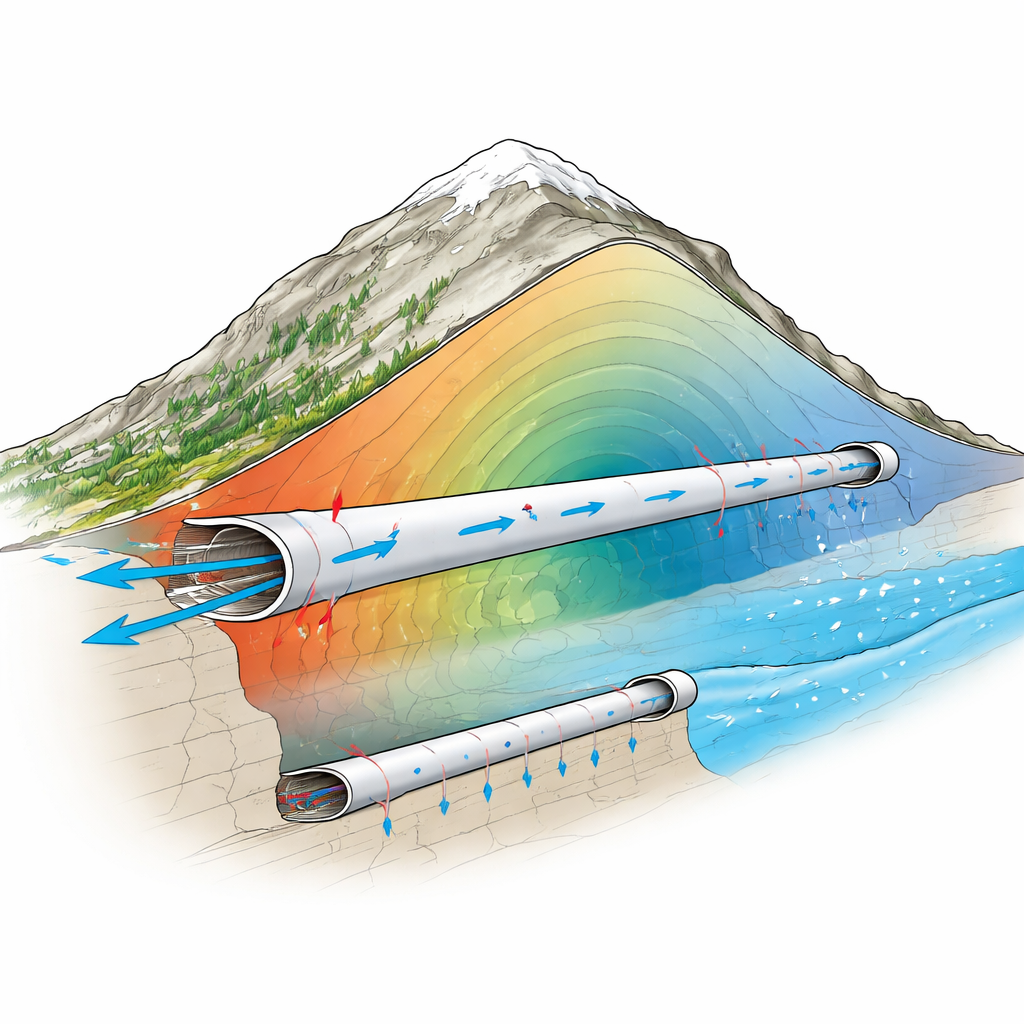
The researchers focus on water diversion tunnels in high‑altitude, very cold landscapes where winter temperatures sit below freezing and the ground cycles repeatedly between frozen and thawed states. Natural ventilation pulls outside air into the tunnel, and its temperature and humidity swing with the seasons. As this air moves through the tunnel, it exchanges heat and moisture with the concrete lining and the surrounding rock. At the same time, groundwater flows through cracks and pores in the rock, bringing its own heat and moisture. Together, these processes create complex patterns of freezing, thawing, wetting, and drying that gradually weaken materials and change the forces acting on the lining.
Building a digital twin of a cold tunnel
Because it is nearly impossible to measure every detail inside a buried tunnel over many years, the team built a detailed computer model to mimic the real environment. They combined airflow calculations from one software platform with a second model that tracks heat, water movement, and mechanical stress in the rock and lining. To keep the problem manageable but realistic, they assumed the rock behaves like a uniform porous medium, the air in the tunnel is an ideal, incompressible fluid, and water in the rock moves mainly as liquid. The model includes how heat moves, how moisture diffuses and seeps, and how the lining responds when temperature and water content change. Field measurements of air temperature, humidity, wall temperature, and airflow in an actual tunnel, along with comparisons to classic freezing experiments in soil, were used to check that the simulations reproduce real‑world behavior.
What ventilation really does to a tunnel
With this digital tunnel, the authors explored how different inlet air speeds and humidities, groundwater levels, and the spacing of a nearby drainage tunnel change temperatures, moisture, stresses, and displacements. They found that air speed has a double‑edged effect. When air moves slowly, it stays in contact with the walls longer, producing strong cooling and humidifying of the lining; when air moves very fast, there is less time for exchange, but the stronger flow can still drive greater stress changes. Beyond about 2 meters per second, increasing speed no longer greatly changes air temperature or humidity, yet the main stress in the lining becomes more sensitive to the airflow. Air humidity at the entrance affects moisture more than temperature: moderate humidity around 40 percent made the lining crown most responsive and produced the largest vertical movements, while very dry or very moist air led to more stable behavior.
Hidden roles of groundwater and drainage layout
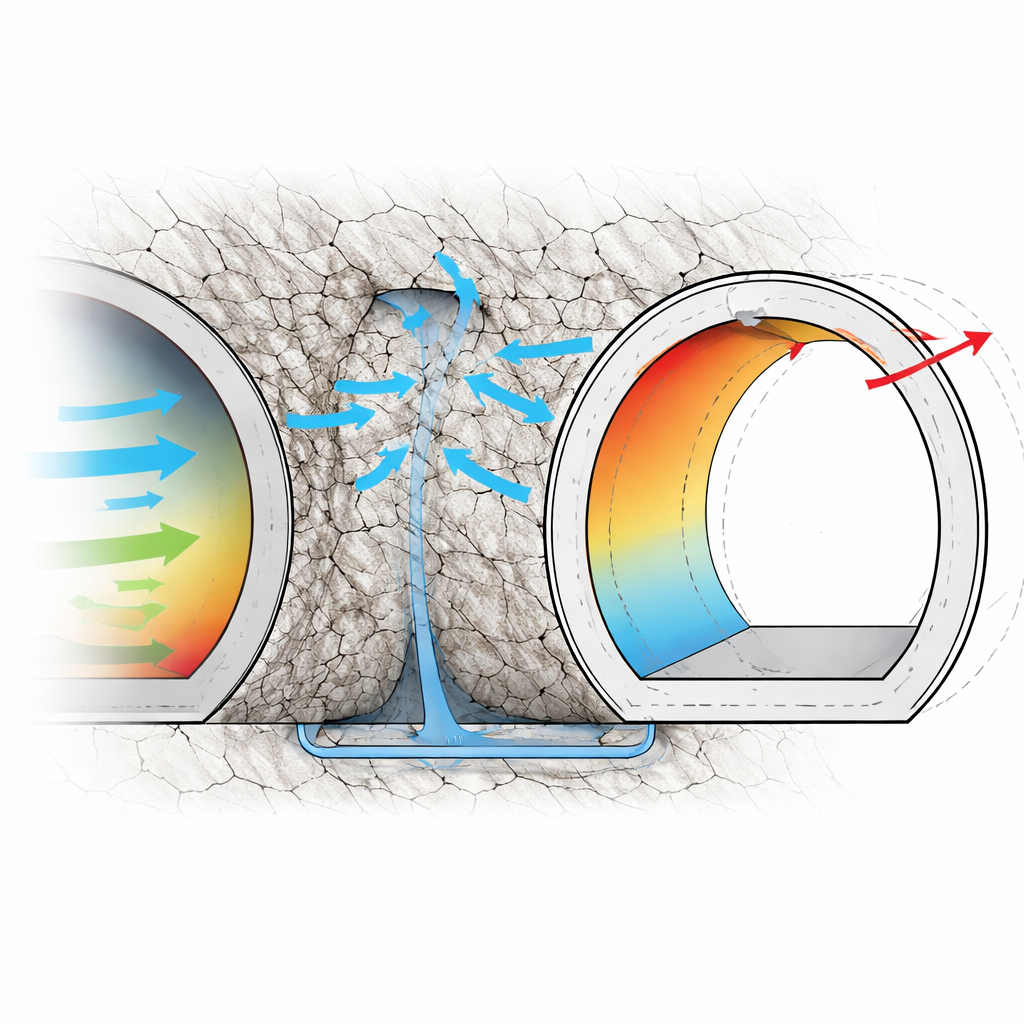
Groundwater turned out to be as important as air. A high water table, with rock nearly saturated, tends to smooth out temperature swings but raises humidity, encouraging more active moisture migration. Shallow groundwater, by contrast, produces larger stress and displacement peaks at the tunnel crown during freeze–thaw cycles. The distance between the main tunnel and its drainage tunnel also matters. When the tunnels are too close, the lining experiences large, periodic displacements as water and temperature fields interact; when they are too far apart, the crown stress can climb to high levels and fluctuate strongly, raising the risk of cracking. Moderate spacing reduces both deformation amplitude and stress concentration.
The restless entrance to the underground
The tunnel entrance emerges as a particular trouble spot. There, the lining and surrounding rock feel the full force of changing outside weather, shifting airflow, and strong temperature and humidity gradients. The model shows that both stress and displacement grow in magnitude as one approaches the portal, and the pattern of crown settlement combined with sidewall bulging becomes most pronounced. Deeper inside the tunnel, where air is calmer and the rock acts as a thermal buffer, conditions are far more stable and stresses are more evenly spread.
What this means for safer tunnels
For non‑specialists, the key message is that tunnel safety in cold regions is controlled not just by how strong the concrete is, but by how air and water are managed. The study shows that carefully choosing natural ventilation speeds, keeping inlet humidity out of the most sensitive range, placing drainage tunnels and holes at suitable distances, and accounting for seasonal groundwater levels can markedly reduce deformation and stress in the lining—especially near the entrance. While the model simplifies some material behaviors, it provides engineers with a practical framework to predict where and when a cold‑region tunnel is most likely to deform, and how to adjust design and operation to keep these vital underground passages working safely over the long term.
Citation: Chang, X., Qiao, J., Ren, J. et al. Study on the deformation response of support for water diversion tunnels in cold regions under ventilation and convection conditions. Sci Rep 16, 9391 (2026). https://doi.org/10.1038/s41598-025-34234-6
Keywords: cold-region tunnels, tunnel ventilation, freeze–thaw damage, groundwater seepage, lining deformation