Clear Sky Science · en
Vertically transmitted bacterivorous nematodes are consistent nest inhabitants in the Azteca-Cecropia ant-plant mutualism
Tiny worms in tree houses
High in tropical trees, certain ants live inside hollow stems and fiercely defend their leafy homes. This study reveals that these arboreal "tree houses" are also reliably inhabited by microscopic worms called nematodes. Far from being mere freeloaders or hidden pests, these tiny creatures turn out to be regular, long-term residents that may quietly help keep this miniature world running.
Life inside a living tree
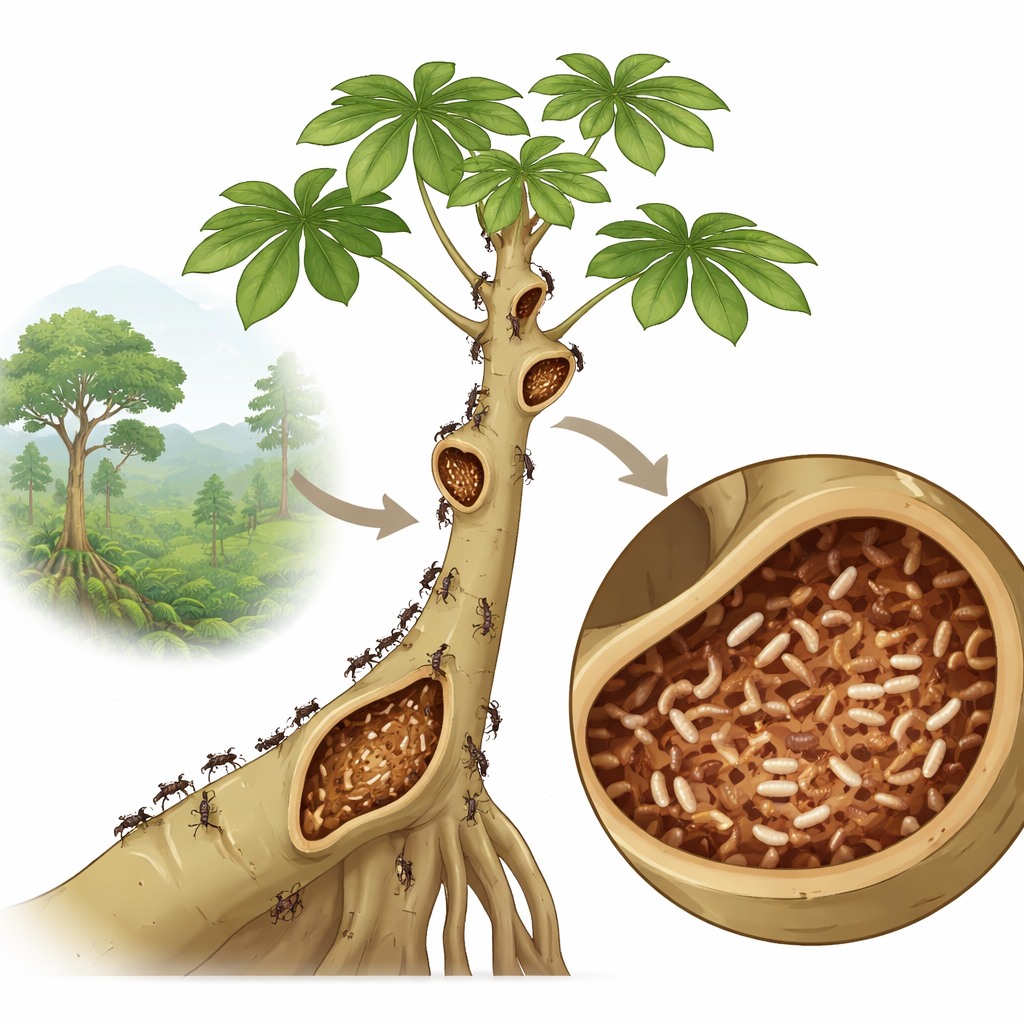
In Central American forests, Cecropia trees grow hollow stems that shelter Azteca ants. The ants tunnel into the stems, raise their young there, and protect the tree from hungry insects and encroaching vines. Inside the stem chambers, workers build loose piles of chewed plant tissue, shed ant skins, and other organic bits known as "patches." Earlier work had shown that bacteria and fungi thrive in these patches. The new question was whether nematodes also form a stable part of this tiny ecosystem, and how their communities change as ant colonies grow and as different ant and tree species interact.
Hunting for hidden neighbors
The researchers opened hollow stems from 65 Azteca colonies living in three Cecropia species in Costa Rica. They collected the patches from young and mature colonies and examined them in two ways. First, they used microscopes to visually identify and count nematodes from a subset of colonies, focusing on body shape and mouth structures. Second, they extracted DNA from the patches and sequenced a marker gene that can be used to recognize different nematode lineages. By combining these approaches, they could see not only which types of nematodes were present, but also how common each group was across many nests.
Faithful residents that spread with the ants
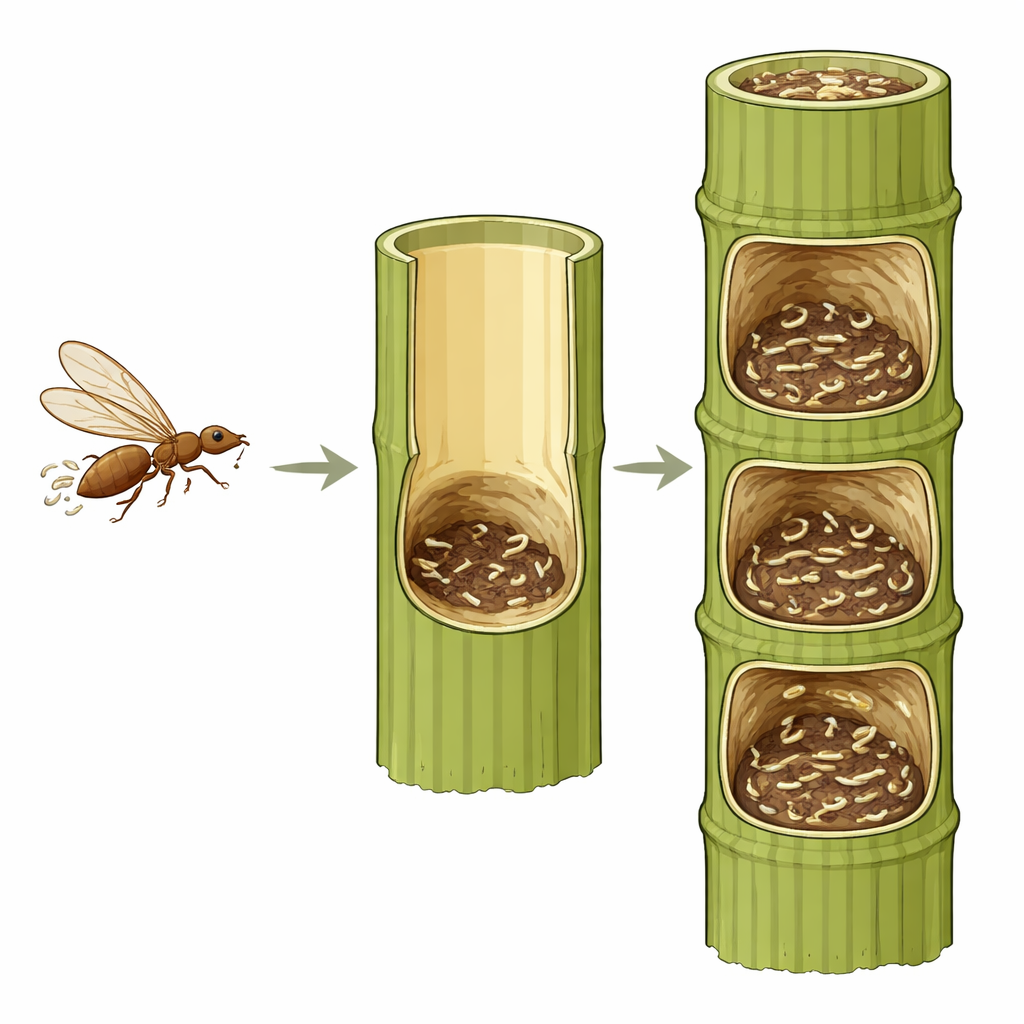
The most striking pattern was consistency: bacteria-feeding nematodes from one order, Rhabditida, were found in every single patch sample, regardless of ant species, tree species, or colony age. Other nematodes appeared only now and then. Some were likely plant- or fungus-feeders that favored young patches rich in fresh plant tissue, while others were omnivores or predators that showed up mainly in older, well-developed patches. Yet overall, the diversity and balance of nematode types in a given colony remained stable from the earliest stages, when a lone queen starts a nest, through to large, established colonies. Because earlier work had shown that young queens carry nematodes on or inside their bodies, and because new patches deeper in the tree resemble older ones in nematode makeup, the findings strongly support two routes of spread: vertical transmission from mother colony to daughter via the queen, and horizontal spread from patch to patch as the colony occupies more stem chambers.
Ant species shape the microscopic community
Although nematode communities were consistent over time within a colony, they were not identical across ant species. Colonies of two Azteca species hosted similar sets of Rhabditida worms but in different proportions. One ant builds thicker, wetter, three-dimensional patches, while the other forms drier, sandier layers. These contrasting patch structures likely favor nematodes of different sizes and movement styles, much as soil texture influences which worms can thrive underground. In contrast, the particular Cecropia tree species had little effect on nematode diversity once the ants had established their nests, underscoring that the ants, through their construction habits and waste management, are the main architects of this microscopic world.
What the worms might be doing
From the nematodes’ perspective, ant nests offer a safe, food-rich refuge and a built-in transport system via winged queens. But what do the ants and trees gain, if anything? Despite the huge numbers of nematodes observed, the colonies and host trees showed no signs of harm, and ants are known to aggressively remove threats to nest health. The authors suggest that nematodes may act more like helpers than parasites: by grazing on bacteria, excreting nutrients, and constantly moving through the patches, they could speed up the breakdown of organic matter, recycle nitrogen, and help keep microbial communities balanced. In this view, nematodes become tiny ecosystem engineers, quietly supporting the functioning and cleanliness of the ants’ living quarters.
A hidden partnership within a partnership
This work shows that bacteria-feeding nematodes are not occasional visitors but permanent, reliably inherited members of the Azteca–Cecropia partnership. Different ant species appear to cultivate distinct nematode combinations simply by how they build and maintain their nests. While many details remain to be tested, the study points to a deeply intertwined three-way relationship among trees, ants, and microscopic worms, in which even the smallest residents may help sustain life in a hollow stem.
Citation: Barrajon-Santos, V., Nepel, M., Sudhaus, W. et al. Vertically transmitted bacterivorous nematodes are consistent nest inhabitants in the Azteca-Cecropia ant-plant mutualism. Sci Rep 16, 9624 (2026). https://doi.org/10.1038/s41598-025-34231-9
Keywords: ant-plant mutualism, nematodes, Cecropia trees, Azteca ants, microbial ecology