Clear Sky Science · en
AI based optimization of injection pressure for hydrogen and spirogyra biodiesel dual fuel engine to enhance combustion performance and emission characteristics
Cleaner engines for a changing world
Cars, trucks, and farm machines still rely heavily on diesel engines, which are powerful but polluting. This study explores a way to make those familiar engines much cleaner and more efficient by blending a special algae-based biodiesel with hydrogen gas, and then using artificial intelligence to fine‑tune how the fuel is injected. The result is a practical path toward lower emissions and better fuel economy that could be applied to many existing engines rather than replacing them outright.
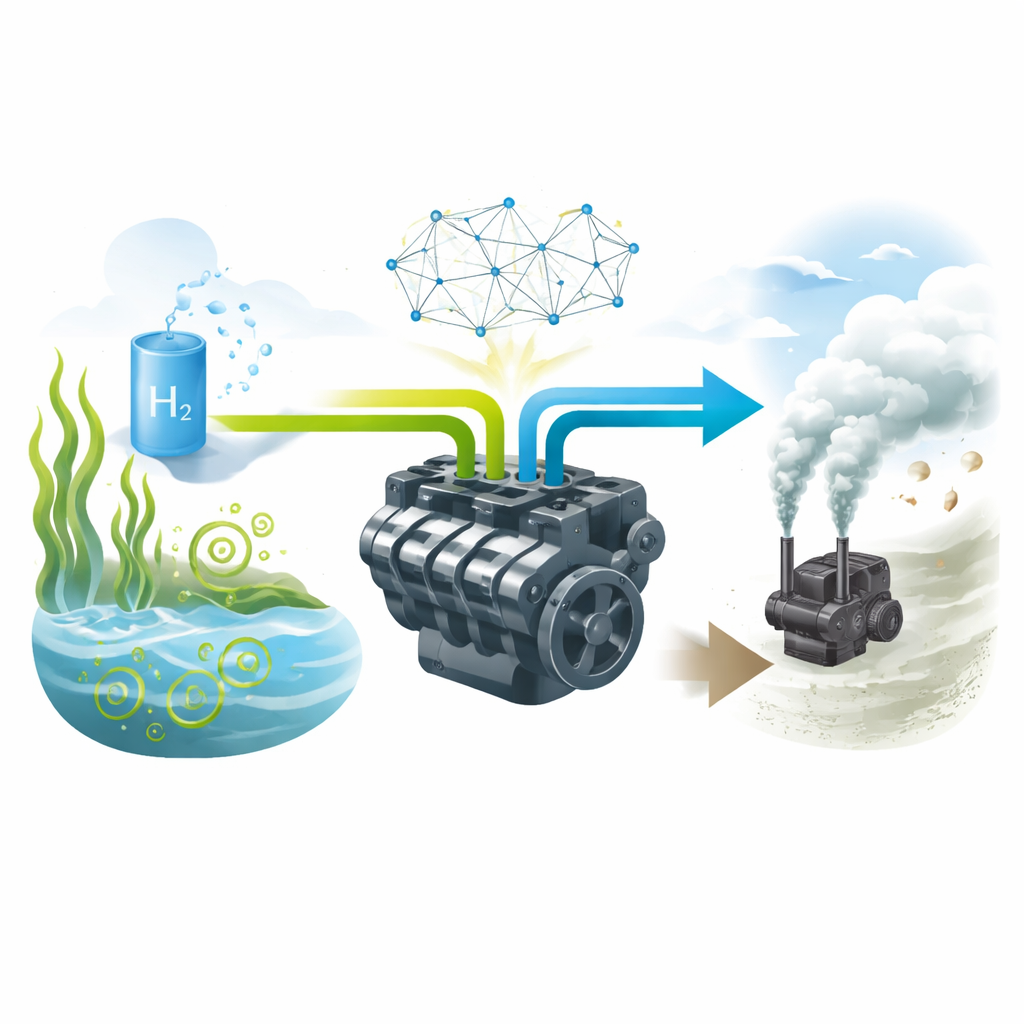
A new spin on diesel fuel
The researchers started with a conventional single‑cylinder diesel engine and replaced much of the standard fuel with a mix derived from Spirogyra algae. This biodiesel was enhanced with tiny carbon nanoparticles and a small amount of an ignition‑boosting additive, then paired with hydrogen fed through the intake. Together, these ingredients form a “dual‑fuel” system: the liquid blend is injected as a pilot charge that ignites first, while the hydrogen burns rapidly and cleanly once lit. The team carefully measured how this setup affected engine power, fuel use, and pollutants across different injection pressures.
Finding the sweet spot in fuel injection
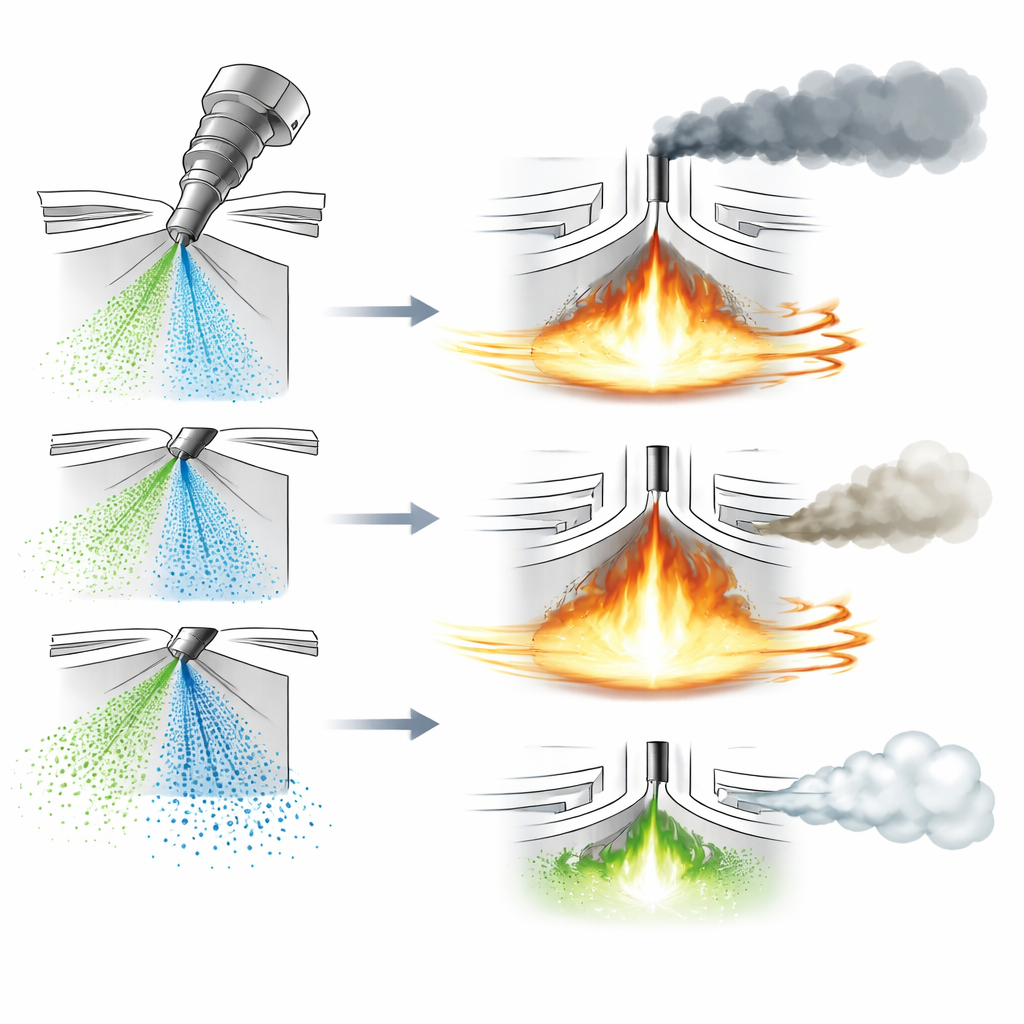
In a diesel engine, the pressure that pushes fuel through the injector determines how finely it sprays and how well it mixes with air. The study tested four injection pressures between 180 and 240 bar while the engine ran on the hydrogen–biodiesel combination. Higher pressures generally shortened the time between injection and ignition, raised peak cylinder pressure, and increased the rate at which heat was released. The highest pressure, 240 bar, gave the lowest fuel consumption and the highest efficiency, but also produced the harshest combustion and more nitrogen oxide gases, which contribute to smog.
At 220 bar, however, the engine struck a promising balance. Combustion started slightly later and peaked at a somewhat lower pressure than at 240 bar, easing mechanical stress on the engine. Fuel consumption was modestly higher than at 240 bar, but still much better than for ordinary diesel. Crucially, the 220‑bar setting reduced smoke, carbon monoxide, and unburned hydrocarbons compared with standard diesel and with less‑optimized dual‑fuel cases. Nitrogen oxides did rise relative to pure diesel but were lower than at the highest pressure, suggesting that moderate injection pressure can temper the usual pollution trade‑offs.
Letting algorithms guide the tuning
Because engines behave in complex ways, the team turned to machine‑learning algorithms to help map how injection pressure and other conditions influence performance and emissions. They trained three types of models—simple linear fits, decision trees, and random forests—using experimental data on fuel use, efficiency, pressure inside the cylinder, and several pollutants. Decision trees, which split the data into many “if‑this‑then‑that” branches, delivered the most accurate predictions overall, closely matching measured peak pressure and hydrocarbon levels and keeping error margins very low. This means an AI model could, in principle, suggest the best settings for a given engine and fuel blend without exhaustive testing.
From lab engine to real‑world impact
Beyond the numbers, the combination of hydrogen and algae biodiesel has appealing life‑cycle benefits. Algae can be grown on non‑farmland using waste streams, taking up carbon dioxide as they grow and releasing it when burned, while hydrogen—if produced from renewable electricity—adds energy without adding carbon. Running this pairing in a dual‑fuel engine at around 220 bar injection pressure improved thermal efficiency, cut soot and carbon monoxide, and kept nitrogen oxides at manageable levels. The authors argue that, scaled up and guided by AI‑based control, such systems could help decarbonize heavy vehicles, generators, and off‑road machinery that are difficult to electrify quickly.
What this means for future engines
In simple terms, the study shows that a carefully chosen mix of algae biodiesel and hydrogen, delivered at a moderate injection pressure and tuned with machine learning, can make a diesel engine cleaner and more efficient without radical redesign. While more work is needed on multi‑cylinder engines, variable hydrogen flow, and long‑term durability, the results point to a realistic pathway where existing engines run on greener fuels, guided by smart software, to cut emissions and fuel use in everyday applications.
Citation: Aravind, S., Barik, D., Paramasivam, P. et al. AI based optimization of injection pressure for hydrogen and spirogyra biodiesel dual fuel engine to enhance combustion performance and emission characteristics. Sci Rep 16, 8017 (2026). https://doi.org/10.1038/s41598-025-34179-w
Keywords: hydrogen dual-fuel engines, algae biodiesel, injection pressure optimization, engine emissions reduction, machine learning in combustion