Clear Sky Science · en
Predictive accuracy of clinical, laboratory, and radiological scores for severe acute pancreatitis
Why some belly pain turns into a life-threatening crisis
Most people who land in the emergency room with sudden, intense upper belly pain caused by an inflamed pancreas recover within days. But for a sizable minority, the same condition—acute pancreatitis—spirals into organ failure, long hospital stays, and even death. Doctors see these patients early, often when symptoms look similar, and must quickly decide who needs the closest monitoring and most aggressive care. This study asked a simple but crucial question: among the many tools doctors use, which ones best predict, in the first hours and days, who is at highest risk of severe acute pancreatitis?
Taking a closer look at a common emergency
Acute pancreatitis is now one of the most frequent reasons for admission to hospital digestive disease units, and its numbers are rising worldwide. In the majority of cases the inflammation settles down, and patients go home with little lasting damage. Yet about one in five patients develops a severe form marked by overwhelming inflammation and failure of organs such as the lungs, kidneys, or heart. In this severe form, the chance of dying can climb as high as 30–50%. Because the early symptoms can be deceptively similar across patients, doctors rely on scoring systems built from vital signs, blood tests, and imaging to sort out who is safe on a regular ward and who may suddenly deteriorate.
How the study was carried out
Researchers in Egypt followed 300 adults admitted with acute pancreatitis between 2018 and 2022. Everyone had a full clinical evaluation, blood tests, ultrasound, and a contrast-enhanced CT scan of the abdomen within six hours of arriving at the hospital. Using an international classification system, patients were grouped as having either non-severe disease (mild or moderately severe) or severe disease, defined mainly by how long organ failure lasted. The team then calculated eight different prediction tools for each person, ranging from traditional bedside scores and complex intensive-care indexes to simple ratios derived from routine blood counts. They compared how well each tool separated patients who went on to severe disease from those who did not.
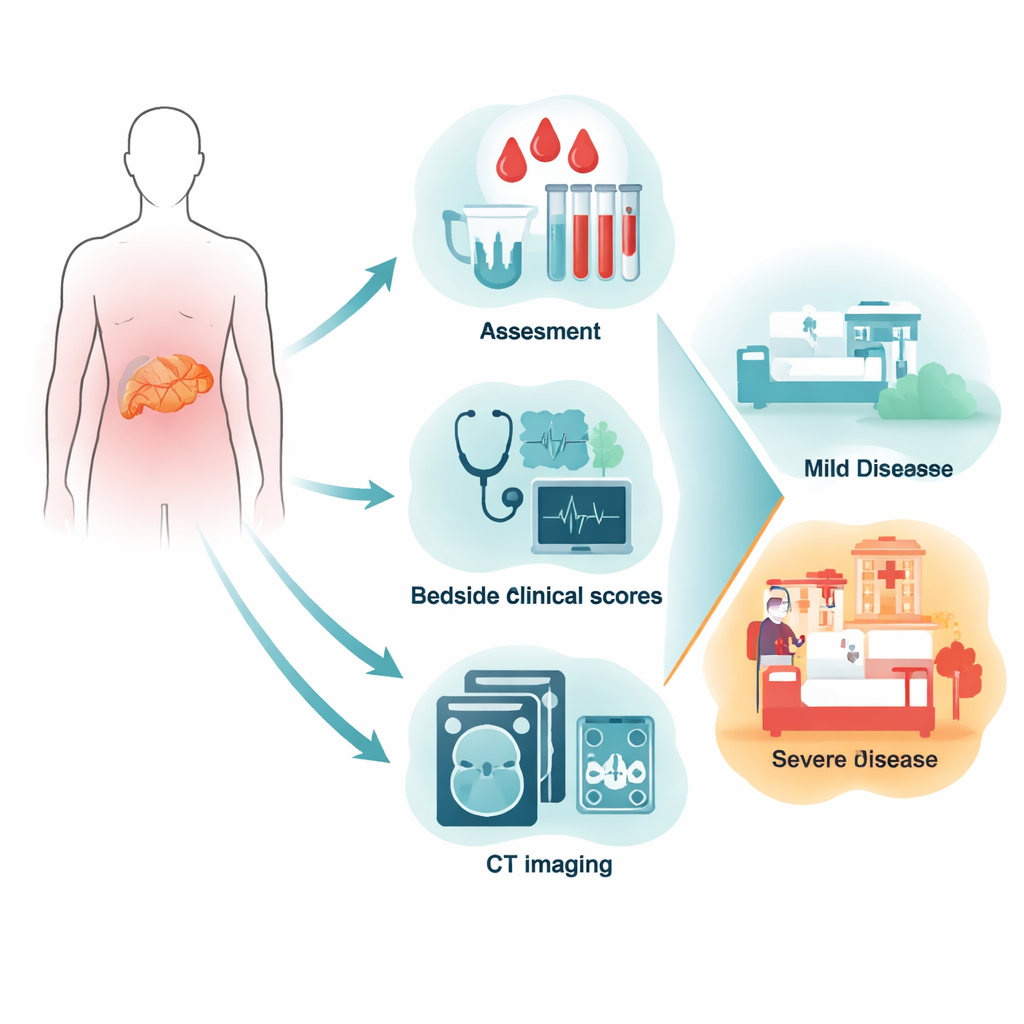
Blood markers, bedside scores, and scan-based grading
The investigators examined several approaches that reflect different aspects of the illness. Classic clinical scores such as the modified Ranson criteria and APACHE II combine age, vital signs, and a long list of blood values. Newer bedside tools like the BISAP and HAP scores use fewer pieces of information—such as blood urea, mental status, age, and basic exam findings—to give a quick snapshot of risk. At the same time, simple blood-count ratios, including the neutrophil-to-lymphocyte ratio (NLR) and platelet-to-lymphocyte ratio (PLR), try to capture how intense the body’s inflammatory response has become. Finally, the CT Severity Index (CTSI) uses cross-sectional imaging to grade how swollen and damaged the pancreas and nearby tissues appear, including how much tissue has died.
What the numbers revealed
One third of the patients in this study developed severe acute pancreatitis. These individuals were, on average, older, had lower levels of blood protein (albumin), stayed in the hospital roughly twice as long, needed far more intensive care, and had a much higher chance of dying than those with milder disease. When the team tested each prediction tool, two stood out. The CT Severity Index was the clear front-runner, perfectly distinguishing severe from non-severe cases in this group. The BISAP bedside score came a close second, with very high overall accuracy while requiring only simple information available at admission. The HAP score and the inflammatory blood ratios (especially NLR) also helped flag higher-risk patients, but the classic modified Ranson score performed more modestly and only after 48 hours. Statistical modeling confirmed that higher NLR, higher PLR, a worse CT score, and higher BISAP and HAP scores were all independently linked with severe disease.
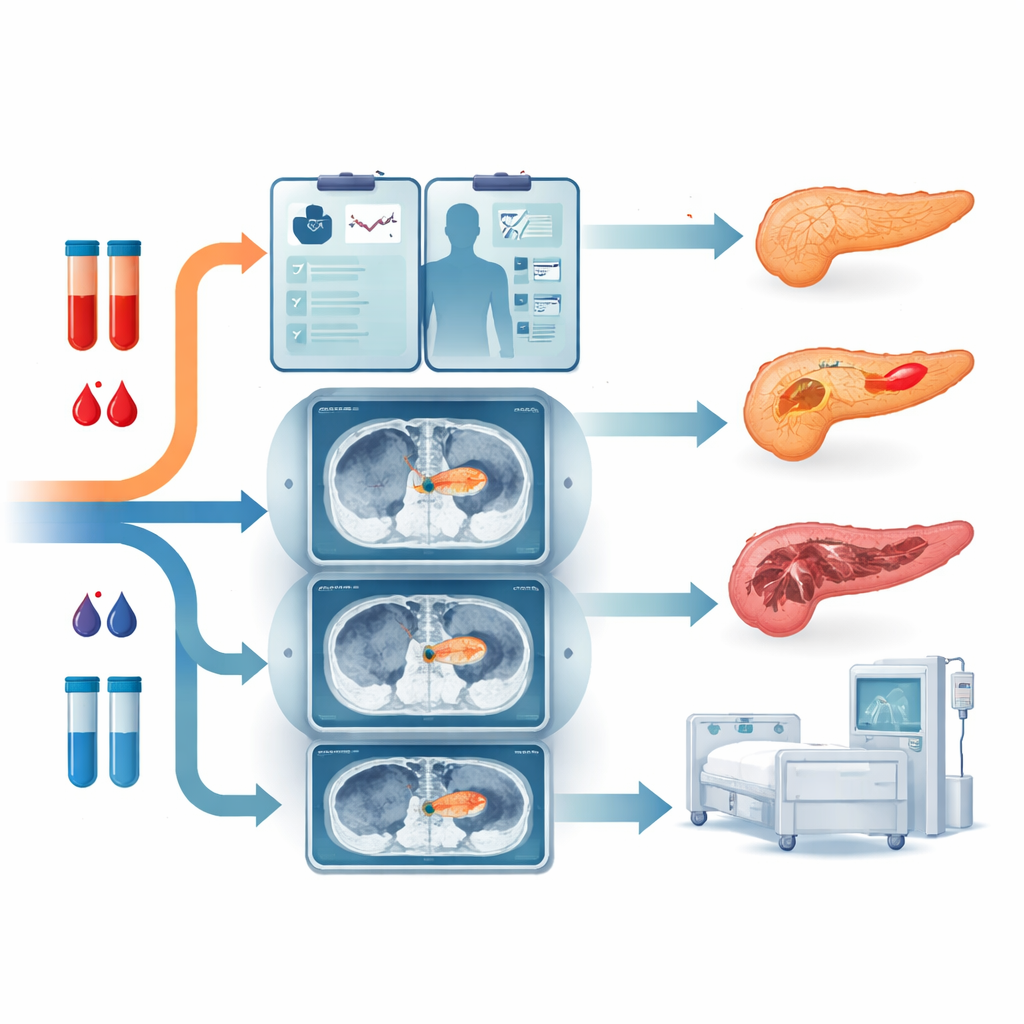
Implications for everyday hospital care
Because CT scans are not always immediately available, the authors recommend using the BISAP score as a fast, bedside tool to triage patients with acute pancreatitis as soon as they arrive. When CT imaging can be obtained, the CT Severity Index adds a powerful second layer of precision by directly showing the extent of damage within and around the pancreas. Simple blood-count measures such as NLR and PLR offer low-cost support for these decisions, especially in resource-limited settings. Together, these approaches can help doctors identify, within hours, which patients with a seemingly similar bout of abdominal pain are quietly heading toward a dangerous course and need closer observation, earlier intensive care, or transfer to specialized centers.
Why this matters to patients and families
For patients, the message is twofold. First, most attacks of acute pancreatitis are mild and resolve with appropriate care. Second, for the minority who are at risk of a severe, life-threatening form, better early prediction can be lifesaving. By showing that a simple bedside score (BISAP) and a widely used scan-based index (CTSI) outperform many older tools, this study points clinicians toward clearer, more reliable ways to decide who needs urgent, high-level monitoring. The authors call for larger, multi-center studies and better timing standards for CT scans, but their findings already give hospitals practical guidance to improve outcomes in a common and sometimes deadly emergency.
Citation: Abu-Elfatth, A., Osman, A.M., Mekky, M. et al. Predictive accuracy of clinical, laboratory, and radiological scores for severe acute pancreatitis. Sci Rep 16, 10337 (2026). https://doi.org/10.1038/s41598-025-34077-1
Keywords: acute pancreatitis, disease severity scoring, medical imaging, inflammation markers, critical care risk