Clear Sky Science · en
Ultra-sensitive graphene–gold hybrid dual core photonic crystal fiber sensor based on surface plasmon resonance for bio-analyte detection
Why Tiny Changes in Blood Matter
Many serious diseases, from diabetes to cancer, quietly alter the chemistry of our blood and other body fluids long before symptoms appear. These changes can slightly shift how light travels through a sample, but spotting such tiny differences demands extraordinarily sensitive tools. This paper presents a new fiber‑optic sensor that uses a special combination of gold and graphene to detect very small changes in liquid samples, potentially enabling earlier and more reliable medical testing.
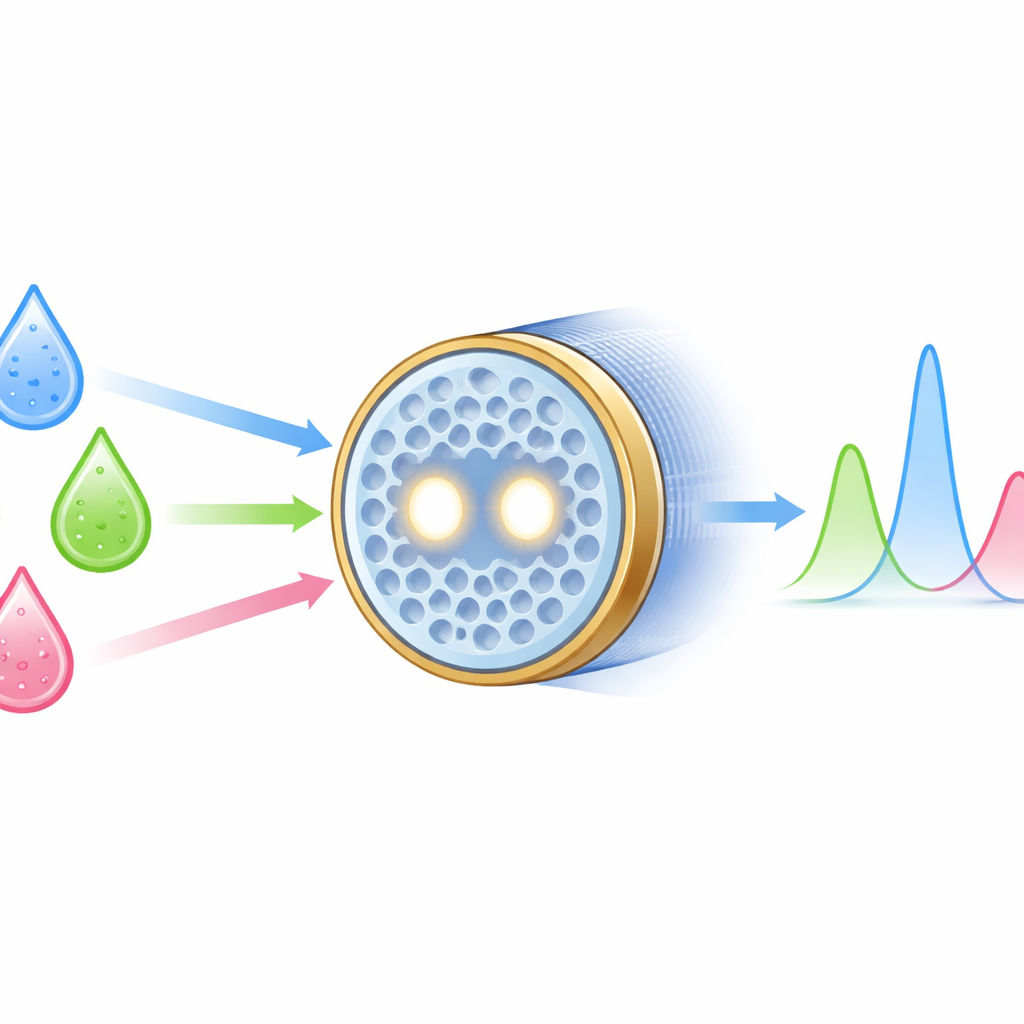
A New Kind of Glass Thread
At the heart of the device is a refined version of an optical fiber—the hair‑thin glass strands that carry internet data as pulses of light. Instead of being a simple solid cylinder, this “photonic crystal fiber” is drilled with a regular pattern of microscopic air holes around two central light‑guiding regions, called dual cores. This patterned structure gives engineers unusual control over how light moves through the fiber, letting them steer and concentrate light where it is most useful for sensing.
Gold, Graphene, and Dancing Electrons
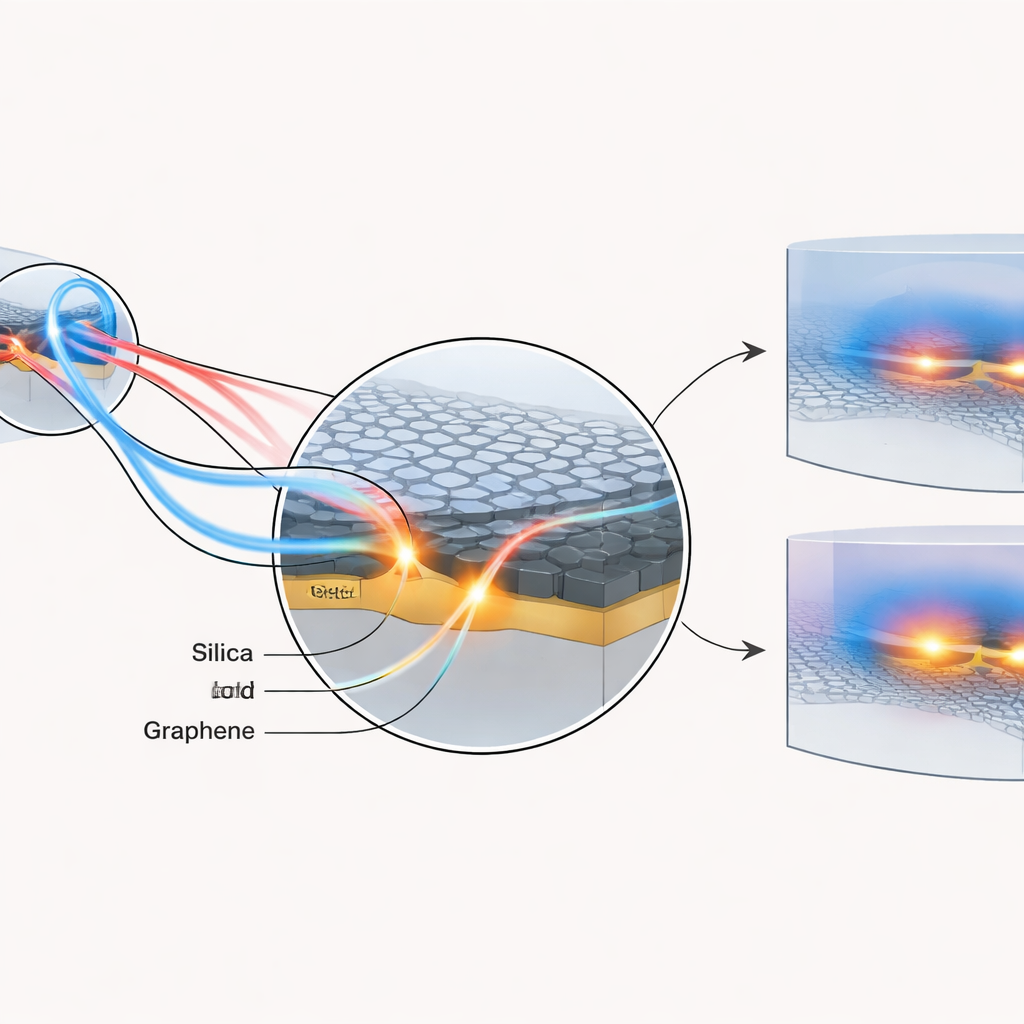
The sensing trick relies on a phenomenon called surface plasmon resonance, in which light couples to collective motions of electrons at a metal surface. The researchers coat the outer part of the fiber with a very thin ring of gold and then add an even thinner coating of graphene, a single‑atom‑thick form of carbon. When light traveling in the dual cores reaches the right conditions, energy leaks from the cores into these surface waves along the gold–graphene boundary. The strength and position of this resonance are extremely sensitive to how easily light passes through the surrounding liquid, a property tied directly to the liquid’s composition.
How Dual Cores and Graphene Boost Sensitivity
Using detailed computer simulations, the team shows that the two cores inside the fiber act together to create “super‑modes” of light—patterns where energy is either shared between the cores or pushed toward the gold–graphene layer. One of these patterns concentrates more light at the sensing surface, making the resonance sharper and more responsive to the sample. Graphene further amplifies this effect. Its strong electrical response reshapes the local electric field at the interface, pulls more light into the thin region where the liquid meets the metal, and offers an attractive surface where biomolecules can adhere. Together, these features make very small changes in the liquid’s properties cause large, measurable shifts in the resonance.
Following Color Shifts to Read Out Chemistry
The sensor’s performance is judged by how much the resonance wavelength—the color at which light is most strongly absorbed—moves when the liquid changes. For a range of refractive index values typical of blood serum, plasma, urine, saliva, and diluted blood (roughly 1.30 to 1.39 on the refractive index scale), the device achieves an impressive shift of up to 30,000 nanometers per unit change. In practical terms, that means a minute change in the fluid can still produce a clear shift in the resonance color that high‑quality optical instruments can track. The authors also fine‑tune the thickness of both the gold and graphene layers, finding an optimal combination that maximizes this color shift while keeping the signal sharp and stable.
From Simulations to Future Diagnostics
Because many medically important substances—such as glucose, urea, and early‑stage cancer markers—slightly alter a fluid’s refractive index, a sensor this responsive could one day serve as a compact “lab on a fiber.” In principle, a small sample placed on the fiber’s coated surface could be analyzed quickly, without needing fluorescent tags or complex chemistry, simply by monitoring how the resonance color moves. While the present work is based on simulations and still faces practical challenges—such as precise layer fabrication and handling polarization effects—it points toward highly sensitive, fast, and potentially portable tools for disease detection and routine health monitoring.
Citation: Maurya, V.C., Trabelsi, Y., Varshney, A.D. et al. Ultra-sensitive graphene–gold hybrid dual core photonic crystal fiber sensor based on surface plasmon resonance for bio-analyte detection. Sci Rep 16, 8478 (2026). https://doi.org/10.1038/s41598-025-33950-3
Keywords: graphene biosensor, photonic crystal fiber, surface plasmon resonance, optical biosensing, biomedical diagnostics