Clear Sky Science · en
Multi-sensor monitoring of a transient event in the Gran Sasso aquifer, Italy
When a Mountain Suddenly Booms
On a quiet August night in 2023, staff working deep inside Italy’s Gran Sasso underground laboratory heard a powerful, unexplained boom echo through the rock. Rather than dismiss it as a curiosity, scientists treated this “mountain bang” as a rare natural experiment, using an array of sensors to watch how water, rock, and even the Earth’s rotation itself responded. Their results show how closely a mountain’s hidden plumbing is tied to what we hear and feel at the surface.
A Hidden River Inside the Mountain
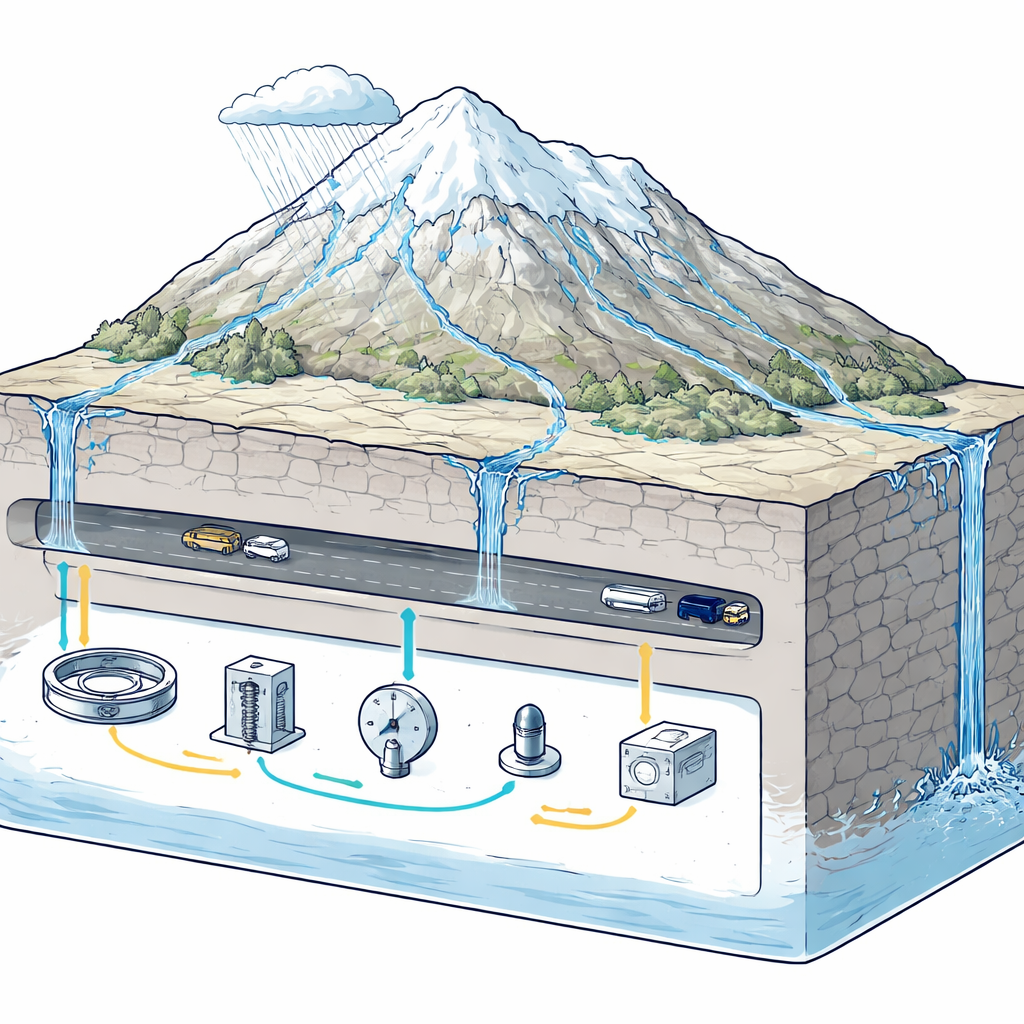
Gran Sasso is more than a dramatic peak in the central Apennines; it is also one of the largest underground water reservoirs in central-southern Italy. Rain and melting snow sink into fractured limestone high on the plateau, then travel through cracks and caves before emerging at large springs around the mountain’s base. This natural system was reshaped in the 1980s when two long highway tunnels and an underground physics laboratory were excavated, adding new pathways that tap into the aquifer and altering how water moves through the massif.
Watching Water, Rock, and Air All at Once
To keep track of this complex system, researchers monitor four key water outlets: two major spring areas on the southern side, drainage from the northern tunnel, and high‑pressure groundwater deep inside the tunnel near the laboratory. At these sites they record water level, temperature, electrical conductivity, and, for one site, water pressure 20 times a second. Above and within the mountain, weather stations log rainfall and snowfall. Underground, a network of instruments listens and feels: sensitive seismometers for ground shaking, accelerometers for strong jolts, a microphone for in‑air sound, and an unusual device called a ring laser gyroscope (nicknamed GINGERINO) that measures tiny twisting motions of the Earth’s crust.
Slow Build‑Up Before the Loud Night
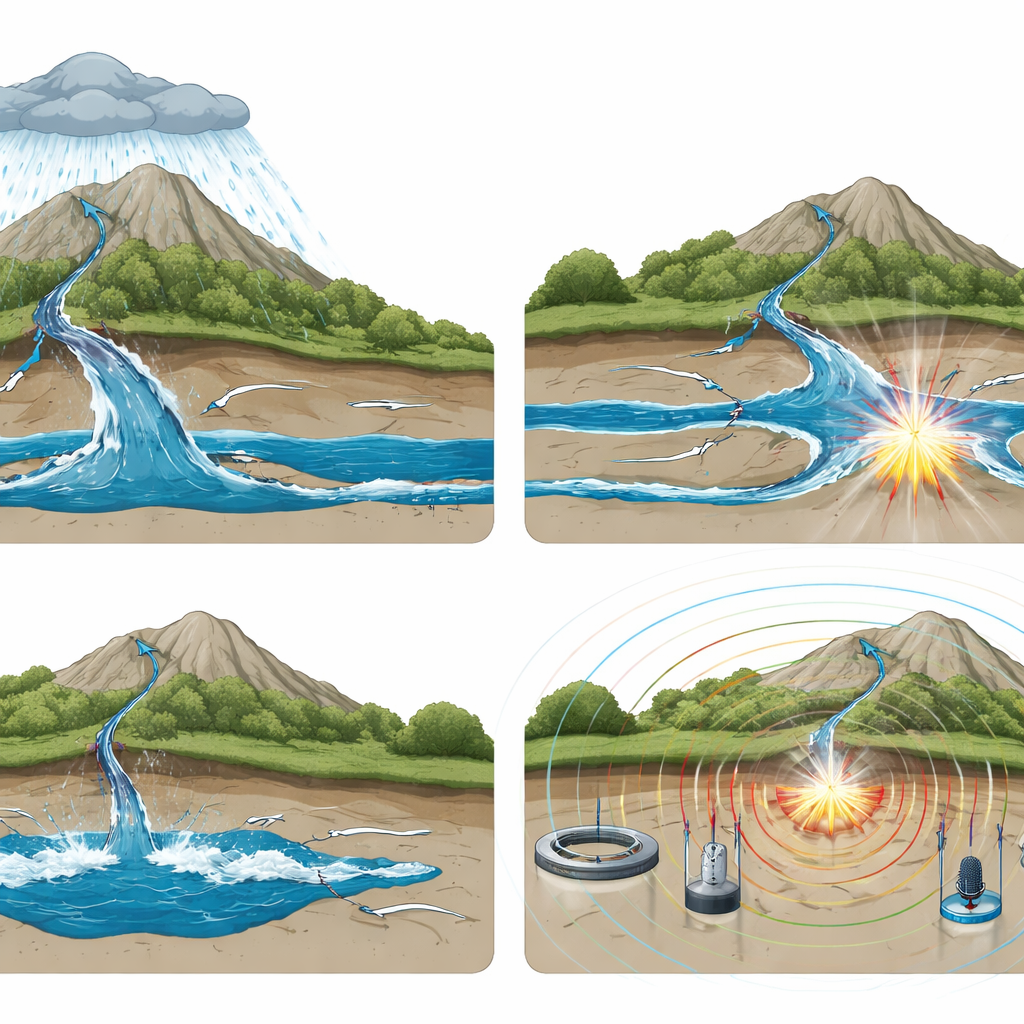
The story of the 2023 bang begins months earlier. Spring 2023 brought exceptionally heavy rain to the Gran Sasso plateau—among the wettest months recorded in more than a decade. Starting in May, one spring (Tempera) and the deep pressure sensor inside the tunnel both showed a rapid and steady rise in water level and pressure, while more distant outlets changed little. This pattern pointed to fast‑responding underground channels being activated near the mountain’s core, likely karst conduits—natural pipes dissolved in the rock. During the same period, the ring laser gyroscope began to show unusually noisy signals, as if the rock around it were experiencing stronger or more frequent subtle movements than usual, and water near the northern tunnel became noticeably murkier, suggesting disturbed flow paths.
The Moment the Mountain Spoke
On August 14, 2023, at 22:00 UTC, the mountain abruptly announced itself. A sharp, seconds‑long bang was heard inside the lab and captured simultaneously by many instruments. Seismometers and accelerometers recorded a short, strong pulse with a small earlier arrival, consistent with a burst in the rock followed almost immediately by sound waves traveling through the air in the tunnels. The gyroscope registered a dramatic spike in rotational motion, large enough to temporarily disrupt its laser, and its optical alignment shifted suddenly, indicating a strong mechanical disturbance. The microphone picked up sound across a wide range of frequencies, from low rumbles to higher tones. At nearly the same time, the deep pressure sensor inside the tunnel began a rapid drop—equivalent to losing about 70 centimeters of water head in roughly a day—followed by a slight increase in water discharge from the tunnel drainage a few days later.
What Likely Happened Underground
By lining up these independent clues in time and space, the authors argue that the bang was not a conventional earthquake, but a sudden re‑arrangement in the mountain’s water‑filled fracture network very close to the laboratory. The most plausible scenarios are that a fracture acting as a barrier suddenly slipped or opened, or that a previously clogged karst conduit was forced open by the unusually high water pressures. Either way, water likely surged into a new path, releasing pressure, stirring up sediment, and sending out a combined rock‑borne jolt and loud acoustic boom that all the instruments detected.
Why This Matters for Mountains and People
For non‑specialists, the work shows that mountains are not rigid monoliths but living systems where water, rock, and even tiny rotational motions are intertwined. The study demonstrates that combining traditional hydrogeology with cutting‑edge tools like ring laser gyroscopes can reveal slow buildup and sudden releases that would otherwise go unnoticed. Such events can subtly redirect groundwater flow, affect the safety and operation of tunnels and underground laboratories, and hint at ongoing geological adjustment inside the massif. By treating one startling noise as a multi‑sensor experiment, the researchers open a path to watching the inner life of mountains in real time.
Citation: Barberio, M.D., Basti, A., Braun, T. et al. Multi-sensor monitoring of a transient event in the Gran Sasso aquifer, Italy. Sci Rep 16, 8221 (2026). https://doi.org/10.1038/s41598-025-33923-6
Keywords: Gran Sasso aquifer, mountain bang, ring laser gyroscope, karst groundwater, multi-sensor monitoring