Clear Sky Science · en
A novel approach to silver nanoparticle biosynthesis using ursolic acid from Catharanthus roseus for therapeutic effects
Why Tiny Silver Particles Matter for Health
Antibiotic-resistant infections and cancer are two of today’s biggest medical challenges, and many current drugs come with serious side effects. This study explores a “green” way to make ultra-small silver particles using a natural compound from the ornamental and medicinal plant Catharanthus roseus. These plant-made particles show promise as a dual-action tool: they can kill harmful bacteria, slow cancer cell growth, and calm inflammation, while aiming to be safer for healthy cells and the environment.
Turning a Garden Plant into a Healing Tool
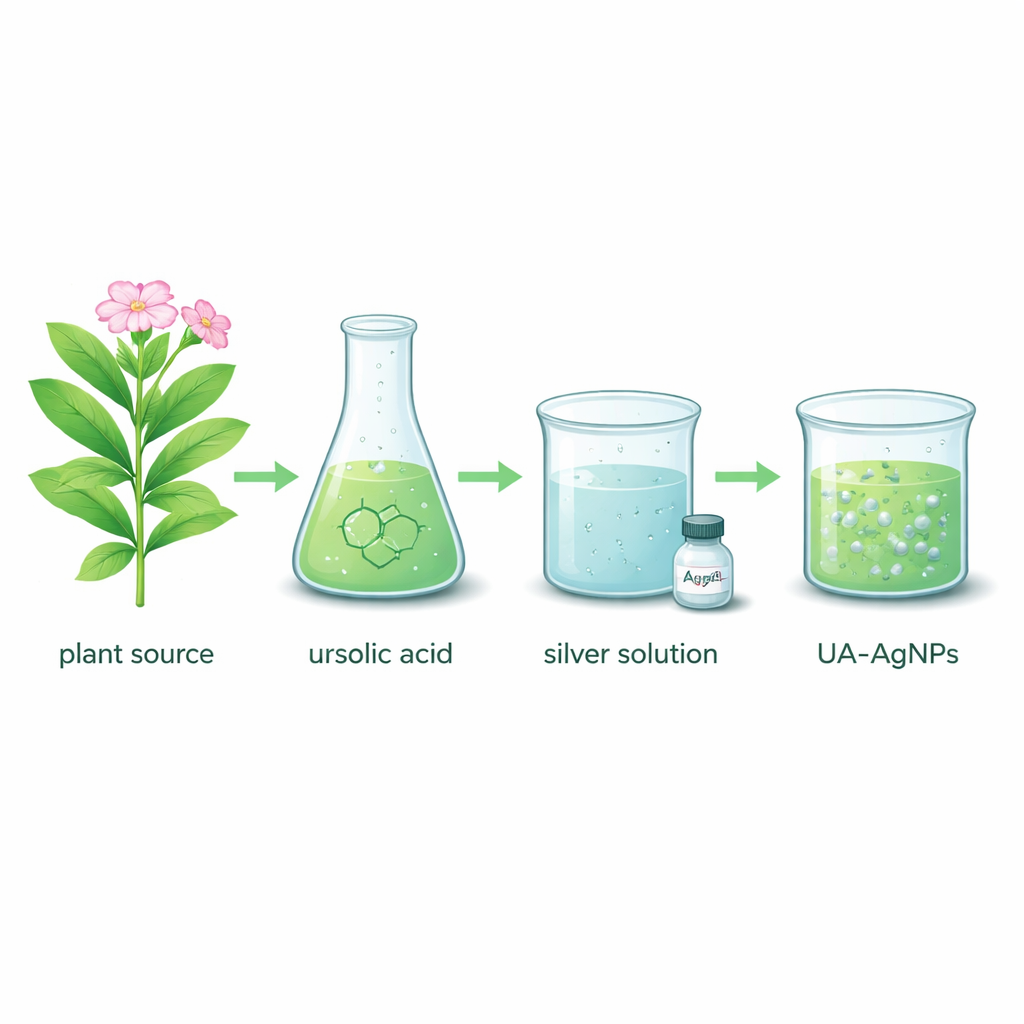
Catharanthus roseus is best known for providing ingredients used in cancer drugs, but its leaves also contain a natural molecule called ursolic acid. The researchers purified this single compound and used it to make silver nanoparticles—tiny spheres of silver only billionths of a meter across. Ursolic acid acts both as a “reducing agent,” turning silver ions into solid silver, and as a “coat” that helps keep the particles stable and water-friendly. This approach avoids harsh chemicals and high-energy processes, fitting into a broader effort to create cleaner, more sustainable nanomaterials for medicine.
How the New Particles Were Made and Examined
To produce the particles, the team mixed a solution of ursolic acid with a mild silver salt and gently heated the mixture. The liquid changed from pale yellow to dark brown, a visual sign that nanoparticles had formed. Advanced instruments then confirmed what the eye could not see. Light absorption tests showed a signature peak typical of silver nanoparticles. X-ray measurements revealed that the particles were crystalline and about 15 nanometers across on average. Electron microscopy images showed mostly round shapes with some mild clumping, while other tests indicated that the ursolic acid coating and surrounding water layer made the particles appear larger in liquid but also helped them remain dispersed and stable—important for any future medical use.
Stopping Bacteria and Their Protective Films
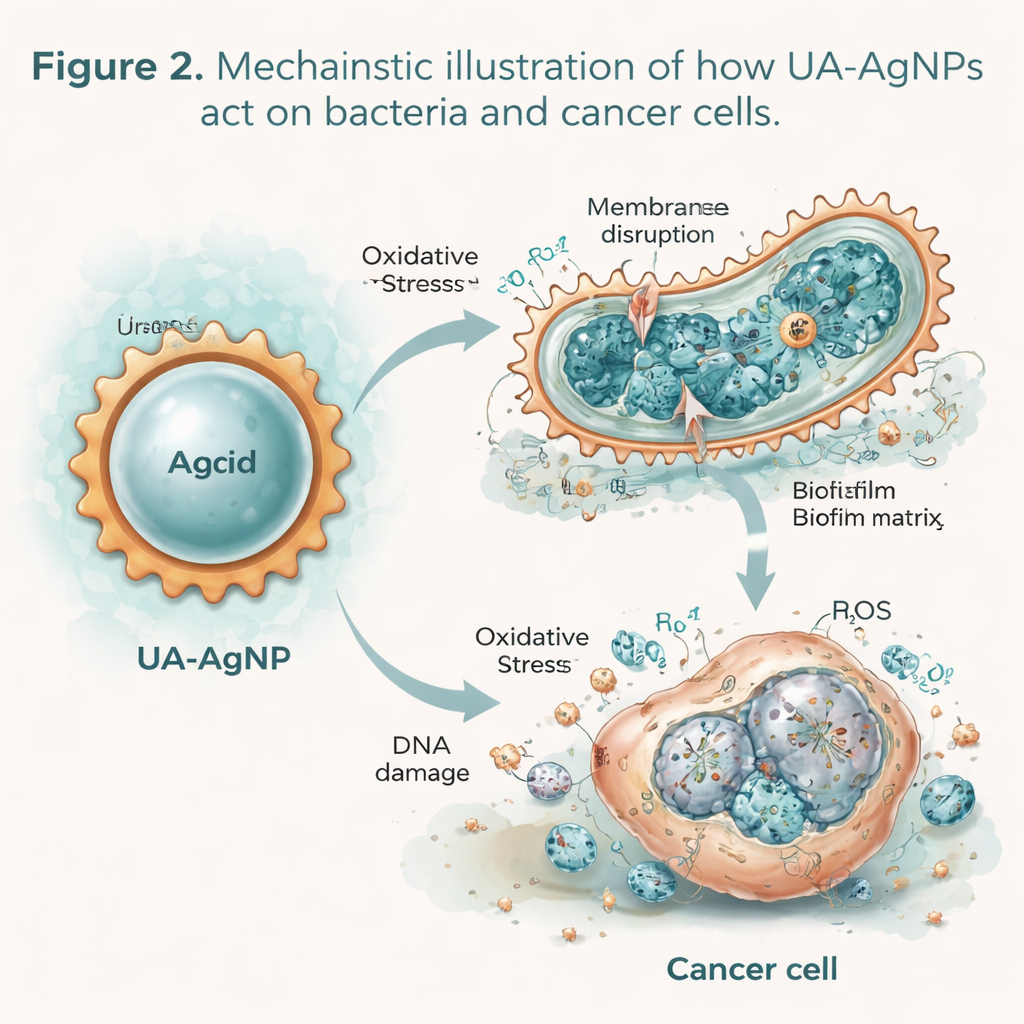
The ursolic-acid-coated silver particles were tested against several common disease-causing bacteria, including Bacillus cereus and Pseudomonas aeruginosa. In lab dishes, the nanoparticles produced clear zones where bacteria could not grow, often matching or approaching the performance of standard antibiotics. They were effective at surprisingly low doses and could actually kill the bacteria, not just slow them down. Importantly, the particles also disrupted biofilms—slimy, protective layers that bacteria build on surfaces such as medical devices and wounds. The nanoparticles reduced biofilm formation by more than half and interfered with the bacteria’s ability to swim and swarm, behaviors linked to infection spread and persistence.
Fighting Oxidative Stress and Cancer Cells
Beyond their germ-killing power, the nanoparticles acted as strong defenders against oxidative stress, a form of molecular damage tied to aging and many diseases. In chemical tests, they neutralized harmful free radicals, and in experiments with yeast cells, they helped cells survive exposure to damaging hydrogen peroxide. When tested on human cervical cancer cells (HeLa), the particles slowed cell growth and triggered signs of programmed cell death, while showing relatively lower harm to normal kidney-derived Vero cells at similar doses. The researchers also found that the particles reduced production of nitric oxide, a signaling molecule that, in excess, fuels inflammation. Computer modeling suggested that the silver component can latch onto key bacterial and cancer-related proteins, offering clues to how these broad effects might arise at the molecular level.
What This Could Mean for Future Treatments
In simple terms, this work shows that a common garden plant can help create tiny silver spheres that act like a Swiss Army knife: they attack bacteria, weaken stubborn biofilms, calm inflammatory signals, and put pressure on cancer cells, all while aiming to spare healthy cells as much as possible. The study is still at an early, laboratory-focused stage, so these particles are far from ready-made medicines. However, their combined antibacterial, anticancer, antioxidant, and anti-inflammatory actions—achieved through a greener manufacturing route—suggest they could form the basis of future coatings for medical devices, wound dressings, or drug-delivery systems designed to work with the body rather than against it.
Citation: Raguvaran, K., Kamatchi, P.A.C., Handayani, M. et al. A novel approach to silver nanoparticle biosynthesis using ursolic acid from Catharanthus roseus for therapeutic effects. Sci Rep 16, 6377 (2026). https://doi.org/10.1038/s41598-025-33908-5
Keywords: green nanotechnology, silver nanoparticles, medicinal plants, antibacterial therapy, nanomedicine