Clear Sky Science · en
Contrasting patterns in kelp consumption across latitude by two barren forming sea urchin species
Why these spiny grazers matter for our coasts
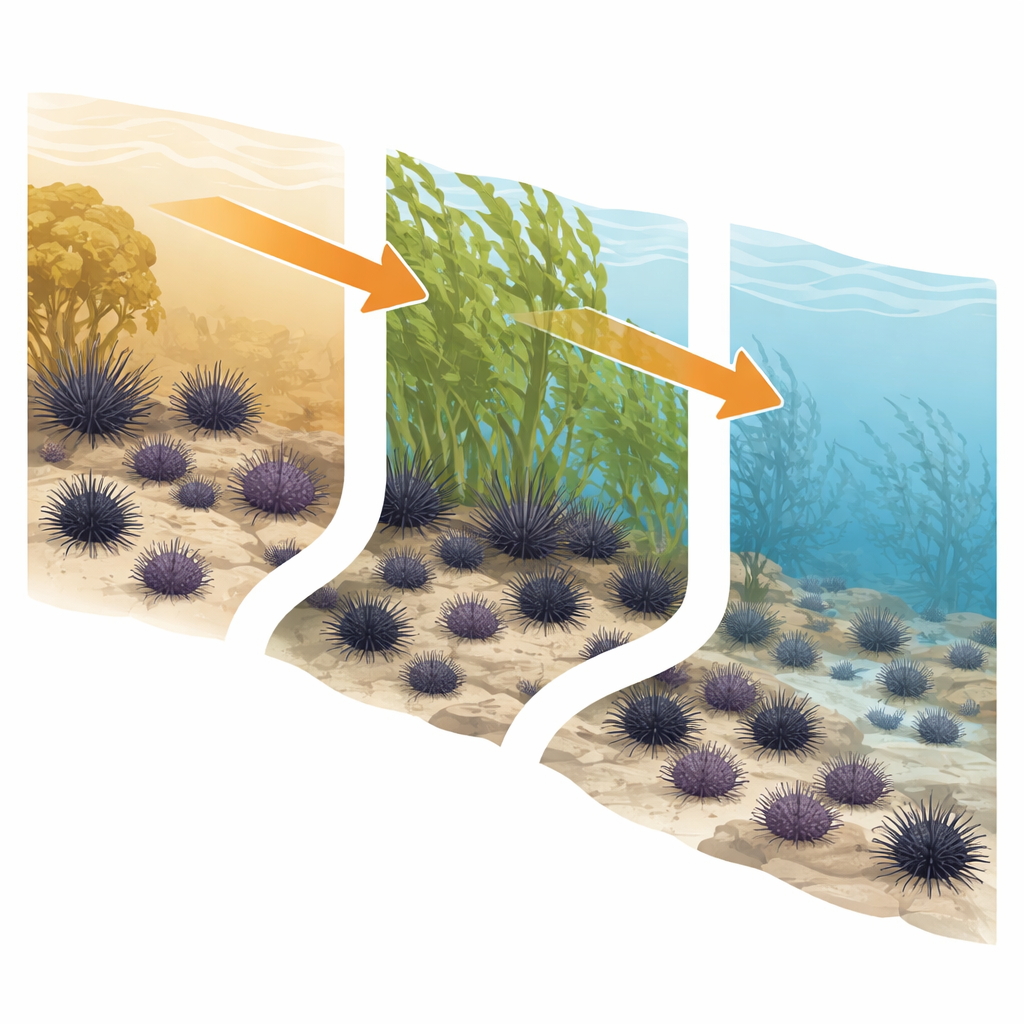
Kelp forests are the underwater equivalents of rainforests, sheltering fish, feeding countless creatures and buffering coasts from waves. Along southern Australia, however, two species of sea urchins can graze these forests down to bare rock. This study asks a simple but crucial question: as the ocean warms and species shift their ranges, how will the feeding of these urchins change, and what will that mean for the future of kelp forests?
Two urchins, one coastline, different stories
The researchers focused on two common kelp‑eating urchins: a long‑spined species that has recently expanded its range southward into cooler Tasmanian waters, and a short‑spined species that has long occupied much of temperate Australia. Both can create extensive "barrens" where kelp once thrived, but they differ in their preferred temperatures and in how far their larvae can drift. By comparing these urchins across 12 degrees of latitude and over nearly two years at one cool southern site, the team set out to see how climate and local conditions shape their appetite for kelp.
Measuring hunger in the wild
To track feeding in real reef conditions, divers collected individual urchins and placed them into small underwater cages, each supplied with fresh blades of the dominant local kelp. After several days on the seafloor, the scientists weighed how much kelp remained, corrected for natural changes in kelp weight and calculated how much each urchin had eaten. They also measured the size and body condition of every urchin, including how full its digestive tract was and how much energy it had invested in reproductive organs. At the same time, they sampled kelp tissue to gauge its nitrogen content, a key indicator of food quality, and compiled long‑term records of water temperature and urchin abundance along the coast.
Where and when grazing hits hardest
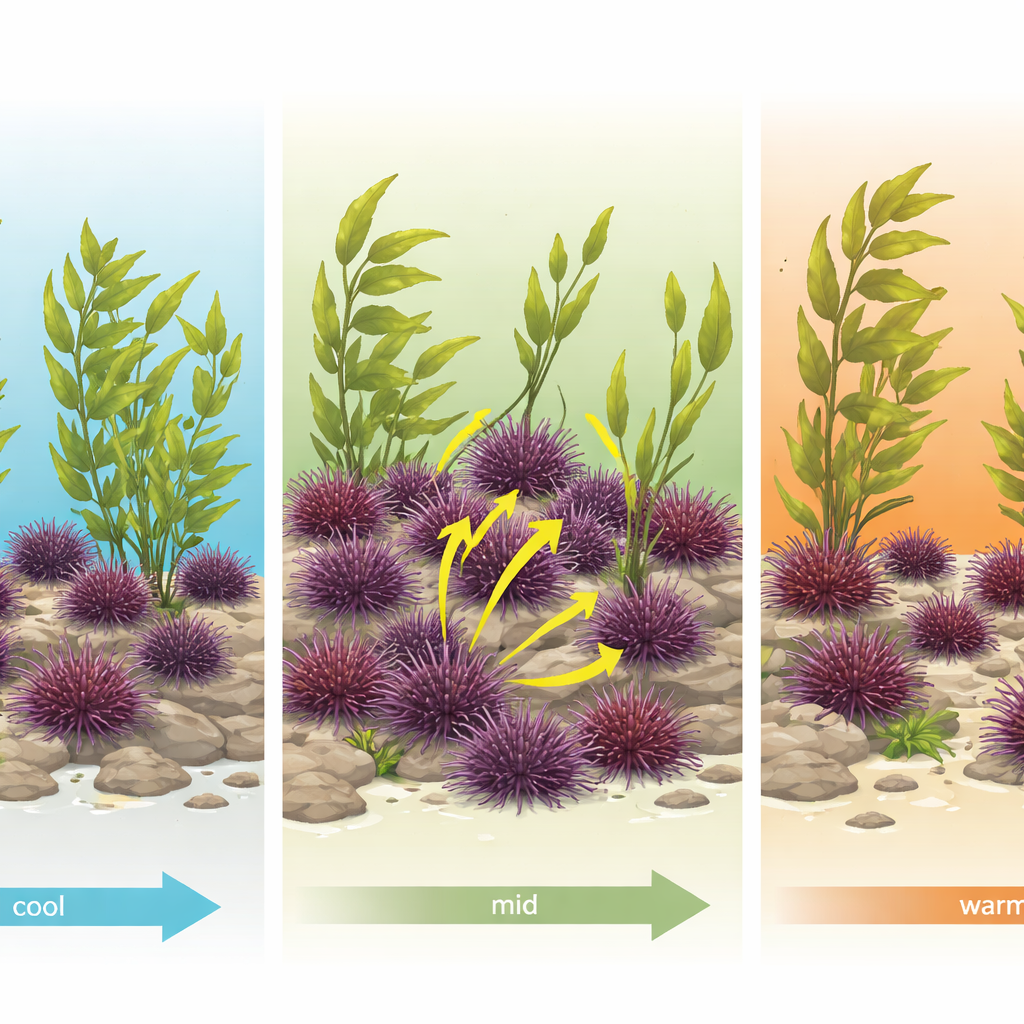
The long‑spined urchin showed a strong geographic pattern. Its per‑animal grazing was highest in the middle of its range, where waters are neither the warmest nor the coldest, and declined towards both the tropical and cool extremes. This hump‑shaped pattern mirrors what biologists call a thermal performance curve: performance rising toward an optimum temperature then dropping off under heat or cold stress. In these mid‑latitude regions, not only did individual urchins eat more kelp, they were also most abundant, combining to create the strongest overall grazing pressure and the greatest risk of kelp loss.
Different rules for a resident grazer
The short‑spined urchin told a different tale. Its average grazing rate stayed similar from warm to cool sites, even though temperatures varied by about 8 °C. Instead of temperature, its feeding was more closely tied to internal condition and kelp quality. Individuals with lower investment in reproductive tissue tended to eat more, and seasonal analyses showed that this species increased feeding when its energy stores were low, regardless of modest shifts in temperature. Kelp nitrogen levels also influenced patterns, hinting that this urchin may adjust how much it eats to compensate for leaner, less nutritious kelp rather than simply responding to warmer water.
What a warmer ocean could bring
Together, these findings suggest that the two urchins occupy different “comfort zones” along the temperature gradient. The long‑spined urchin appears to have a relatively fixed thermal sweet spot, with feeding and numbers peaking where temperatures are just right; as coastal waters warm, that sweet spot—and the zone of most intense kelp loss—is likely to shift farther south. By contrast, the short‑spined urchin seems more finely tuned to local conditions at each site, with similar grazing pressure across its range and a more even sensitivity to warming. For coastal managers, this means efforts to protect kelp forests in southern Australia will need to focus on curbing long‑spined urchin impacts at the cool edge of their expanding range, while tracking how short‑spined populations cope with rising temperatures. In simple terms: as the ocean heats up, one urchin is poised to push kelp forests harder in new places, while the other remains a steady, if still important, grazer across the entire coastline.
Citation: Butler, C., Wang, Y., Brown, C.J. et al. Contrasting patterns in kelp consumption across latitude by two barren forming sea urchin species. Sci Rep 16, 9069 (2026). https://doi.org/10.1038/s41598-025-33714-z
Keywords: kelp forests, sea urchins, climate warming, marine herbivory, temperate reefs