Clear Sky Science · en
Towards greener construction: a comprehensive evaluation of eco-friendly UHPC reinforced with hybrid fibers
Building stronger, greener structures
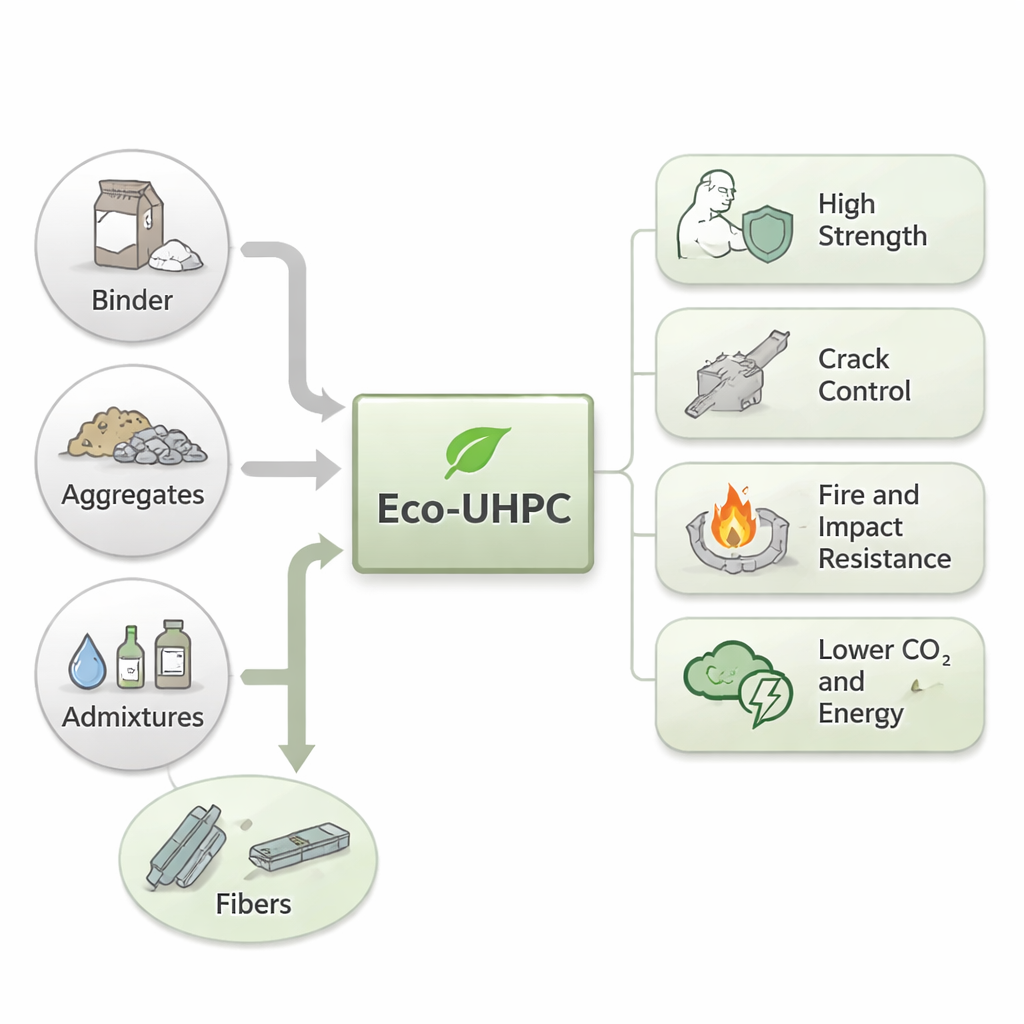
Concrete is the backbone of modern cities, but making it releases huge amounts of carbon dioxide. Ultra-high-performance concrete (UHPC) is an especially strong and durable version used in bridges, towers, and other critical structures—but it usually contains so much cement that it is far from eco‑friendly. This study explores how to redesign UHPC so it uses less cement and a smarter mix of tiny fibers, creating concrete that is both greener and tougher where it matters most: resisting cracks, impacts, and fire.
What makes this concrete different
Traditional UHPC often uses about 1000 kilograms of cement per cubic meter, which carries a heavy environmental cost. The researchers cut that cement content to 700 kilograms and replaced part of it with finely ground industrial by‑products such as silica fume and metakaolin. These powders pack tightly between sand grains and cement, filling microscopic voids and helping the material harden into a dense, stone‑like mass. To fight UHPC’s natural brittleness, they added two types of short fibers: stiff steel fibers and light, plastic‑like polypropylene fibers. The fibers were used alone and in combinations, always keeping the total fiber volume at 3%, to see which blend gave the best balance of strength, toughness, and sustainability.
How tiny fibers tame cracks
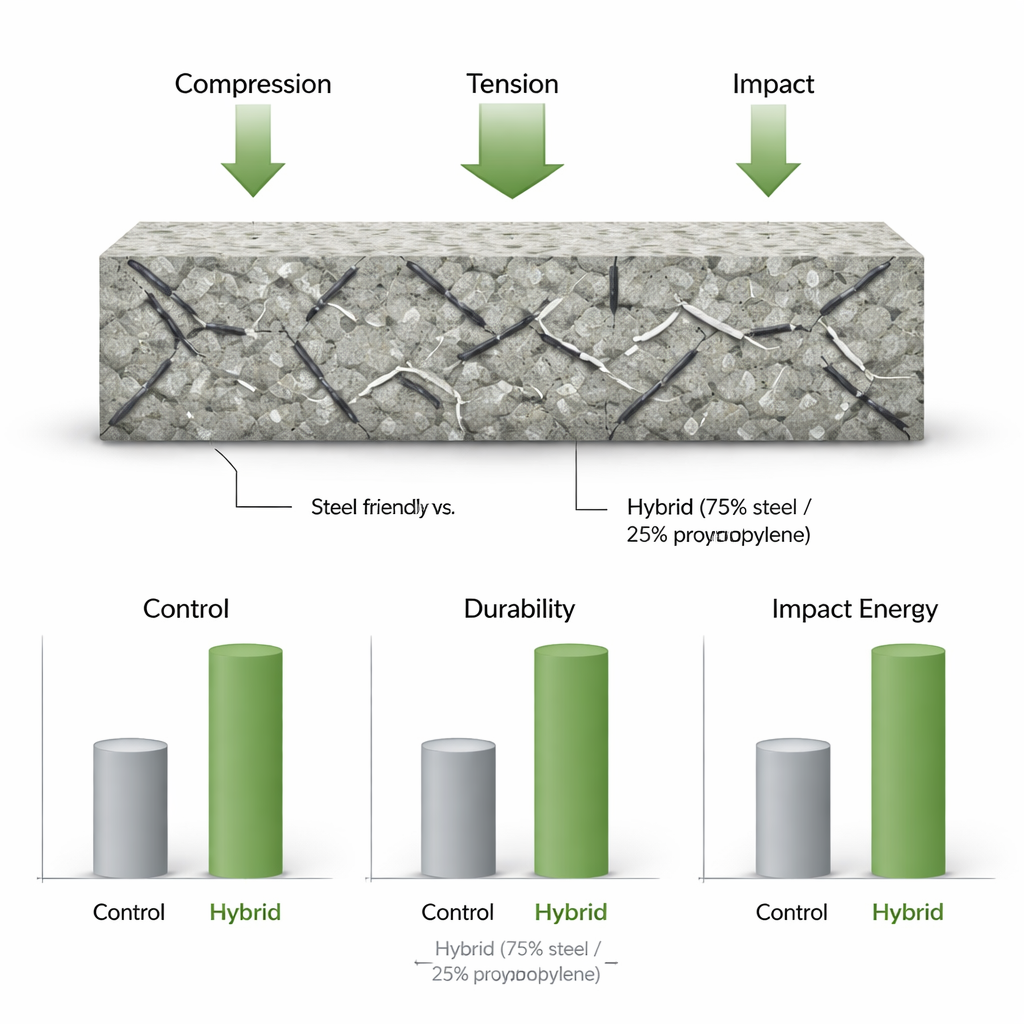
Concrete fails when tiny cracks grow into big ones. In this study, steel fibers acted like miniature reinforcing bars, bridging wider cracks and carrying loads after the concrete itself had started to fracture. Polypropylene fibers, which are much thinner and lighter, excelled at controlling very fine, early‑age cracks and at creating paths for steam to escape under high heat, which helps prevent explosive spalling in fires. When combined, the two fiber types created a three‑dimensional mesh within the concrete that delayed the start of cracking, slowed crack growth, and allowed the material to absorb much more energy under impact. The standout recipe contained 0.75% steel fibers and 0.25% polypropylene fibers, by volume.
Strength, toughness, and durability in numbers
The hybrid mix with 0.75% steel and 0.25% polypropylene fibers reached about 155 megapascals in compressive strength—well over typical structural concrete—and slightly outperformed the mix with 3% steel fibers alone. It also achieved the highest tensile and bending strengths, meaning it could carry greater pulling and bending forces before cracking. In impact tests using a repeatedly dropped weight, this hybrid concrete withstood many more blows before first cracking and final failure, absorbing up to 47% more kinetic energy than the steel‑only mix. Durability tests showed that the same hybrid blend had the lowest porosity and water absorption, both key indicators of long service life because they limit the movement of water and salts that can damage concrete and embedded steel.
Behavior under fire and in the microscope
Fire tests revealed how the fibers change what happens when the concrete is heated. At moderate temperatures (around 200 °C), all mixes briefly gained strength as remaining water dried out, but at 400 °C and above, the cement structure began to weaken. Mixes with steel fibers held together better at these higher temperatures, while polypropylene fibers melted and left tiny channels that relieved internal steam pressure and reduced violent surface bursting. Microscopic imaging confirmed that mixes rich in steel fibers had a denser internal structure with fewer pores and better bonding between fibers and the surrounding material. In contrast, mixes dominated by polypropylene showed more tiny voids around the fibers, which helped flexibility but slightly reduced strength and tightness.
Greener concrete by design
Because cement production is energy‑intensive and carbon‑heavy, lowering its content is crucial for cleaner construction. The low‑cement UHPC developed in this work, together with the use of industrial by‑product powders, reduced both energy use and carbon emissions compared with typical UHPC. A life‑cycle assessment showed that the plain (no‑fiber) mix and the mix with only polypropylene fibers were especially attractive from a cost and emissions perspective, while hybrid mixes like the 0.75% steel / 0.25% polypropylene blend offered an excellent compromise: very high mechanical performance and durability with much lower environmental impact than conventional UHPC. For non‑specialists, the key takeaway is that by carefully tuning the type and amount of tiny fibers and replacing part of the cement with waste‑derived powders, engineers can design concretes that are not only stronger and safer under impact and fire, but also significantly kinder to the planet.
Citation: AL-Tam, S.M., Youssf, O., Mahmoud, M.H. et al. Towards greener construction: a comprehensive evaluation of eco-friendly UHPC reinforced with hybrid fibers. Sci Rep 16, 7196 (2026). https://doi.org/10.1038/s41598-025-33711-2
Keywords: green concrete, ultra high performance concrete, fiber reinforced concrete, sustainable construction, low carbon materials