Clear Sky Science · en
A quantum-driven multi-objective scheduler for scalable task orchestration in fog-based cyber-physical-social systems
Smarter computing at the edge of the network
From smart watches and connected cars to city-wide sensor grids, our daily lives increasingly depend on millions of tiny devices that must react in real time. This paper explores how to coordinate all that digital activity more quickly, cheaply, and with less energy use by rethinking how tasks are scheduled on the “fog” of small servers sitting between our gadgets and distant cloud data centers.
Why the cloud alone is not enough
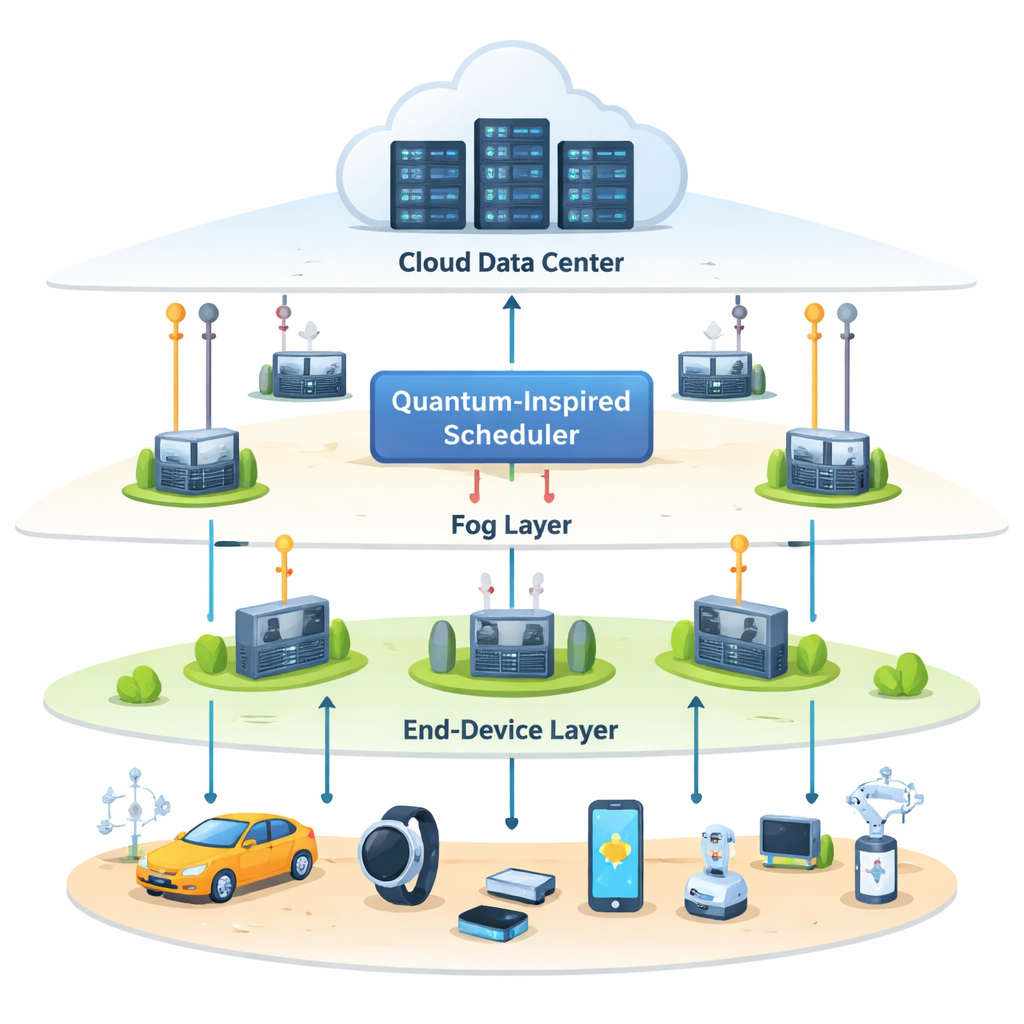
Modern cyber-physical-social systems blend physical sensors, computer networks, and human behavior. Examples include smart transportation, remote health monitoring, and industrial automation. In these settings, data must often be processed in milliseconds; relying only on faraway cloud servers can introduce delays, congestion, and service interruptions. Fog computing addresses this by placing computing nodes closer to users—on roadside units, base stations, and local gateways. However, deciding which fog node should handle which task is far from trivial. Each decision affects how long users wait, how much providers pay for resources and penalties, and how much electricity the overall system consumes.
The challenge of juggling time, money, and energy
Task scheduling in fog environments is what computer scientists call an NP-hard problem: as the number of devices and jobs grows, the number of possible assignments explodes. Existing schedulers based on swarm intelligence, reinforcement learning, or classic evolutionary algorithms can juggle two goals, such as time and cost, but they often struggle when a third factor—energy efficiency—is added, or when thousands of tasks arrive from highly mobile, socially driven users. These methods may converge slowly, get stuck in local optima, or produce a limited set of trade-off options, making it difficult to run large, realistic deployments.
Borrowing ideas from quantum physics—without a quantum computer
The authors propose FOG-QIEA, a new scheduling framework that is “quantum-inspired” but runs entirely on ordinary processors. Instead of using real qubits, the algorithm encodes each possible task-to-node assignment as a probabilistic vector that mimics quantum superposition: many possibilities are represented at once. Specialized update rules, likened to rotation gates and entanglement, adjust these probabilities in a coordinated way, helping the search explore widely at first and then home in on promising regions of the solution space. A neighborhood strategy further refines groups of related solutions so that the final set of schedules offers balanced trade-offs among three objectives: total execution time, overall monetary cost (including penalties for missed deadlines), and total energy consumption across fog nodes.
Putting the new scheduler to the test
To evaluate FOG-QIEA, the authors simulate realistic smart-city style scenarios using the iFogSim toolkit, modeling hundreds to thousands of Internet of Things tasks flowing through a three-layer architecture of end devices, fog nodes, and cloud servers. They compare their approach with well-known evolutionary algorithms like NSGA-II, newer swarm-based and learning-based schedulers, and other quantum-inspired techniques. Across many runs and task sizes, FOG-QIEA converges to high-quality solutions 20–35% faster, cuts energy use by roughly 15–25%, and lowers total cost and service-level violations compared with competing methods. It also maintains a richer “Pareto front”—a more diverse set of best-compromise options—so system operators can choose schedules that emphasize speed, savings, or sustainability as needed.
What this means for future connected societies
For non-specialists, the key message is that borrowing concepts from quantum mechanics can make today’s classical computers manage complex networks more intelligently. FOG-QIEA shows that by representing many scheduling choices at once and updating them in a coordinated, probability-driven manner, fog-based systems can serve more users more reliably while consuming less power. This makes large-scale smart city, healthcare, and transportation services more practical and environmentally friendly today, and lays groundwork for future hybrid systems that may one day combine such algorithms with real quantum hardware.
Citation: Hammouda, N.G., Shalaby, M., Alfilh, R.H.C. et al. A quantum-driven multi-objective scheduler for scalable task orchestration in fog-based cyber-physical-social systems. Sci Rep 16, 6874 (2026). https://doi.org/10.1038/s41598-025-33627-x
Keywords: fog computing, task scheduling, quantum-inspired algorithms, smart cities, energy-efficient computing