Clear Sky Science · en
Unmasking inequalities in gastrointestinal cancer outcomes among Asian American subpopulations
Why this study matters to everyday families
Cancers of the digestive system are among the world’s deadliest, yet they are often treatable when caught early. In the United States, more than 24 million people identify as Asian American, representing many different cultures and histories. Despite this diversity, health statistics usually treat Asian Americans as one uniform group. This study asks a simple but urgent question: when we look more closely at specific Asian American communities, are some facing much higher risks of dying from gastrointestinal (GI) cancers than others—and than White Americans? The answer, the authors find, is yes, with important consequences for screening, prevention, and access to care.

Looking beyond a single label
The researchers used a national database of death records from 2018 to 2023, maintained by the Centers for Disease Control and Prevention. Crucially, this database recently began separating Asian American data into subgroups such as Indian American, Chinese, Filipino, Japanese, Korean, and Vietnamese, instead of lumping everyone into a single “Asian” category. The team focused on adults and counted deaths from all causes and from GI cancers, including cancers of the esophagus, stomach, small intestine, colon, rectum, anus, liver and bile ducts (hepatobiliary), and pancreas. Rather than estimating raw cancer risk, they calculated “proportional mortality” for each cancer—what share of all deaths in a group was due to that particular type of cancer—and compared those shares between Asian American subpopulations and non-Hispanic White Americans.
Unequal burdens within Asian America
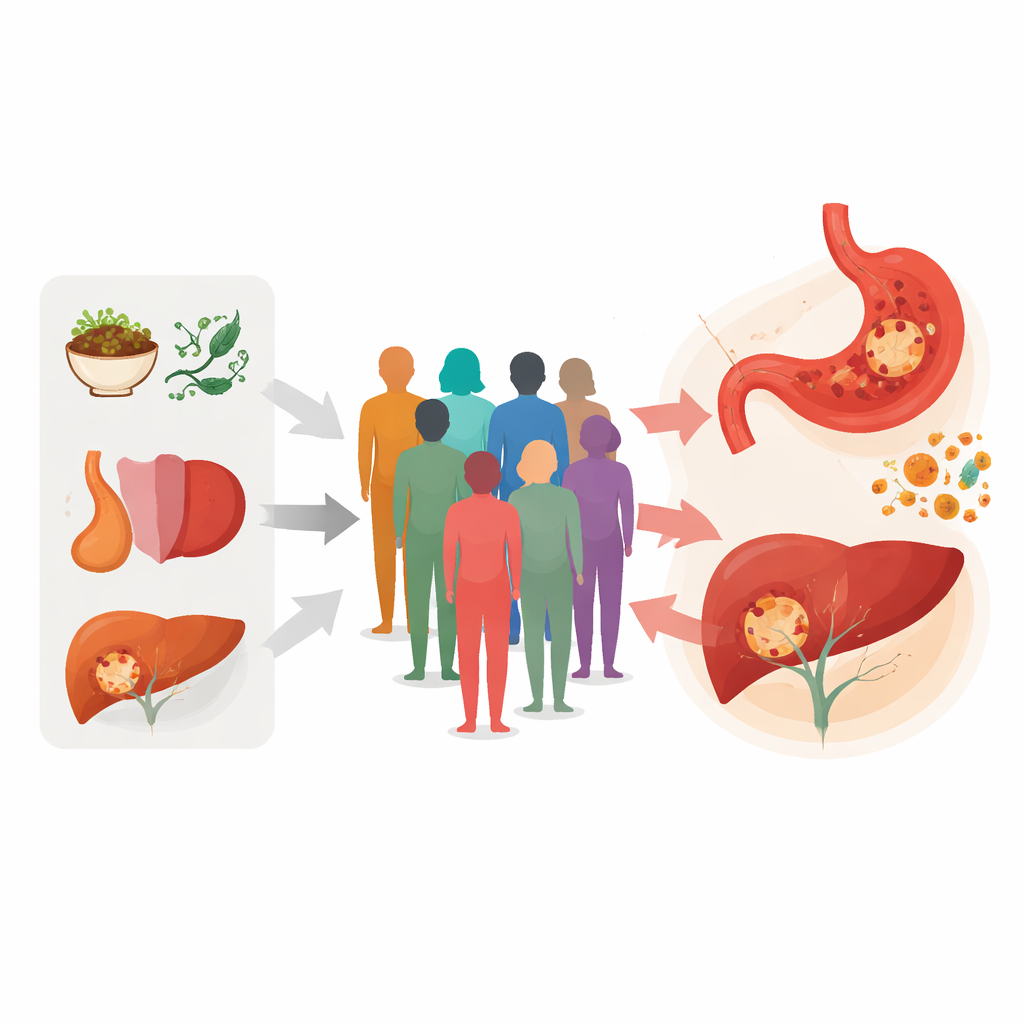
Across the six-year period, GI cancers made up a larger slice of deaths for Asian Americans than for White Americans: 8.0% versus 5.1%. But this headline number hides even more striking contrasts among Asian American communities themselves. Koreans had the highest proportion of deaths from GI cancers (about 11%), followed by Vietnamese and Chinese individuals, while Indian Americans had the lowest, roughly similar to White Americans. Two cancer types stood out as major drivers of these differences: stomach cancer and hepatobiliary cancers. For both men and women, Asian Americans had roughly two to three times the proportional mortality from these cancers compared with White patients, with the largest gaps seen in Korean, Chinese, and Vietnamese groups across all age ranges.
Different patterns for men and women, young and old
When the researchers looked separately at women and men and divided them into age groups (18–44, 45–64, and 65 and older), the picture remained consistent but became more detailed. Among women in every Asian American subgroup, GI cancers as a whole accounted for a higher share of deaths than among White women of the same age. Stomach cancer was especially prominent: young and middle-aged Chinese, Vietnamese, and Korean women had many times the proportional mortality from stomach cancer seen in their White peers, and older Korean, Chinese, and Japanese women also showed large gaps. Hepatobiliary cancers were another major concern across nearly all female subgroups, especially in middle-aged and older women. In contrast, anal cancer was the only GI cancer for which Asian American women in all subgroups had a lower proportional mortality than White women.
Men face similar, and sometimes greater, risks
Patterns among men echoed those among women, with some differences in which cancers dominated at different ages. Across nearly all Asian American male subgroups, GI cancers made up a larger share of deaths than among White men; again, Indian American men were a notable exception, showing lower proportional mortality overall. For younger Asian American men, hepatobiliary cancers were especially prominent in Chinese, Vietnamese, and Korean groups, while stomach cancer became the main source of disparity in middle-aged and older men. Colon and rectal cancers also contributed to higher proportional mortality in many subgroups of older men compared to their White counterparts. As with women, anal cancer stood out as the one GI cancer where Asian American men had lower proportional mortality than White men.
What may be driving these differences
The authors discuss several possible reasons why some Asian American communities shoulder a greater burden of GI cancer deaths. Diets that include frequent salty or pickled foods, such as traditional fermented dishes, have been tied to higher rates of stomach cancer and may influence patterns among Korean and other East Asian groups. Infections common in parts of Asia, including Helicobacter pylori (linked to stomach cancer) and hepatitis B and C (linked to liver and bile duct cancers), may also play a role for immigrants or those with close ties to their countries of origin. Meanwhile, many Asian Americans face barriers such as language differences, limited health literacy, immigration-related stress, and lower access to screening and early treatment, particularly in Southeast Asian communities. By contrast, Indian Americans as a group often have higher socioeconomic status, which may translate into better access to preventive care and more favorable outcomes.
Why tailored care can save lives
For non-specialists, the key message is that “Asian American” is not a single health story. The study shows that certain communities—especially Chinese, Korean, and Vietnamese men and women—are far more likely to die from stomach and hepatobiliary cancers than White Americans and than some other Asian American groups. Because these cancers can be more effectively treated when found early, the findings argue strongly for prevention and screening strategies that are tuned to each community’s unique risk profile, culture, and barriers to care. That could mean earlier or more frequent stomach or liver cancer checks for specific subgroups, culturally sensitive discussions about diet and infection risks, and public health efforts to reduce language and access hurdles. Recognizing these hidden differences is a crucial first step toward more equitable cancer outcomes.
Citation: Wang, C.C., Ali, D., Habib, D.R.S. et al. Unmasking inequalities in gastrointestinal cancer outcomes among Asian American subpopulations. Sci Rep 16, 8213 (2026). https://doi.org/10.1038/s41598-025-33389-6
Keywords: Asian American health, gastrointestinal cancer, cancer disparities, stomach and liver cancer, culturally tailored screening