Clear Sky Science · en
Exploration of electrospinning hemp/polyacrylonitrile composite fiber membrane and dye adsorption capabilities
Turning Dirty Dye Water into a Cleaner Resource
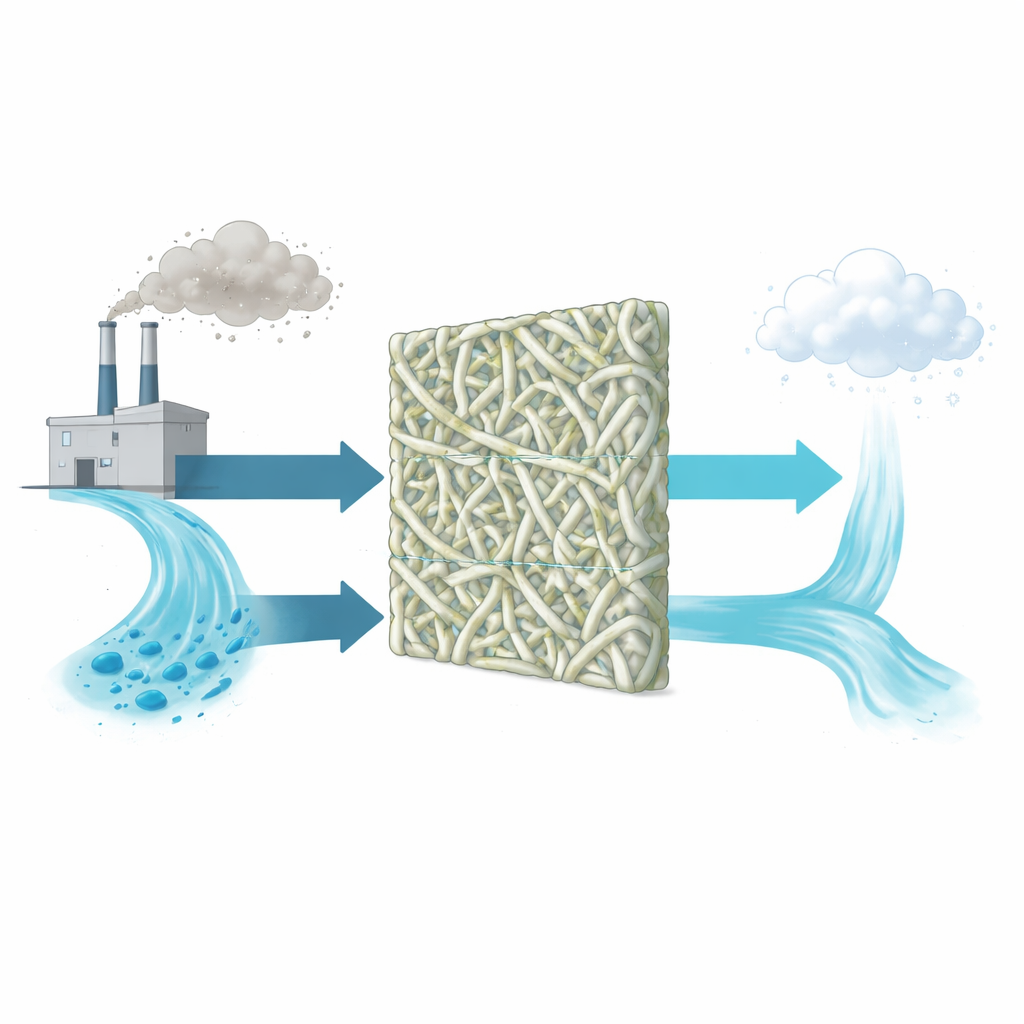
Clothing brings color to our lives, but the dyes used to make bright fabrics often leave behind highly polluted water and dusty air in factories. This study explores a new kind of thin, fabric-like filter made from hemp and a common industrial plastic that can both clean dye-filled wastewater and trap fine airborne particles. Because it uses a renewable plant material and a relatively simple manufacturing method, it points toward more sustainable ways to manage pollution from the textile industry.
Why Fabric Dyes Are Hard to Clean Up
Wastewater from textile mills is a challenging cocktail: it can be hot, strongly colored, and rich in chemicals that are slow to break down. One widely used dye, methylene blue, is especially stubborn and can harm human health if it reaches rivers or drinking water. Traditional treatment methods can be complex or expensive. Simple adsorption filters—materials that grab and hold pollutants on their surfaces—are attractive because they are easy to operate and can be retrofitted into existing plants. The authors set out to design a filter that is not only effective at capturing dye, but also made from greener ingredients and useful for more than one type of pollution.
Building a Plant-Based High-Tech Filter
The researchers combined hemp, a fast-growing agricultural crop rich in cellulose, with polyacrylonitrile, a strong, stable polymer already common in textiles. First, they pretreated and dissolved hemp fibers in a salt-based solvent so that the cellulose became a smooth solution. This hemp solution was then blended with a polyacrylonitrile solution and transformed into a mat of ultra-fine threads using electrospinning—a process where a high-voltage electric field draws out nanometer-scale fibers. By carefully tuning factors such as hemp content, spinning voltage, the distance to the collector, and how fast the liquid was fed, they produced membranes with smooth, uniform fibers and few defects. Microscopy and mechanical tests showed that the optimal settings created a thin, flexible sheet with well-aligned fibers and good strength.
How the New Membrane Grabs Dye and Dust
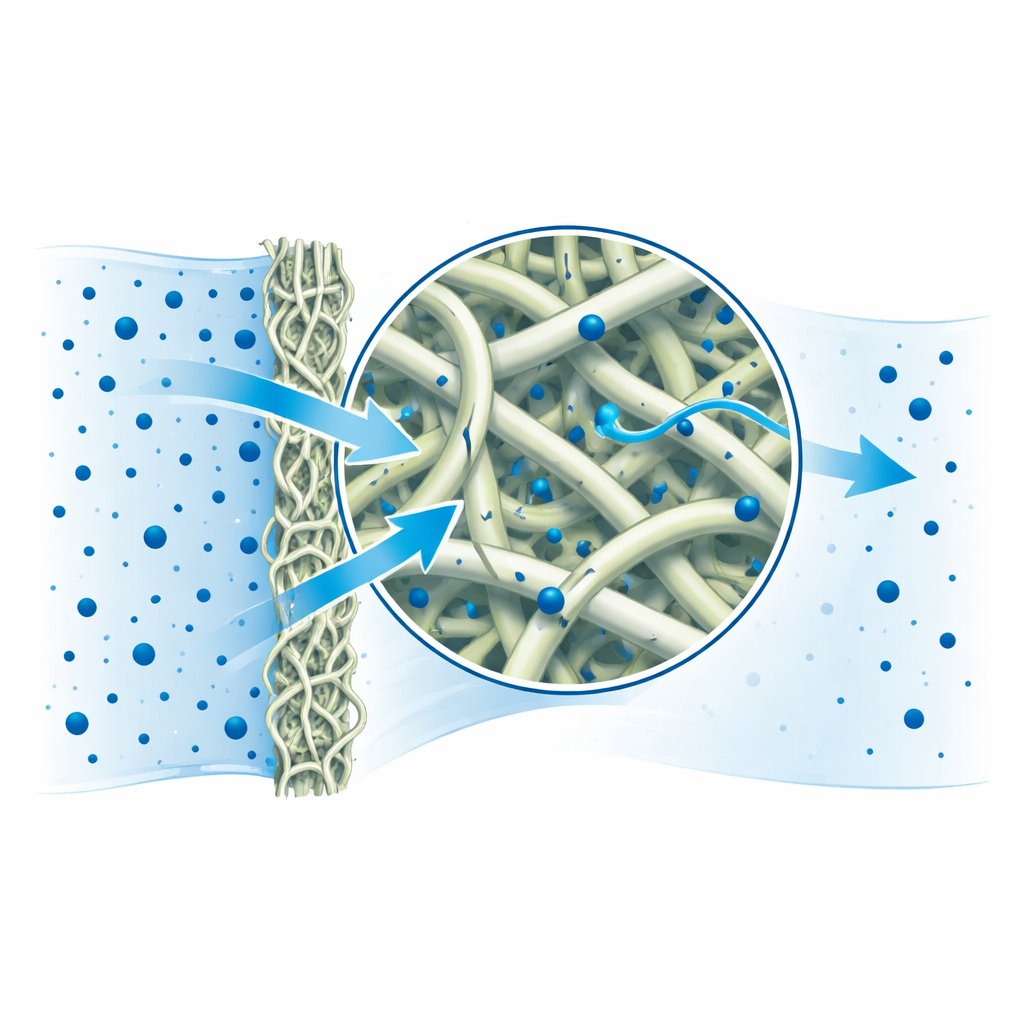
Once the filter was made, the team examined how its structure and chemistry support cleaning. Tests of how water droplets spread on the surface showed that the hemp-containing membrane is highly water-loving: droplets soaked in within two seconds, a sign that dye solutions can quickly penetrate. Measurements of pore structure revealed that adding hemp increased the overall porosity compared with pure plastic membranes, creating a network of channels that allow water and dissolved dye to reach many internal sites. Chemical analyses confirmed that hemp’s natural groups and the plastic’s nitrogen-containing groups are well mixed and interact strongly, rather than simply sitting side by side. This close mixing improves stability and creates more active spots where dye molecules can stick. In air-filtration tests, the same membrane removed 99.97% of fine particles, linking its high porosity and uniform fibers to excellent dust-capturing behavior.
Probing the Cleaning Power in Detail
The authors then tested how well the membrane cleans simulated dye wastewater and what conditions work best. They varied dye concentration, temperature, contact time, pH (acidity), and hemp content, and used statistical tools to pinpoint the most efficient combination. Around 10% hemp, a moderately warm temperature near 40–45 °C, slightly alkaline water, and enough contact time yielded a dye removal rate of about 95%. By fitting the data to standard models, they inferred that dye molecules first move quickly into the pores, then bind more slowly and strongly to the fiber surfaces. The behavior matched a pattern typical of “chemical adsorption,” where the dye forms specific interactions—such as hydrogen bonds and attractions between positive and negative charges—with groups on the hemp and plastic. The process turned out to be spontaneous and slightly more favorable at higher temperatures, and the membrane’s maximum dye-holding capacity reached roughly 76 milligrams of dye per gram of material, competitive with or better than several similar filters reported in earlier work.
What This Means for Cleaner Textile Production
Overall, the study shows that a thin sheet made from hemp and an industrial polymer can act as a dual-purpose filter, efficiently removing both a stubborn dye from water and fine particles from air. To a non-specialist, the key message is that combining a renewable plant resource with a robust synthetic material, and shaping them into a porous nanofiber mat, creates a powerful yet simple tool for pollution control. While the present tests used a single dye in controlled conditions, the approach offers a promising route toward more sustainable treatment systems in real textile plants, where one filter material could help tackle multiple kinds of waste at once.
Citation: Sun, Y., Wang, J., Kong, W. et al. Exploration of electrospinning hemp/polyacrylonitrile composite fiber membrane and dye adsorption capabilities. Sci Rep 16, 7960 (2026). https://doi.org/10.1038/s41598-025-33369-w
Keywords: textile wastewater, dye removal, hemp nanofibers, air and water filtration, sustainable materials