Clear Sky Science · en
Particle monitor probe: a novel tool for fast plasma diagnostics and space charge compensation investigation in high-intensity proton accelerators
Watching Invisible Clouds Inside Particle Machines
Modern particle accelerators do much more than smash atoms—they help design cleaner reactors, study new materials, and probe the structure of matter. But to run reliably, these machines must keep tight control over the swirling clouds of charged particles, or plasma, that surround the proton beams inside them. This paper introduces a simple, low-cost sensor called a Particle Monitor Probe (PMP) that can “listen in” on these hidden plasmas in real time, helping engineers keep powerful accelerators stable, efficient, and safe.
Why Proton Beams Need Careful Watching
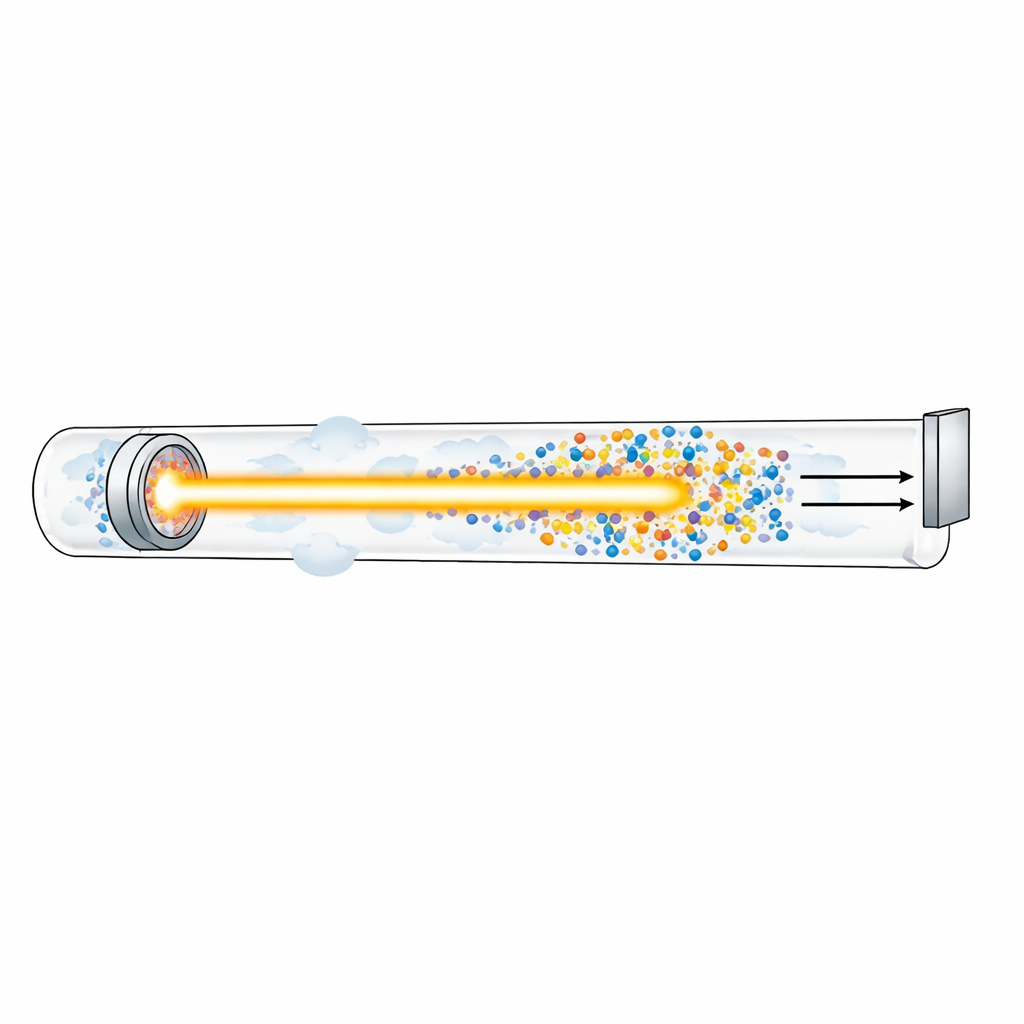
In high-intensity proton accelerators like India’s Low Energy High Intensity Proton Accelerator (LEHIPA), intense beams are used to generate the neutrons needed for advanced nuclear systems, including designs that could help tap thorium reserves and reduce radioactive waste. At low energies, however, protons strongly repel one another. This “space charge” push tends to make the beam spread out, lose focus, and damage equipment. Fortunately, a beam traveling through sparse background gas creates a thin plasma that partially neutralizes this repulsion. Electrons liberated from gas atoms are drawn into the beam, while positive ions are pushed toward the walls. How quickly this neutralization, called space charge compensation, builds up—and how stable it remains—strongly affects how well the accelerator performs.
The Challenge of Measuring Fleeting Plasmas
Measuring these plasmas is surprisingly hard. Many conventional tools, such as delicate probes inserted into the beam, either disturb the beam or cannot survive in such harsh environments. Optical techniques using cameras and fast light detectors can work, but they tend to be expensive and demand very clean, low-noise conditions and complex analysis. Adding to the difficulty, key changes in the plasma often unfold in just a few millionths of a second, so any useful instrument must respond extremely fast. LEHIPA’s ion source also sits on a high-voltage platform, making it risky to place electronics nearby. Engineers therefore need a sensor that can sit safely to the side of the beam, react on nanosecond timescales, and still pick up subtle signals from far upstream.
A Small Side-Mounted Plate With a Big Job
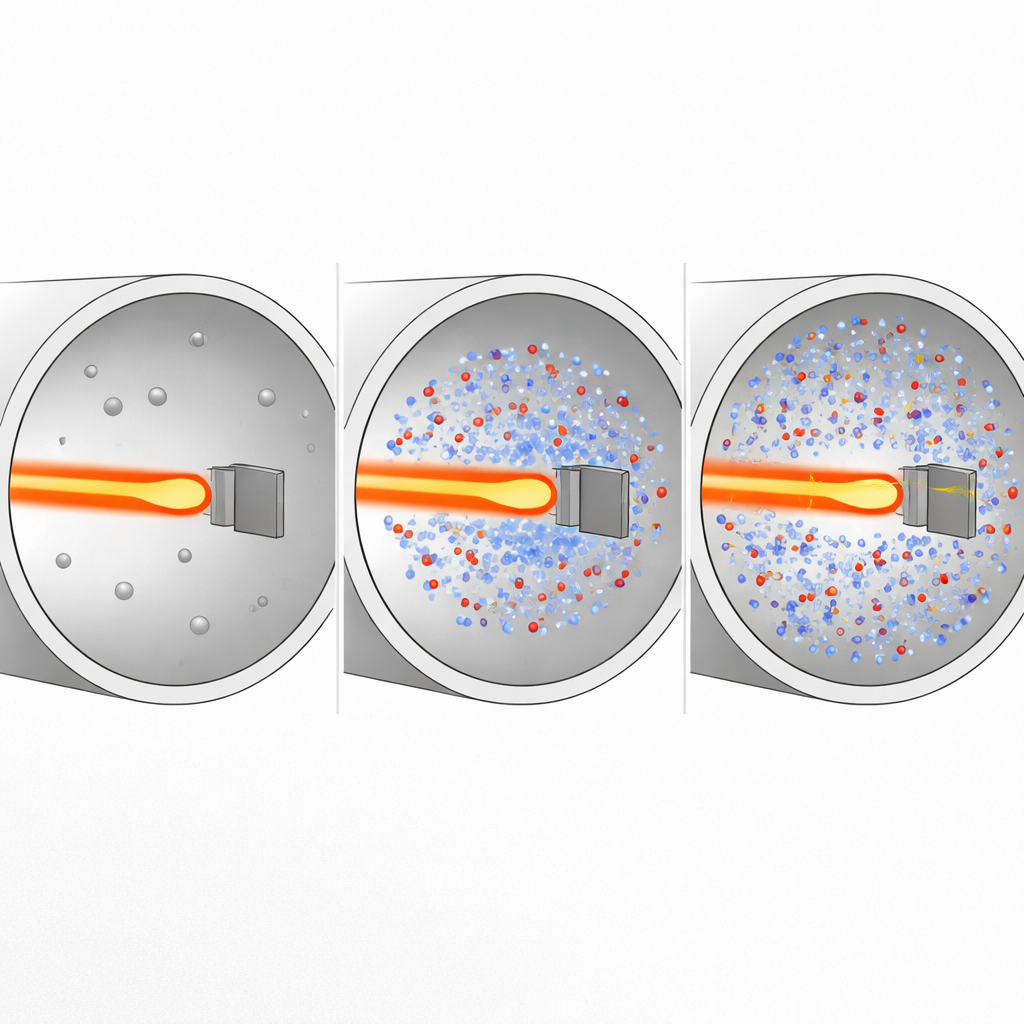
The Particle Monitor Probe is essentially a small copper plate mounted at the edge of the beam pipe, slightly away from the main proton stream. Because it is off to the side, it does not block or disturb the beam. Charged particles from the surrounding plasma—especially the lightweight electrons—occasionally reach this plate, and their tiny currents are amplified and recorded. The researchers first used detailed computer simulations to mimic LEHIPA’s beam traveling through argon gas, generating electrons and ions. The simulated PMP, treated as a passive collector, picked up changing flows of electrons whose rise and fall closely tracked how quickly the beam’s electric field was neutralized. These studies showed that by watching how the electron signal grows and then settles, the probe can reveal the time it takes for the beam to become effectively neutralized, and how that time depends on gas pressure.
Testing the Probe in a Working Accelerator
After simulations, the team built the PMP and installed it in LEHIPA’s Low Energy Beam Transport line. Using a fast test signal technique called time domain reflectometry, they confirmed that the whole probe-and-cable system responds in about 22 billionths of a second—fast enough to track microsecond-scale plasma changes. Remarkably, the probe could sense electrons from the ion source plasma located about two meters upstream, even when the beam itself was not being extracted. By tweaking the magnetic coils that confine the ion source plasma, the researchers saw clear changes in the PMP signal that matched changes in the measured proton beam current. When the plasma pulse was more stable in time, the extracted beam was steadier too. This one-to-one link means the PMP can act as a remote “stethoscope” for tuning the ion source without ever touching the high-voltage region.
Timing How the Beam Settles Down
The researchers then used the PMP to study how space charge compensation builds up during a 50 kiloelectron-volt proton pulse. By introducing argon gas into the beamline and measuring the evolving electron current at the probe, they could infer the compensation time: the moment when enough electrons have gathered around the beam to largely calm its electric field. They found that this time shrinks as gas pressure increases—because more atoms are available to ionize—and then levels off at about 12 microseconds beyond a certain pressure. These trends closely matched both theory and detailed simulations, giving confidence that the probe is accurately capturing the underlying physics. By applying positive or negative voltages to the plate, they also showed that the same device can selectively emphasize electron or ion signals, offering a richer picture of the plasma’s makeup.
What This Means for Future Accelerators
The study shows that a modest, inexpensive probe can provide high-speed insight into some of the most important—and previously hard to access—processes inside powerful proton accelerators. The PMP can help operators fine-tune ion sources, monitor the health of the beam over long runs, and better understand how background gases and multiple ion species influence beam stability. Because it is simple, robust, and minimally intrusive, it can be adopted in many accelerator facilities, supporting efforts to build reliable machines for advanced nuclear systems and other demanding applications where a well-behaved beam is essential.
Citation: Priyadarshini, P., Mathew, J.V. & Kumar, R. Particle monitor probe: a novel tool for fast plasma diagnostics and space charge compensation investigation in high-intensity proton accelerators. Sci Rep 16, 9350 (2026). https://doi.org/10.1038/s41598-025-33368-x
Keywords: proton accelerator diagnostics, space charge compensation, plasma probe, ion source stability, beam transport