Clear Sky Science · en
Smart irrigation system and early plant disease detection using IoT and novel non-linear growing self-organizing map based artificial neural network
Why smarter watering and plant checks matter
Feeding a growing world depends on farmers spotting crop problems before they spread and using precious water wisely. This study focuses on sugarcane, a major source of sugar and biofuel, and shows how a combination of field sensors, camera‑equipped drones, and advanced computer algorithms can catch leaf diseases early and fine‑tune irrigation. The result is more reliable harvests, less wasted water, and a practical glimpse of how “smart farms” may soon work in everyday fields.
Watching the field from ground and sky
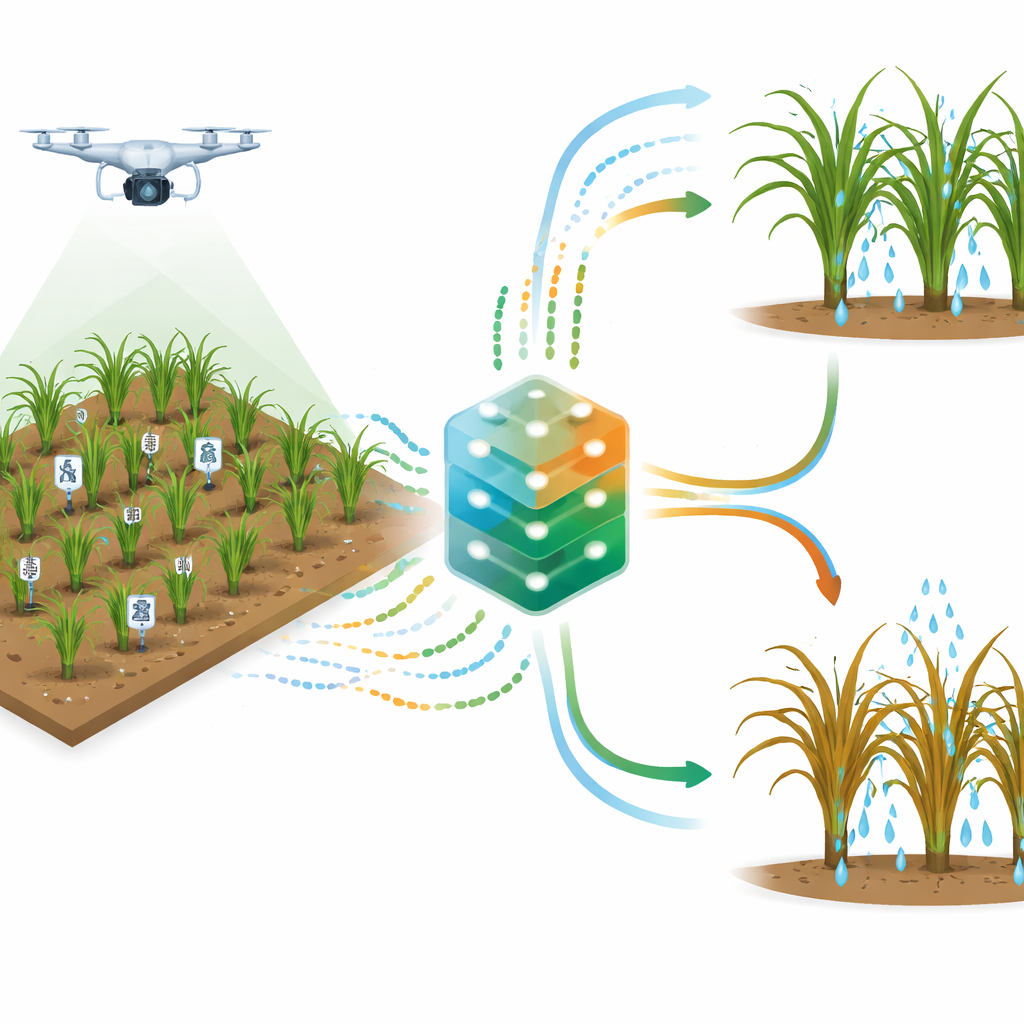
The researchers designed a system that constantly watches sugarcane plants from two vantage points. In the soil and around the plants, small internet‑connected devices record temperature, humidity, soil moisture, and leaf shade. Overhead, unmanned aerial vehicles (UAVs), or drones, capture sharp color and near‑infrared images of the leaves. Subtle changes in leaf texture and color can signal infections such as red rot, smut, or rust before they are visible to the naked eye. By collecting both environmental readings and aerial images from three major sugarcane‑growing regions in India, the team built a rich picture of plant health across different climates, soils, and growth stages.
Cleaning and distilling the clues
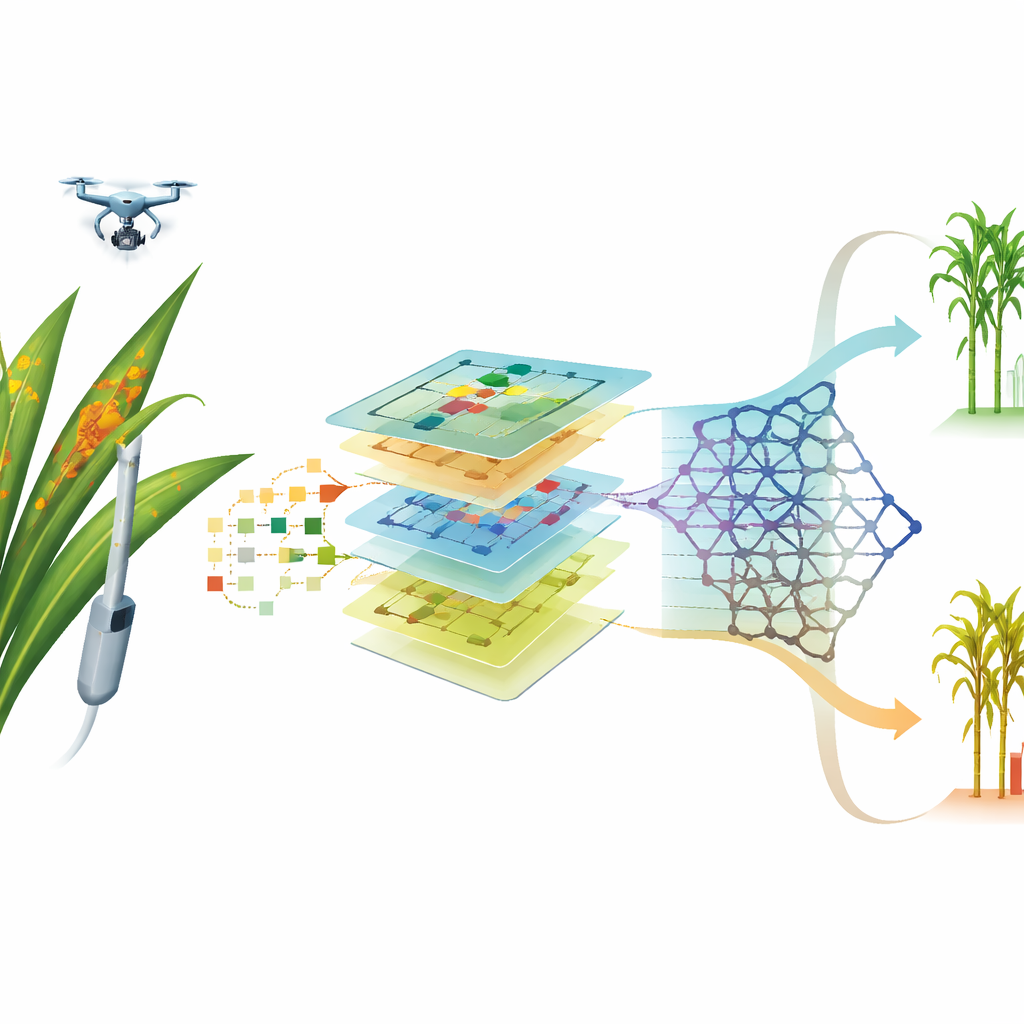
Raw data from fields is messy. Sensors can drift or pick up noise, and drone images may suffer from lighting changes or blur. The system therefore begins by filtering and normalizing the readings, removing random spikes and putting all measurements on a common scale. Drone images are sharpened and their contrast enhanced so that spots, streaks, and discolored patches on leaves stand out clearly. From these improved images, the program extracts compact descriptions of texture and color, while a standard vegetation index highlights how vigorously each patch of cane is growing. These distilled clues are combined with temperature and moisture readings into a single dataset that summarizes the state of each part of the field.
How the digital brain learns disease patterns
At the heart of the system is a digital “brain” built from interconnected processing units inspired by biological neurons. The first stage organizes the mixed image and sensor features into a map of recurring patterns, placing similar cases near each other and expanding its structure when it encounters new combinations. This helps expose the complex, non‑straight‑line relationships between weather, soil conditions, and leaf appearance that tend to indicate disease. A second stage then learns, from thousands of labeled examples, which patterns correspond to healthy plants and which signal specific diseases. Because the model can represent curved and tangled boundaries between these groups, it can separate look‑alike conditions that simpler tools would confuse.
From early warning to smarter watering
Once trained, the system not only labels each patch of cane as healthy or diseased but also estimates how much the infection is likely to cut into yield. It does this by relating disease severity in the images, along with temperature and moisture levels, to past records of harvest size. In tests on 10,000 plant samples, the approach correctly identified sugarcane diseases over 95% of the time and reduced false alarms compared with other leading methods. Its predictions of yield loss were also more accurate, allowing it to suggest when and where to adjust irrigation or apply treatments. In areas flagged as stressed, the system would point to targeted watering, while healthy zones could avoid unnecessary water use.
What this means for farmers and food security
For farmers, the study points to a future in which a mix of low‑cost sensors, drones, and farm‑ready software provides an ongoing health check for their crops and guides irrigation decisions. By spotting sugarcane diseases early and tying those findings directly to expected yield, this approach helps focus attention and resources where they matter most. In practical terms, that means higher, more stable production with less wasted water and fewer blanket treatments. While this work centers on sugarcane, the same ideas could be adapted to many other crops, making precision agriculture more accessible and helping safeguard food supplies in a warming, water‑stressed world.
Citation: Gorijavolu, D., Sharma, K. & Rao, N.S. Smart irrigation system and early plant disease detection using IoT and novel non-linear growing self-organizing map based artificial neural network. Sci Rep 16, 9488 (2026). https://doi.org/10.1038/s41598-025-33323-w
Keywords: smart irrigation, crop disease detection, IoT agriculture, drone imaging, sugarcane yield