Clear Sky Science · en
Hybrid meta heuristic and fuzzy impedance method for fast fault location in power system lines
Why finding power line faults faster matters
When a fault occurs on a high-voltage power line—because of storms, equipment failure, or human error—electricity can be cut to thousands of homes and factories in an instant. Today’s grids rely on crews and control-room software to find the exact point of failure before repairs can even begin, a process that can be slow, uncertain, and expensive. This paper presents a new way to pinpoint problems along long-distance power lines quickly and with remarkable accuracy, using smart measurements at just one end of the line and an intelligent search method inspired by hunting birds.
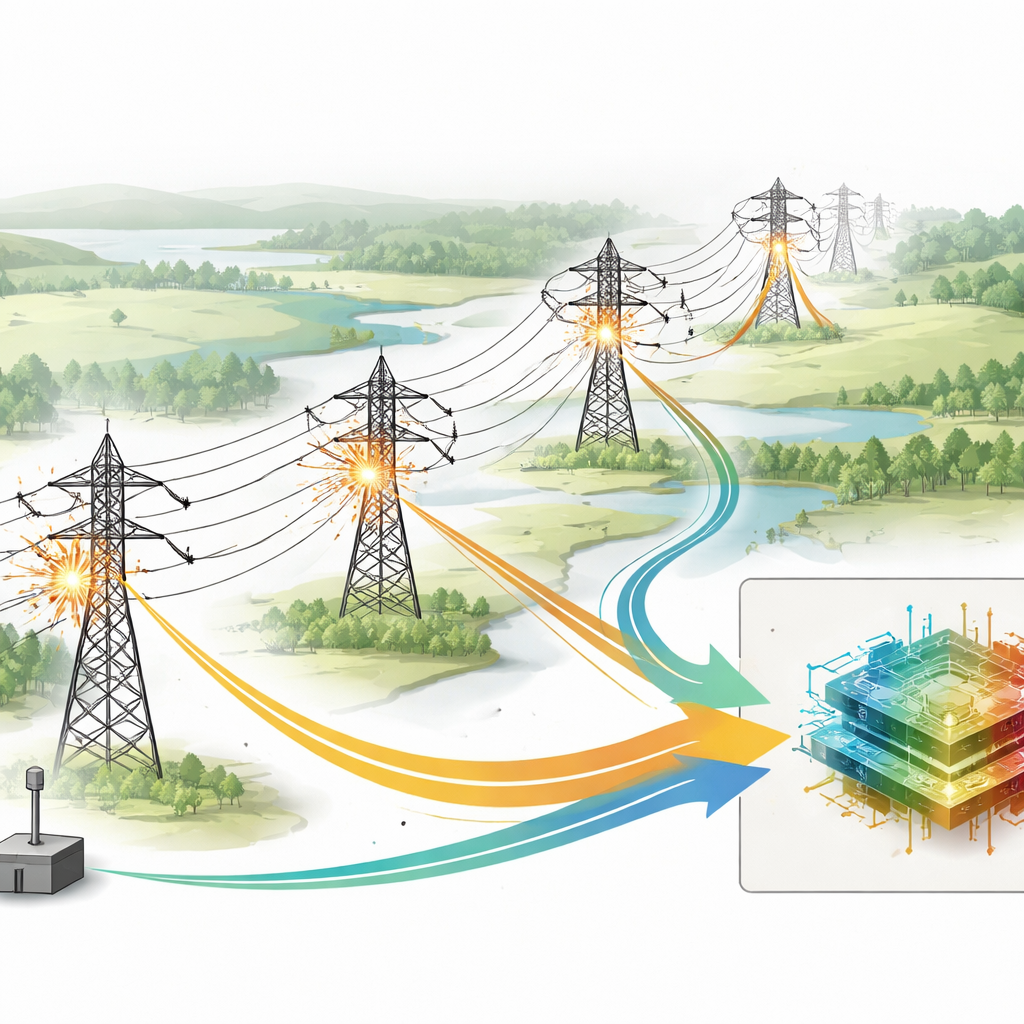
How power lines usually reveal their problems
When something goes wrong on a transmission line, the electrical “feel” of the line changes. Engineers describe this in terms of impedance, a quantity related to how strongly the line resists current flow. Traditional fault-location tools estimate where the problem lies by comparing voltages and currents measured at both ends of the line and then solving equations based on a detailed model of the hardware. These methods can work well, but they demand accurate knowledge of line parameters, precise time synchronization between distant stations, and sometimes struggle with subtle or high-resistance faults. As power grids grow more complex and incorporate renewable sources, noise and uncertainty in these measurements make clean, fast fault location even harder.
Reading the grid from one end
The authors propose a different strategy that relies on a phasor measurement unit (PMU) placed at just one end of the line. This device samples voltages and currents at a high rate and converts them into phasors—compact representations of the grid’s electrical state. When a fault appears, the currents and voltages in each phase change abruptly, and with them, the apparent impedance seen from the PMU. By watching only how these quantities shift at the local terminal over time, the system can first decide whether a fault has occurred and what type it is (single-phase, two-phase, or three-phase, with or without ground involvement), and then use that information to infer how far along the line the fault must be.
A bird-inspired search for the fault
Turning these raw changes into an accurate distance is not straightforward, because the relationship between impedance and location is strongly nonlinear and varies with fault type. To tackle this, the researchers build two complementary models that learn this relationship from simulated examples of faults along a 200 km, 220 kV line. One model fits a flexible fifth-order curve to the data; the other uses a fuzzy logic system that blends many simple rules, each describing how certain ranges of impedance values correspond to distances on the line. Both models are trained using the Fire Hawk Optimizer, a meta-heuristic algorithm modeled on birds that spread small fires to flush out prey and then close in on the best hunting spots. Here, the “prey” is the combination of model parameters that minimizes the error between predicted and true fault locations.
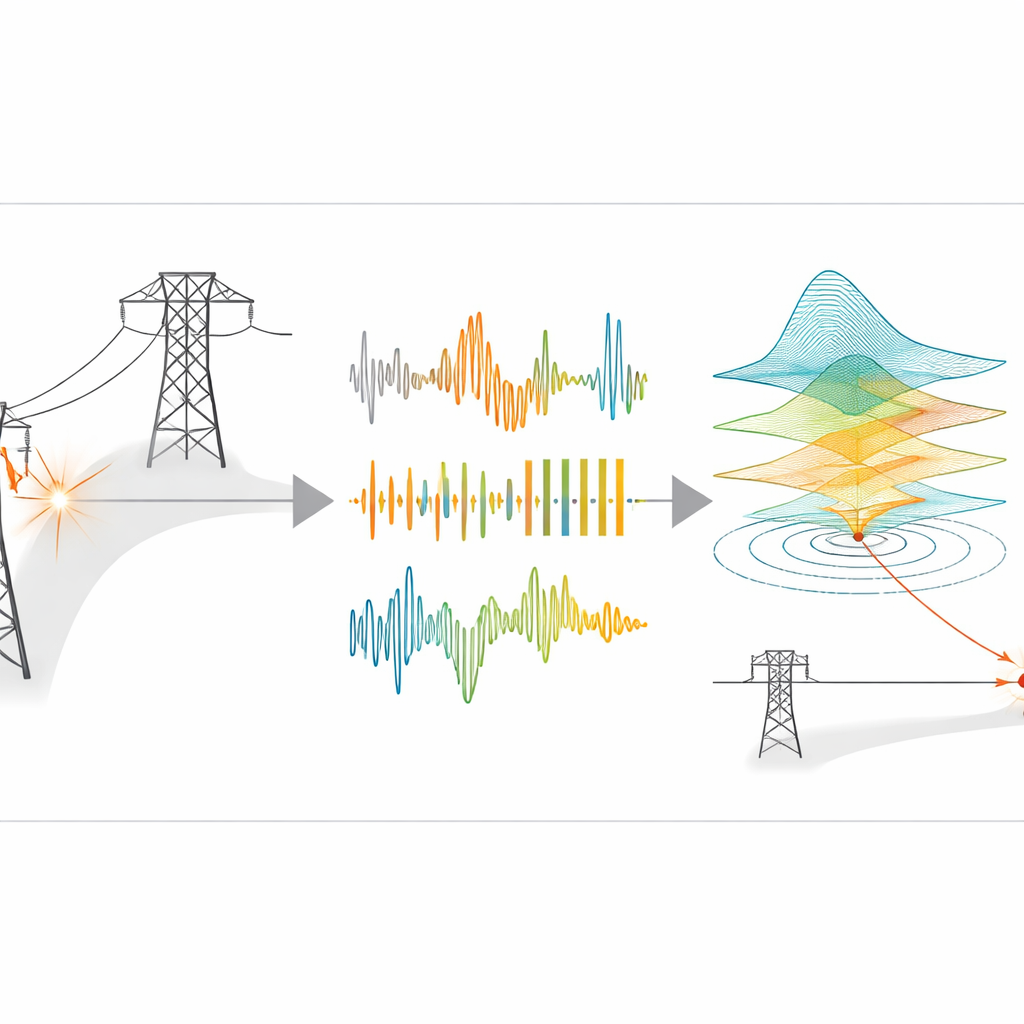
Speed, accuracy, and robustness in real-world conditions
Once trained, the hybrid method can locate faults of different types and at different positions along the line with very low error—on average, around 0.16% of line length for the fuzzy model and under 1% for the polynomial model. In practical terms, this means errors of only a few hundred meters on a 200 km line. The approach also proves resilient to complications that commonly plague real grids. Tests show it keeps its accuracy even when measurement noise is added, when the line’s electrical properties are altered, when loads on the network change, and when the fault itself has a high resistance that would weaken usual diagnostic clues. Just as important, the full computation finishes in less than about 0.16 seconds on standard hardware, fast enough for real-time protection systems.
What this means for future power grids
For non-specialists, the key takeaway is that the authors have developed a way for a single smart sensor at one end of a high-voltage line to act like an expert locator, spotting not just that a problem exists but exactly where it is, almost instantly and with very little prior knowledge about the line. By combining a physically meaningful signal (impedance), a flexible rule-based model (fuzzy logic), and an efficient search strategy inspired by nature (the Fire Hawk Optimizer), the method promises quicker repairs, fewer and shorter outages, and lower costs for utilities. As electric networks become more complex and more vital, such intelligent, fast fault-location tools could become a core part of keeping the lights on.
Citation: Najafzadeh, M., Pouladi, J., Daghigh, A. et al. Hybrid meta heuristic and fuzzy impedance method for fast fault location in power system lines. Sci Rep 16, 8019 (2026). https://doi.org/10.1038/s41598-025-33182-5
Keywords: power transmission faults, phasor measurement units, fuzzy logic, metaheuristic optimization, grid reliability