Clear Sky Science · en
The impact of surface ozone on agricultural yields in the Ciuc Basin
Why the air above farms matters
For many of us, air pollution brings to mind coughing city streets and hazy skylines. Yet some of the same pollutants that bother our lungs can quietly nibble away at the harvests that feed us. This study looks at one such pollutant—ozone near the ground—and asks how it affects the main crops grown in the Ciuc Basin of Romania, a mountain‑ringed valley where bad air can linger. The findings show that even modest amounts of ozone, building up over many summers, can shave off part of farmers’ yields and cause substantial financial losses.
A valley where pollution gets trapped
The Ciuc Basin lies between mountain ranges in the Eastern Carpathians, with farms spread across a long, narrow depression. This bowl‑like shape is scenic but problematic: it can trap air and the pollutants it carries. The researchers drew on 15 years of records from a regional monitoring station that tracks ozone, sunlight, and temperature, along with county statistics on wheat, barley, maize, and potato harvests. 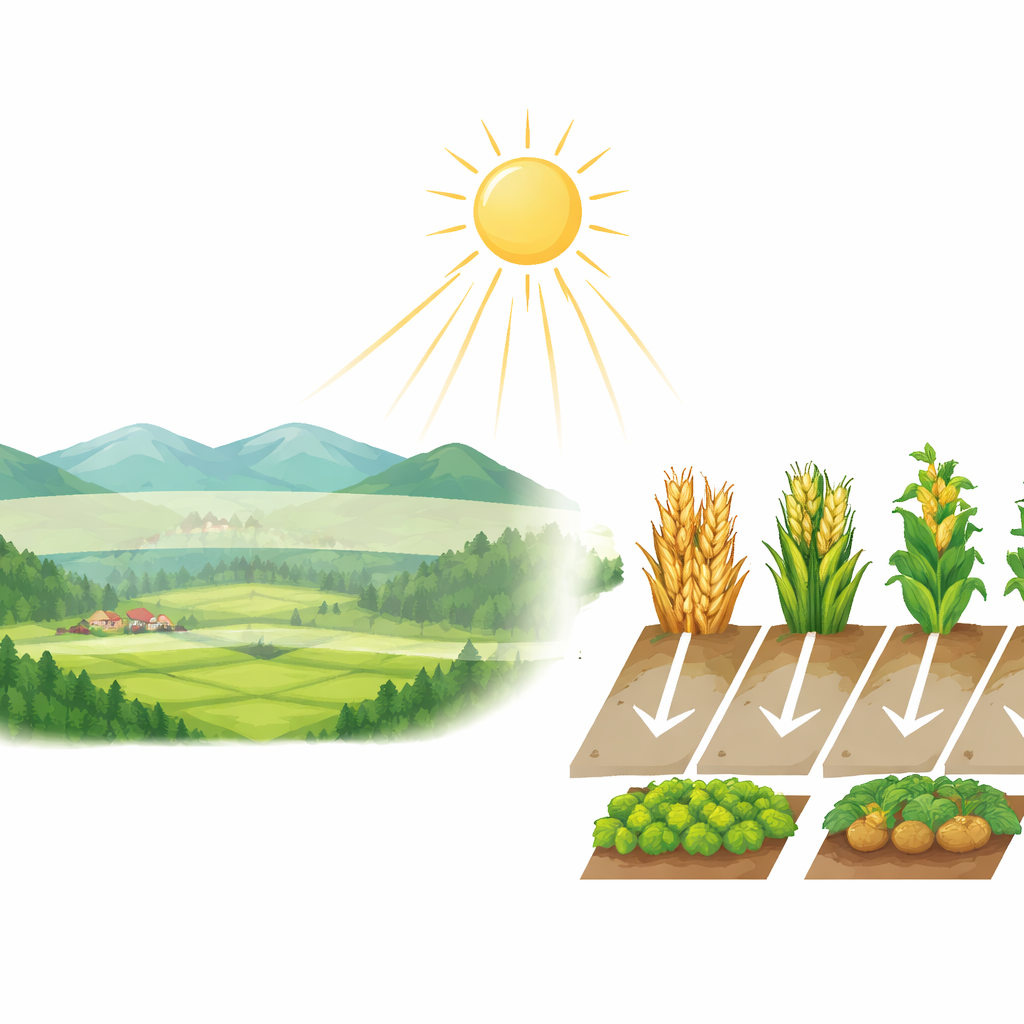
Invisible smog and sunny summer days
Ozone high in the atmosphere shields us from harmful ultraviolet rays, but at ground level it is created when sunlight drives reactions between gases from vehicles, industry, and other human activities. In the Ciuc Basin, the team found that ozone levels rise and fall with the seasons. The strongest build‑up occurs from April to September, when days are long and bright. During these months, daily sunlight often exceeds the levels typical of mild spring days, and hourly ozone peaks in mid‑afternoon. Over the years 2008 to 2023, average ozone levels crept upward, alongside increases in both sunlight and temperature, suggesting that a warming climate may be making the problem worse.
Measuring harm to crops over time
Plants do not just react to a single ozone spike; damage accumulates over many hours of exposure during the growing season. To capture this, the researchers used established international indicators that sum up how often and how strongly ozone rises above a critical threshold while crops are actively photosynthesizing. They then applied known dose–response relationships for wheat, barley, maize, and potato, which connect this accumulated ozone exposure to percentage losses in yield. By combining these percentages with actual county harvest records and current market prices, they could estimate not only how much grain or tubers were lost, but also what those losses meant in euros. 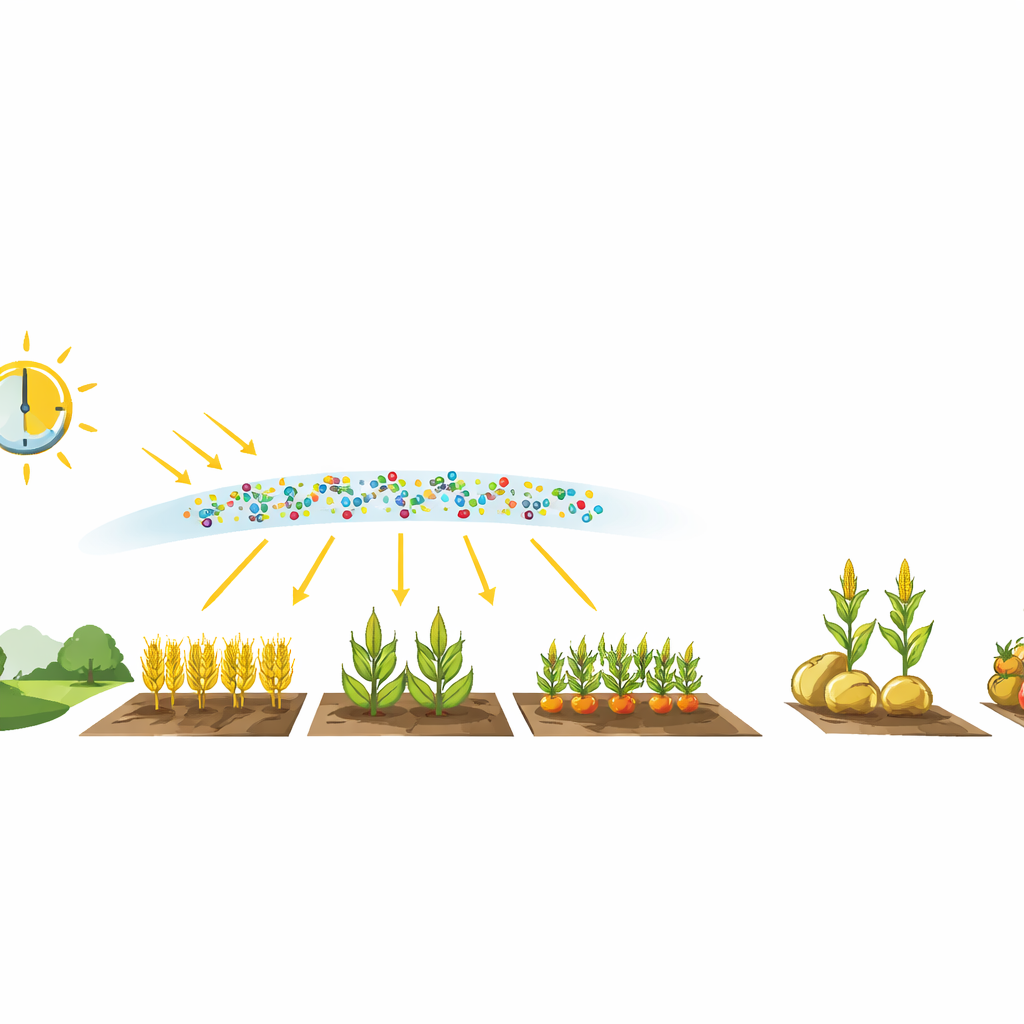
Small percentage losses, big money
The estimated yield reductions for individual crops might sound modest at first glance—generally under one percent per year. On average, maize showed the highest sensitivity in terms of percentage loss, followed closely by barley and potato, while wheat was somewhat less affected. But once these seemingly small fractions were applied to the many thousands of tons harvested each year, the totals became striking. Between 2012 and 2021, ozone‑related losses added up to about 2,500 tons of wheat, 1,300 tons of barley, 1,000 tons of maize, and, most dramatically, tens of thousands of tons of potatoes. Because potatoes fetch a relatively high market price, they accounted for more than 85 percent of the total economic damage, which reached roughly 5.7 million euros over the study period.
What it means for farmers and food security
In plain terms, this work shows that the air above fields in the Ciuc Basin is quietly taxing farmers every year. Even though the percentage losses per crop are small, the steady accumulation across seasons and across large areas adds up to serious economic harm, especially for valuable crops like potatoes. The study suggests that reducing pollution that forms ozone, choosing crop varieties that tolerate it better, and improving farming practices could help protect both yields and livelihoods. More broadly, it highlights that air‑quality policies and climate trends do not just affect our lungs—they also shape how much food our fields can produce.
Citation: Bodor, K., Bodor, Z. The impact of surface ozone on agricultural yields in the Ciuc Basin. Sci Rep 16, 9434 (2026). https://doi.org/10.1038/s41598-025-33122-3
Keywords: surface ozone, crop yield, air pollution, Ciuc Basin, potato production