Clear Sky Science · en
Fusion of NSGA-II and Latin hypercube sampling for optimizing node displacement in thin-film IME molding
Why safer shields matter for firefighters
Firefighters routinely enter buildings where ceilings can collapse and debris can fall without warning. This study explores a new kind of protective shield that does not have to be held in the hand: it floats in front of the firefighter using magnetic forces. The shield is controlled by thin electronic circuits built directly into a lightweight plastic armor. By making these hidden circuits more reliable, the researchers aim to give firefighters stronger protection without adding heavy gear.
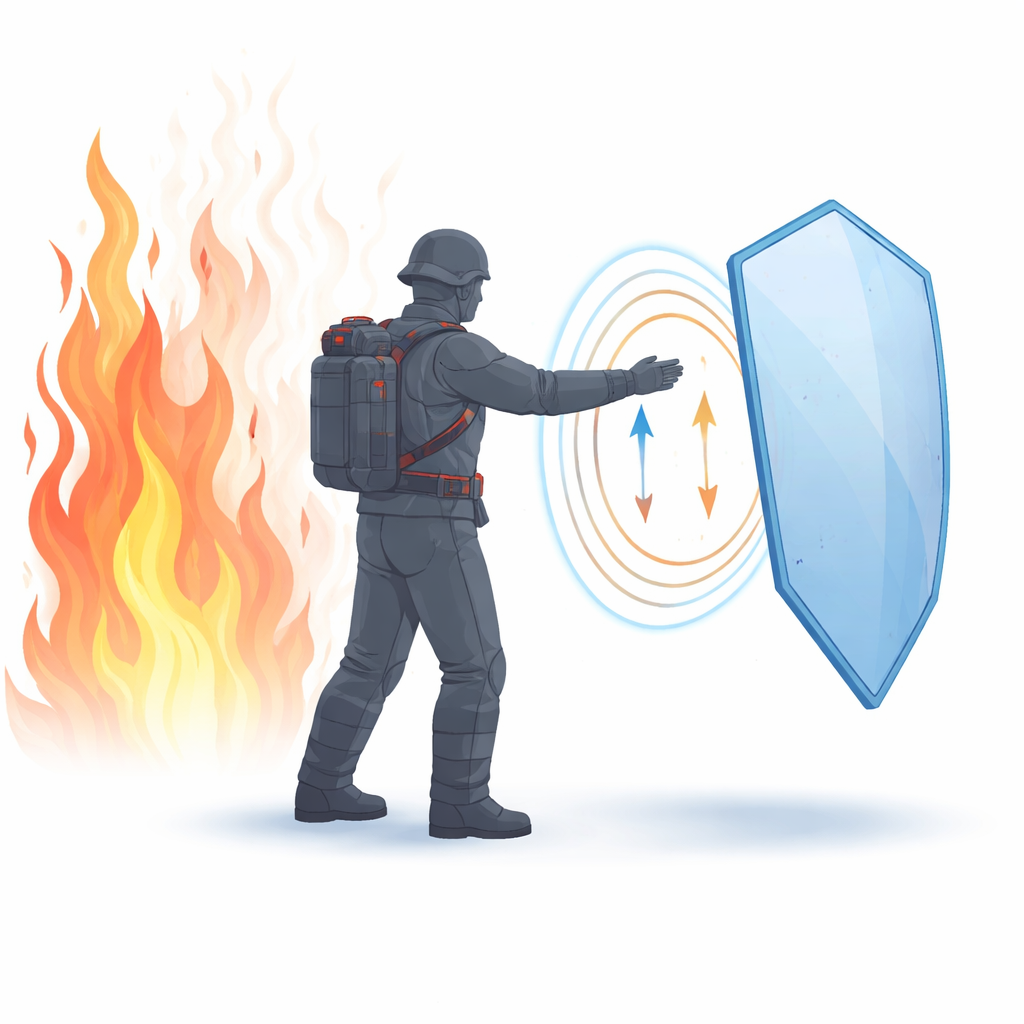
A floating barrier between danger and the body
The proposed system combines three ideas: a plastic armor worn on the body, a separate shield plate containing magnets, and an electronic film that lets the wearer adjust electric current by simple button-like actions. When current flows through the system, magnetic forces push the shield away from the armor so that it hovers at a distance, forming a protective barrier between the firefighter and falling objects or intense heat. Because the shield does not need to be physically held, it can move and reposition more freely as conditions change.
The hidden weakness inside molded electronics
To make this work in the real world, the electronics buried in the plastic must carry stable current even in extreme fire conditions. The circuits are printed on a thin film and then shaped along with the plastic during an injection molding process. As the hot plastic cools and shrinks, tiny points—called nodes—on the surface can shift out of place. When these nodes move, the attached circuit paths are stretched, compressed, or bent. That subtle distortion can thin the conductive tracks, crack insulation, or create near-breaks, all of which waste current and power. The authors show that such damage can dramatically raise electrical resistance, driving up heat in local spots and threatening sudden failure or even fire.
Smarter trial-and-error for molding settings
Instead of tuning molding settings by hand, the team turns the process into a guided search problem. They focus on three controllable knobs: mold temperature, holding pressure after the mold fills, and cooling time. Using a method called Latin hypercube sampling, they pick a set of combinations that efficiently cover the full range of possibilities without needing thousands of tests. For each combination, they run detailed computer simulations of how the plastic shield deforms and how much each node on the surface moves, as well as how much the overall volume shrinks. These results are then fed into a second tool, a multi-objective evolutionary algorithm (NSGA-II), which imitates natural selection to home in on the best trade-offs between low node movement and low shrinkage.

From warped circuits to safer current flow
The optimization loop gradually discovers process settings that sharply reduce how far the nodes wander across the shield surface. For 24 representative nodes, the average displacement drops by roughly two-thirds to almost nine-tenths after optimization. The paper connects these geometric improvements directly to electrical behavior. By modeling different kinds of circuit damage—such as scratched insulation, narrowed copper traces, corroded joints, and almost-broken paths—the authors show how resistance and power loss soar in a highly nonlinear way as damage worsens. In the most severe cases, local power can spike high enough to heat metal to glowing temperatures, easily igniting surrounding plastics. Keeping node displacement small therefore prevents the physical distortions that would push circuits into these dangerous regimes.
A safer path to future firefighting gear
In plain terms, this work shows that carefully chosen molding conditions can make the electronics inside a floating shield much more robust, without changing materials or redesigning the circuits. By combining smart sampling with an evolutionary search algorithm, the researchers turn a slow, experience-based tuning task into a fast, computer-driven exploration that yields a menu of near-optimal settings. Their approach not only strengthens a promising concept for magnetic levitation shields, but also offers a general recipe for designing safer, more reliable electronic structures in harsh environments.
Citation: Chang, H., Long, F. & Li, J. Fusion of NSGA-II and Latin hypercube sampling for optimizing node displacement in thin-film IME molding. Sci Rep 16, 9026 (2026). https://doi.org/10.1038/s41598-025-33062-y
Keywords: firefighter protection, magnetic levitation shield, in-mold electronics, injection molding optimization, multi-objective algorithms