Clear Sky Science · en
Aging analysis of latent fingerprint residues by tracking carotenoid and lipid degradation by Raman spectroscopy
Why Fingerprints Change With Time
Fingerprints are a cornerstone of crime investigations, but they carry more than just ridge patterns. They also contain tiny traces of body oils and natural pigments that slowly break down after a fingertip touches a surface. This study asks a question that matters to courts and investigators alike: can we read those chemical changes to tell how old a fingerprint is, and therefore whether it was likely left during a crime or long before?
Looking Inside a Fingerprint Without Touching It
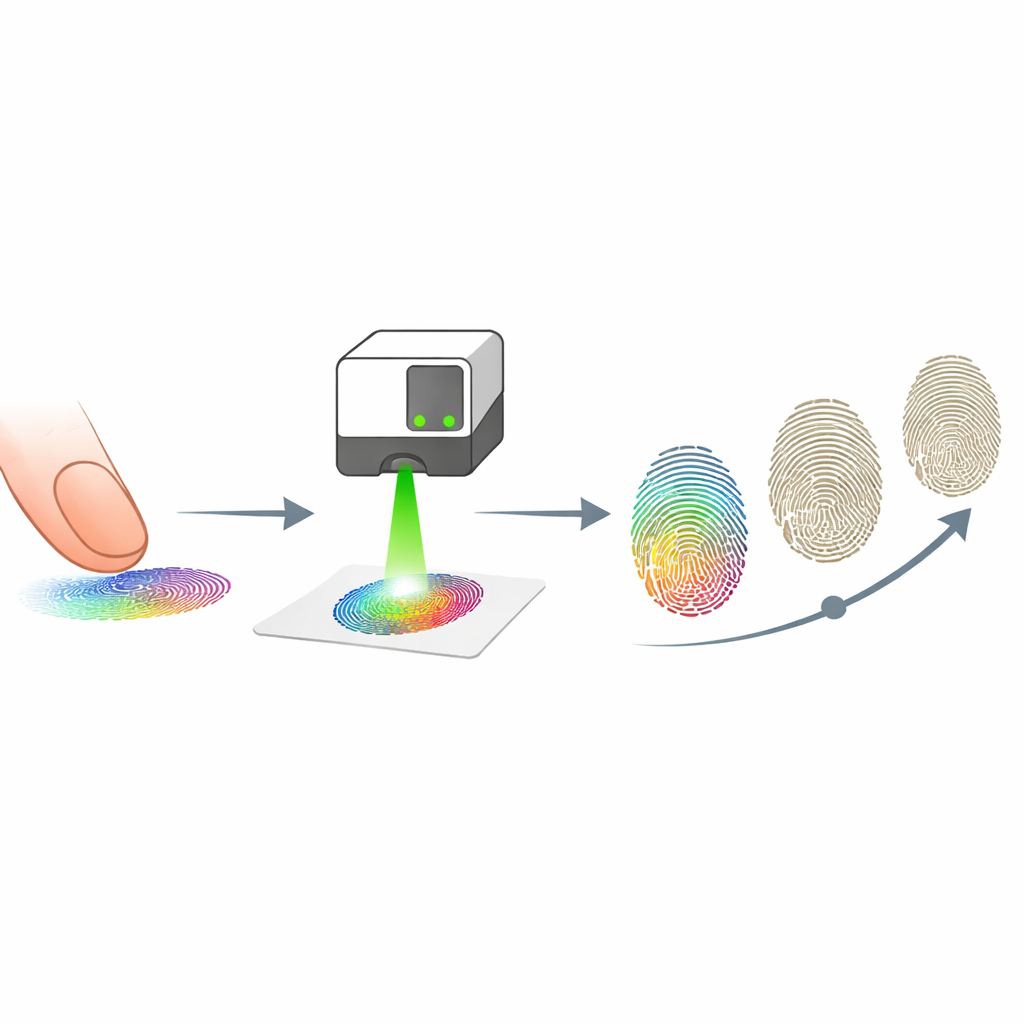
The researchers used a light‑based technique called Raman spectroscopy to examine the invisible chemical mix in “latent” fingerprints – the kind you cannot see until they are developed. Raman instruments shine colored light on a spot and measure how the light scatters back, producing a kind of molecular barcode. Here, the team focused on two main ingredients in fingerprint residue: carotenoids, which are yellow‑orange pigments that come largely from diet, and lipids, which are fatty substances from skin oils. Because Raman measurements are contact‑free, the same type of analysis could in principle be done directly on prints at a crime scene without damaging them.
Following Fingerprints as They Age
To track how these components change over time, the scientists collected fingerprints from three adult men and stored the samples under carefully controlled laboratory conditions for 90 days. They recorded multiple Raman spectra from each print on many different days, then mathematically untangled overlapping signals to isolate the contributions from carotenoids and several kinds of lipids. They also ran a simple diet test with one donor, briefly restricting carotenoid intake, and saw the fingerprint signals from these pigments noticeably drop and later rebound, hinting that lifestyle and nutrition can leave a chemical fingerprint of their own.
Fast‑Fading Pigments and Slower‑Changing Oils
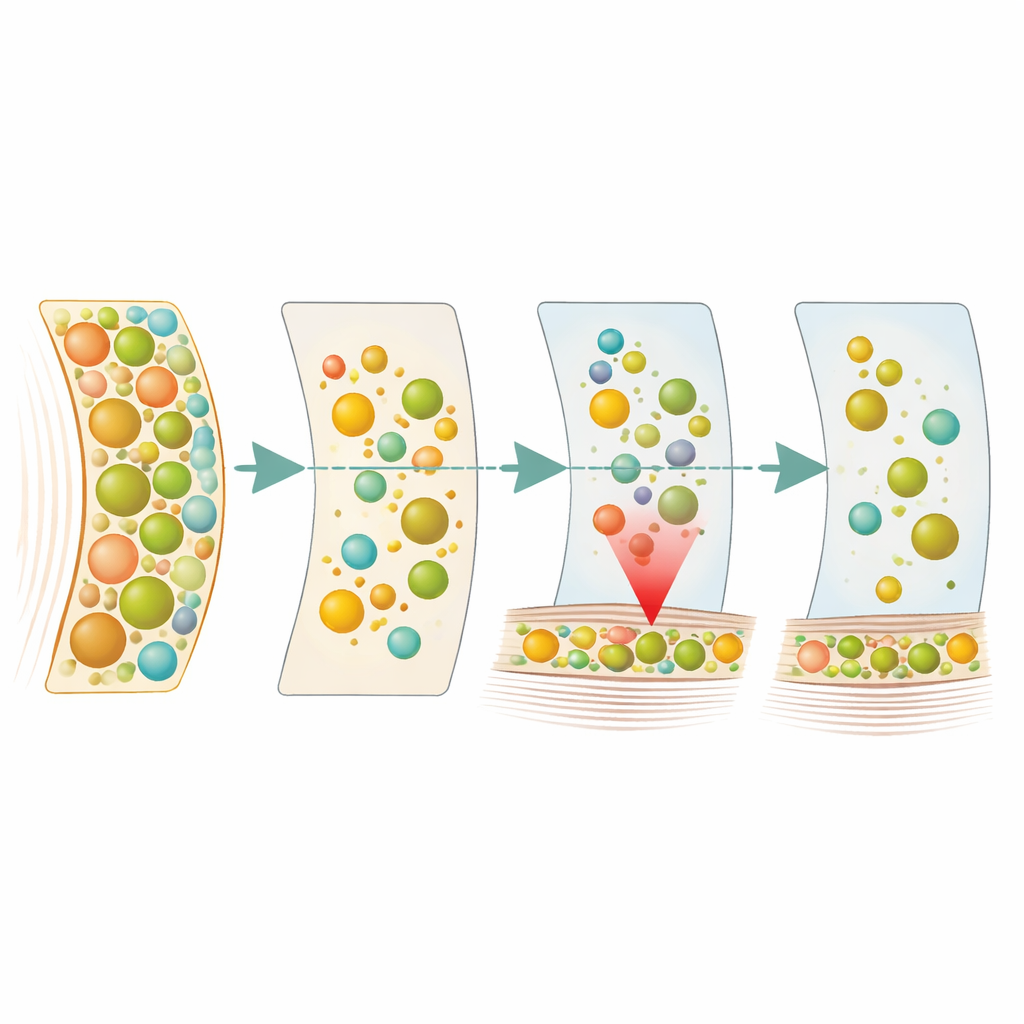
The measurements revealed that carotenoids are particularly fragile. Their signals declined in a way that fits a classic “first‑order” decay curve, meaning the loss rate is proportional to how much is left. Yet the pace varied greatly between people: in one donor, carotenoid signals almost vanished within 10 days, while in another they remained detectable for around 80 days. Detailed inspection of the Raman peaks showed that the carotenoid molecules first twisted into different shapes and then broke apart, forming oxidized by‑products. Lipids behaved differently. Certain spectral markers showed that double bonds in their long carbon chains gradually shifted from one structural form to another and then were lost, reflecting a slower process in which skin oils are steadily oxidized and broken down over weeks.
What the Changes Reveal About Molecular Wear and Tear
By tracking several Raman features at once, the team pieced together a timeline of molecular “wear and tear” inside each fingerprint. At early stages, the overall number of reactive bonds in the lipids changed only slightly, even as some subtle rearrangements took place. Around 40 days, the chemical signatures of these unsaturated bonds dropped sharply, signaling stronger oxidation. At the same time, weak but telling bands associated with bond‑breaking in lipid head groups hinted at ongoing hydrolysis – a process in which fats are cleaved into smaller pieces. Together with the pigment data, this gave a layered picture: visible ridge lines may look similar, but the hidden chemistry beneath them ages in a predictable, though person‑dependent, way.
What This Could Mean for Crime Investigations
In plain terms, the study shows that shining the right kind of light on a fingerprint can reveal how its inner chemistry has aged, with carotenoid pigments fading quickly and skin oils transforming more slowly over months. That pattern, in principle, could be turned into a sort of chemical clock to help estimate when a fingerprint was left. However, the strong differences between donors, and the fact that this work was done on only three volunteers under ideal laboratory conditions, mean it is not yet ready to be used in court. Instead, this research is a proof of concept: it demonstrates that non‑destructive optical methods can track time‑dependent changes in fingerprint residues, laying the groundwork for larger studies that may one day allow investigators to say not just whose print was found, but roughly when it was placed.
Citation: de Carvalho, J.P.S., Santos, A.S., de Souza, M.A. et al. Aging analysis of latent fingerprint residues by tracking carotenoid and lipid degradation by Raman spectroscopy. Sci Rep 16, 9608 (2026). https://doi.org/10.1038/s41598-025-32986-9
Keywords: fingerprint aging, forensic spectroscopy, Raman analysis, carotenoids and lipids, crime scene evidence