Clear Sky Science · en
Study on crack propagation law of overlying strata in the process of small coal pillar mining in inclined extra-thick coal seam
Why Cracks Above Coal Mines Matter
Modern coal mining doesn’t just remove coal; it reshapes the rocks above it and the way underground gas moves. In western China’s Xinjiang region, coal seams are unusually thick and tilt at a steep angle, and miners often leave only a narrow pillar of coal to hold up the roof. This study asks a practical question with big safety implications: how exactly do cracks form and spread in the rock above these workings, and how can that knowledge be used to keep gas levels under control and mining operations safe?
The Challenge of Steep, Extra‑Thick Coal
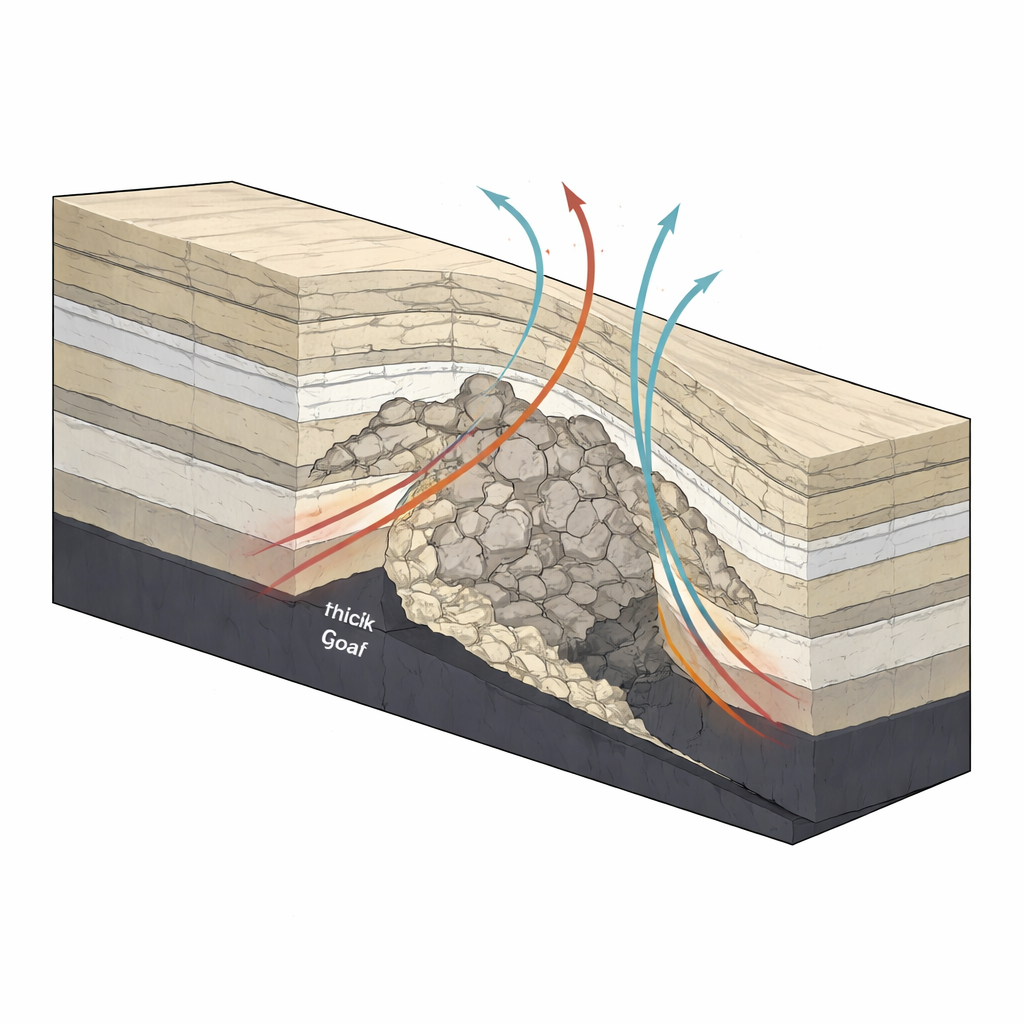
Most earlier research on rock cracking above coal mines focused on nearly flat seams. But in Xinjiang, the main coal layers are both very thick and noticeably inclined. When miners remove coal and leave a small pillar behind, the rocks above are disturbed in complex ways. Cracks open and close over time, creating winding pathways for gas to escape or accumulate. If engineers cannot predict where these high‑permeability zones will be, gas extraction boreholes may miss their targets, leaving dangerous pockets of gas hanging above active mine workings.
Building the Mine in the Laboratory and on the Computer
The researchers used a combination of scaled physical models and advanced computer simulations to mimic a real mining panel, the 11,002 working face in Tengda Coal Mine. In the laboratory, they built a two‑dimensional model of the inclined coal seam and its overlying rock layers at a 1:200 scale. They mined this model step by step from one side to the other, adding and removing wooden blocks to stand in for the moving supports used underground. At the same time, they ran 3D numerical simulations with 3DEC software, which treats the rock mass as many interacting blocks and can track how stresses and cracks evolve as mining progresses.
How the Rock Roof Breaks and Cracks
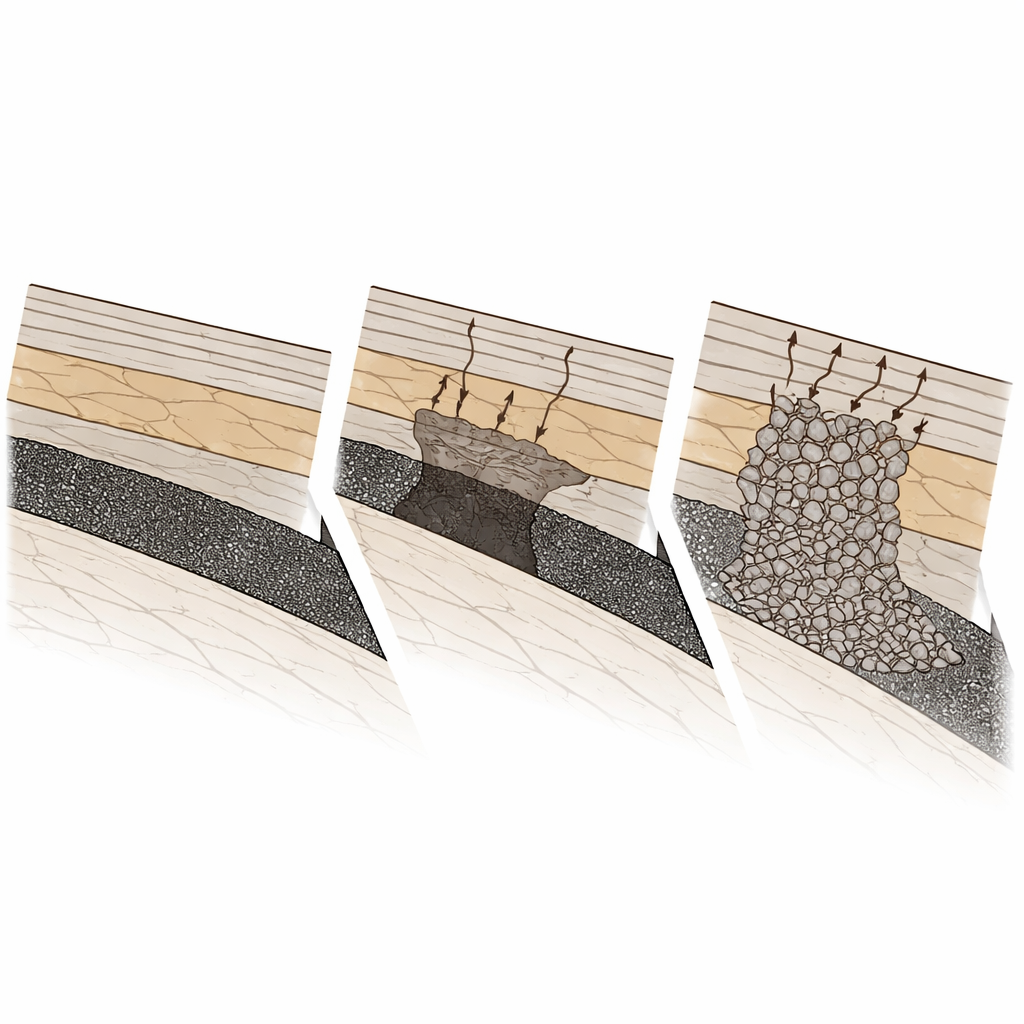
Both approaches showed that the roof does not simply cave in all at once. Instead, the overlying rock passes through a three‑stage pattern: tiny cracks start, then layers begin to separate, and finally large, visible fractures form. As mining advances, the lowest rocks collapse into a rubble‑filled caving zone, while higher layers develop tall fracture zones where blocks are broken but not fully fallen. In the Tengda case, the caving zone stabilizes at about 25 meters above the coal seam, and the fracture zone extends to roughly 80 meters. Because the seam is inclined, broken blocks tend to slide downslope, causing the collapse pattern to be clearly asymmetric: the lower side of the panel is more tightly packed, while a wedge‑shaped, relatively undisturbed area sits above the small coal pillar.
Measuring and Combining Different Views
To pin down the height of the caving and fracture zones more reliably, the team compared three kinds of estimates: simple engineering formulas, the physical model, and the numerical simulation. Each method gives slightly different values, so the authors used a weighted averaging scheme that gives more influence to methods with smaller errors across all results. Because the physical model reproduced the real mining process most faithfully, it received the highest weight. The final combined result put the caving zone height at about 24.98 meters and the fracture zone height at 81.67 meters. They also showed that stresses concentrate strongly around the small coal pillar and that the rate of rock movement and cracking decreases with distance upward from the seam.
Turning Rock Cracks into Safer Gas Control
Armed with a clearer picture of where the broken and highly permeable rocks sit above the mined‑out area, the team designed a targeted gas drainage system for the 11,002 working face. They laid out rows of high‑position boreholes and drainage roadways so that they intersected the predicted high‑permeability fracture regions. Field data from several months of operation showed that gas was drawn off efficiently, while gas concentrations in key mine airways stayed well below the 1% safety limit, even as hundreds of thousands of tons of coal were produced. In simple terms, the work shows that by carefully mapping how the roof breaks above an inclined, extra‑thick seam with small coal pillars, engineers can place gas drainage systems where they will work best—reducing accident risks and supporting safer, more efficient coal mining.
Citation: Lu, W., Zhao, P., Jin, Q. et al. Study on crack propagation law of overlying strata in the process of small coal pillar mining in inclined extra-thick coal seam. Sci Rep 16, 8536 (2026). https://doi.org/10.1038/s41598-025-32844-8
Keywords: coal mining, rock fractures, gas drainage, numerical simulation, mine safety