Clear Sky Science · en
Multiple AMMI models investigation to decipher the genotype by environment (G×E) interaction in sugarcane interspecific hybrids for yield and quality traits
Why this sugarcane study matters
Sugarcane does far more than sweeten tea. It supplies most of the world’s sugar and a large share of renewable fuel. Yet farmers often see yields rise in one season and fall the next, even when they grow promising new varieties. This study asks a practical question with big consequences for food, fuel, and farm income: which sugarcane types give both high harvests and reliably good sugar content across different years and crop cycles? The researchers use advanced but increasingly farmer-focused tools to separate flash-in-the-pan performers from truly dependable workhorse varieties. 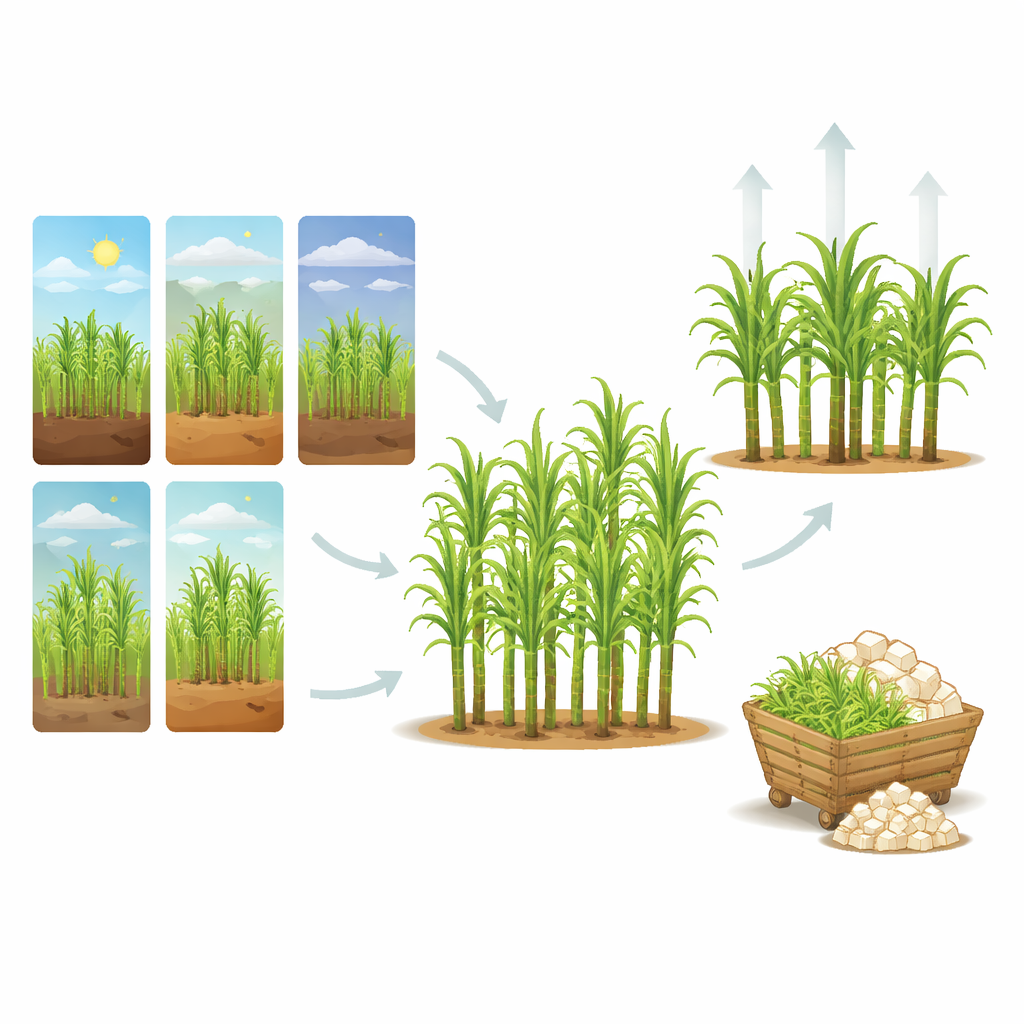
Growing many cane types, many ways
The team tested 19 sugarcane clones, most bred in India, on a commercial research farm over two years. They followed the crop through three cycles that farmers commonly grow: the first planting, the second plant crop, and the ratoon crop that springs from old stubble. For each clone, they measured traits that matter directly to growers and mills: how many canes stand per hectare, how tall and thick they are, the weight of a single stalk, total cane yield per hectare, and how much extractable sugar is actually produced. They also tracked juice quality at 10 and 12 months after planting, including sucrose percentage, purity, and commercial cane sugar yield, a key indicator of factory returns.
Untangling plants from their surroundings
One of the hardest tasks in crop breeding is deciding whether a variety does well because it is truly superior, or simply because it got lucky with the weather or soil. To tackle this, the researchers used a family of statistical tools known as AMMI models that are designed to separate the effects of the plant’s genetics, the environment, and the interaction between the two. They compared the traditional AMMI approach with newer “robust” versions designed to cope better with odd or extreme data points. Across five main yield traits and several juice traits, they found that both genetics and environment strongly influenced performance, and that the interaction between them was especially important for cane yield, stalk size, and sugar yield.
Finding canes that are both strong and steady
To make the results useful for selection, the team went beyond graphs and calculated stability scores for each clone. These scores reward varieties that keep their performance close to the average of all environments rather than swinging up and down. Several clones emerged as particularly dependable. For overall cane yield, types such as Co 15020, Co 19002, Co 15017 and Co 20010 showed high stability. For sugar yield per hectare, Co 20010, Co 20005, Co 21004 and Co 15020 stood out. When the researchers combined yield and stability into a single index, they highlighted Co 15017, Co 14012 and Co 15020 as especially promising for high and reliable cane production, and Co 20010, Co 86032 and Co 15017 for reliable sugar output.
Spotting early maturing, high-sugar canes
Not all sugarcane needs to stay in the field the full 12 months. Early maturing types that reach high sucrose levels by 10 months can help mills stagger supply and farmers manage risk. Using sucrose and purity thresholds at 300 days, the study grouped several clones as early maturing, including Co 11015, Co 15020, Co 20009, Co 20010, Co 20011 and Co 21007. These types combined high sugar percentages with relatively stable behavior across seasons. One clone, Co 20010, was notable for accumulating high sucrose early while still increasing sugar content later, making it attractive for both early and standard harvest schedules. 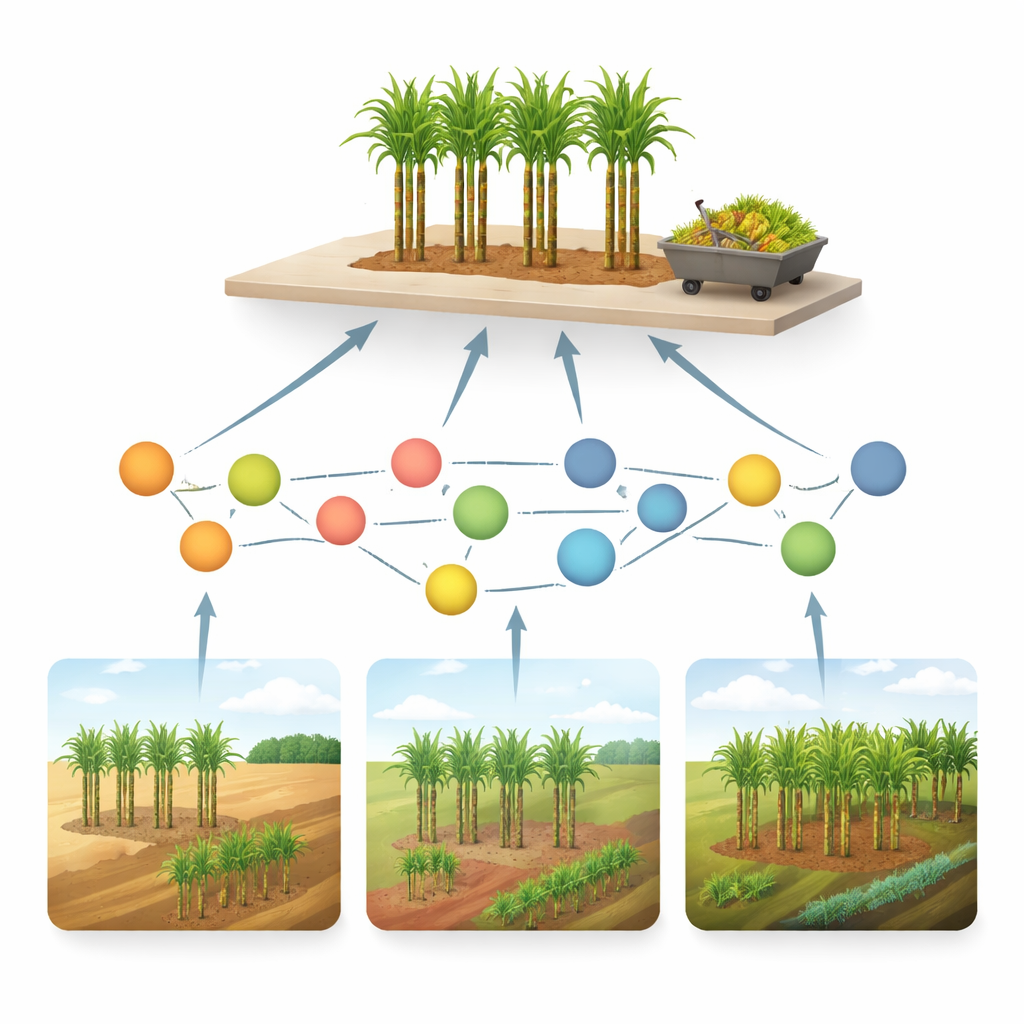
What this means for farmers and mills
In plain terms, the study shows that it is possible to pinpoint sugarcane clones that are not just high yielding in one good year, but reliably productive and sugary across different crop cycles. Among the tested models, a robust AMMI approach using a linear fit gave the clearest and most consistent picture of which varieties truly handled changing conditions well. The standout clones, particularly Co 15017 and Co 14012 alongside the long-used standard Co 86032, now look ready for wider testing across India. If they perform as expected, farmers could gain varieties that deliver steady cane tonnage and sugar content from year to year, helping stabilize incomes and ensuring a more reliable flow of sugar and ethanol to markets.
Citation: Durai, A.A., Kona, P., Pazhany, A.S. et al. Multiple AMMI models investigation to decipher the genotype by environment (G×E) interaction in sugarcane interspecific hybrids for yield and quality traits. Sci Rep 16, 9368 (2026). https://doi.org/10.1038/s41598-025-32392-1
Keywords: sugarcane breeding, yield stability, genotype environment interaction, sugar crop varieties, crop performance analysis