Clear Sky Science · en
Multifunctional pectin derivatives as anticancer agents in colorectal cancer via synthesis, computational insights, and modulation of NRF2/HO-1, HIF-1α, and VEGF/PDGF-D signaling pathways
From Fruit Fiber to Cancer-Fighting Molecules
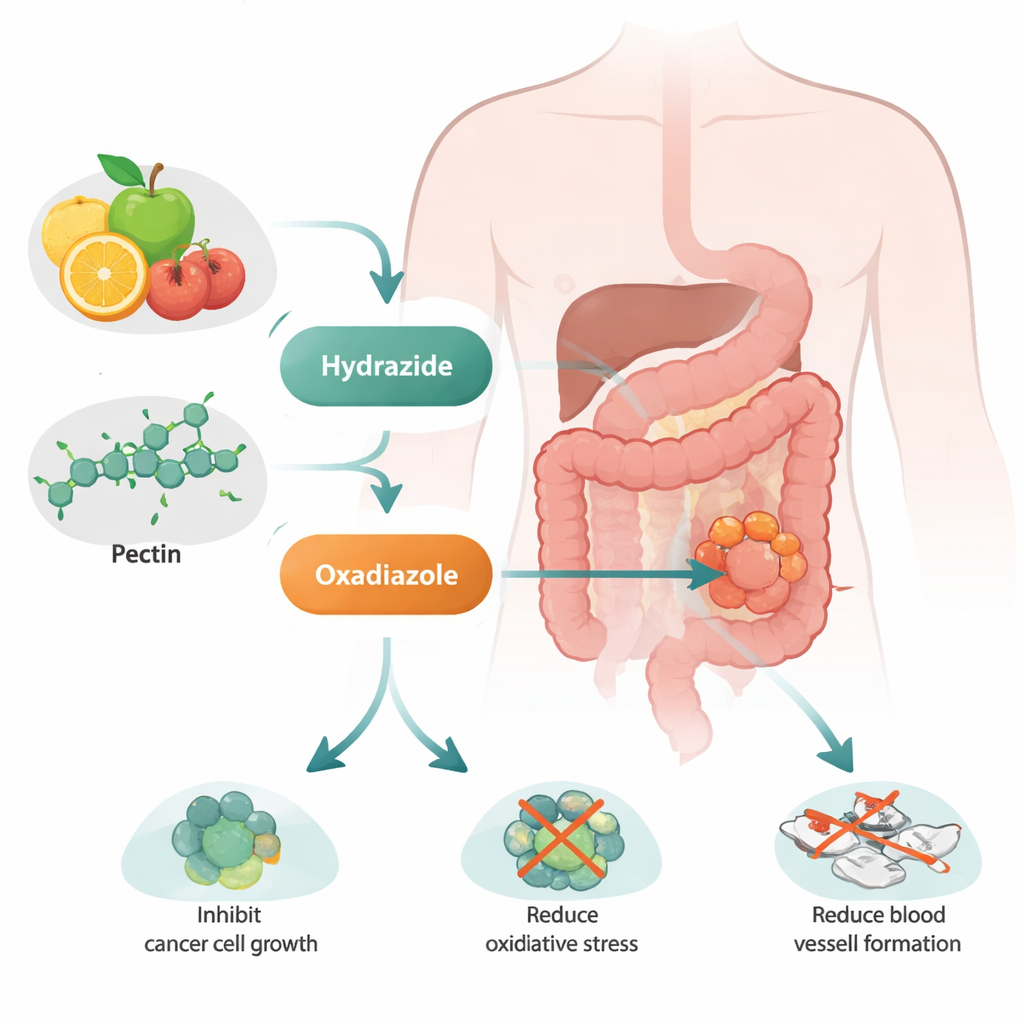
Pectin is a natural fiber best known for thickening jams and jellies, but this everyday kitchen ingredient may also be a quiet ally in the fight against cancer. This study explores how scientists can fine‑tune pectin’s structure to create new compounds that slow the growth of colorectal cancer cells in the lab, while also dampening harmful oxidative stress and cutting off the blood supply that tumors need to grow.
Turning a Common Fiber into a Smart Drug Candidate
The researchers started with ordinary pectin, a plant‑based sugar chain found in many fruits. Using a series of controlled chemical steps, they transformed pectin into two new forms called “pectin hydrazide” and “pectin oxadiazole.” Although the names are technical, the idea is simple: by attaching small nitrogen‑ and sulfur‑containing groups to pectin, they gave the molecule new electronic and structural features that could make it more active against cancer cells. Advanced tools such as infrared spectroscopy, nuclear magnetic resonance, electron microscopy, and heat‑resistance tests confirmed that the reactions worked and that the new materials were more thermally stable than the original pectin.
Putting the New Compounds to the Test on Cancer Cells
To see whether these modified fibers could harm cancer cells, the team exposed two human cell lines—one from liver cancer and one from colorectal cancer—to different doses of the new compounds. They used a dye‑based test that measures how many cells remain alive after treatment. Both pectin hydrazide and pectin oxadiazole were more effective than unmodified pectin at reducing the survival of colorectal cancer (Caco2) cells, with pectin oxadiazole showing the strongest effect. Against liver cancer cells, the compounds were less powerful but still showed measurable activity, suggesting that the new structures are especially promising for targeting colorectal tumors.
Lowering Oxidative Stress and Cutting Off Tumor Blood Supply
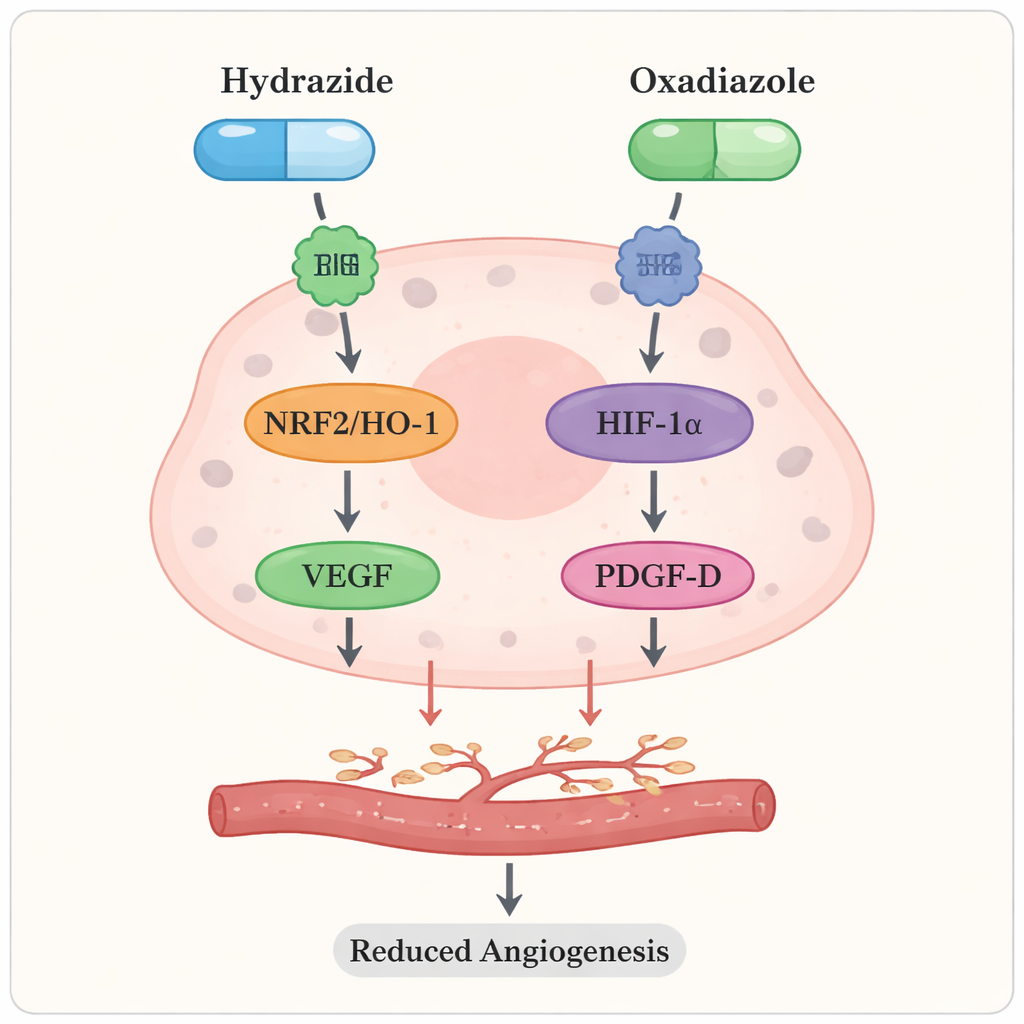
Cancer does not develop in isolation; it is driven by chemical stress and abnormal signaling inside cells. The researchers focused on reactive oxygen species (ROS)—highly reactive molecules that can damage DNA and drive tumor growth—and on proteins that help tumors adapt to stress and build new blood vessels. When Caco2 cells were treated with the new pectin derivatives at active doses, ROS levels dropped, and the amount of an antioxidant enzyme called HO‑1 also decreased. At the genetic level, key “master switches” such as NRF2 and HIF‑1α, along with the blood‑vessel‑promoting factors VEGF and PDGF‑D, were all switched down. In plain terms, the modified pectins not only harmed cancer cells directly but also calmed the internal stress signals and reduced the instructions that tell tumors to grow new blood vessels.
Using Computer Models to Understand Why They Work
To dig deeper into how and why these molecules are so active, the team turned to computer‑based simulations. They virtually “docked” pectin, pectin hydrazide, and pectin oxadiazole into several protein structures that are linked to cancer growth, stress response, and blood vessel formation. Across all these targets, pectin oxadiazole tended to fit best, forming the strongest and most stable interactions. Long computer simulations that track atomic motion over 100 nanoseconds supported this picture: the oxadiazole form held on tightly to its targets and stabilized their shapes more than either hydrazide or unmodified pectin. Quantum‑chemical calculations further showed that adding nitrogen and sulfur rings changed the way electrons are distributed in the molecule, making it more reactive in ways that favor strong binding to biological partners.
What This Could Mean for Future Cancer Treatments
Taken together, the study shows that a familiar dietary fiber can be turned into much more than a gut‑friendly ingredient. By carefully redesigning pectin’s structure, the researchers created new compounds that attack colorectal cancer cells from several angles at once: they slow cell growth, reduce damaging oxidative stress, and weaken the signals that drive new blood vessel formation. While these findings are still at the cell‑culture and computer‑model stage—and must be tested in normal cells and animals before any human use—they point to pectin hydrazide and especially pectin oxadiazole as promising starting points for safer, multifunctional drugs against colorectal cancer.
Citation: Elsayed, G.H., Fahim, A.M. Multifunctional pectin derivatives as anticancer agents in colorectal cancer via synthesis, computational insights, and modulation of NRF2/HO-1, HIF-1α, and VEGF/PDGF-D signaling pathways. Sci Rep 16, 6542 (2026). https://doi.org/10.1038/s41598-025-32107-6
Keywords: pectin, colorectal cancer, oxidative stress, angiogenesis, drug design