Clear Sky Science · en
Life cycle assessment of MSW-to-biofuel conversion pathways: a comparative analysis
Why Your Trash Matters More Than You Think
Every bag of garbage you put out on the curb has a hidden life story. In fast-growing countries like India, this story now involves more than 160,000 tonnes of municipal solid waste generated every single day. What happens to that waste shapes climate change, water use, land demand, and even energy supply. This study asks a simple but powerful question: if we treat the same tonne of mixed city trash in different ways, which option does the least damage—and which can actually help the environment?
From Dumping Grounds to Energy Sources
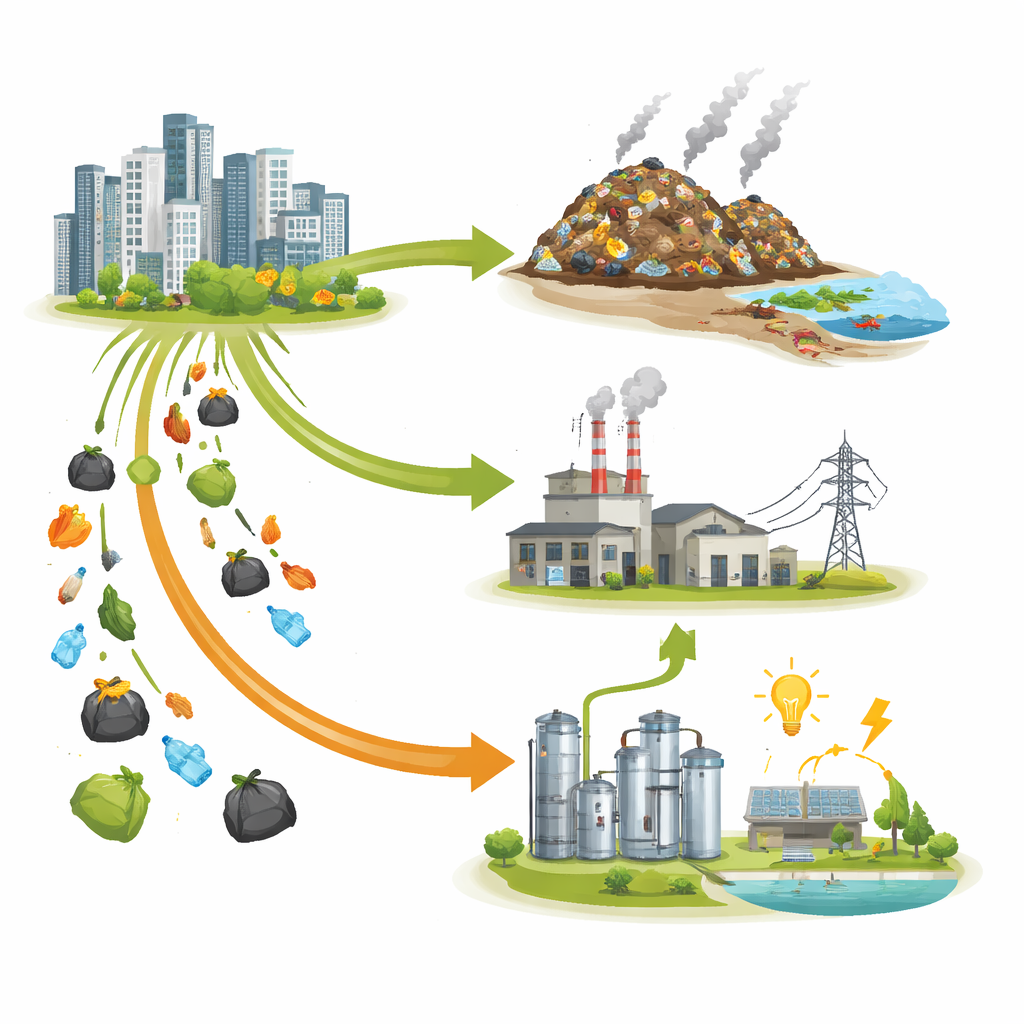
Traditionally, most city waste ends up in open landfills or dump sites. These sites look like the end of the line, but in reality they are busy chemical factories. Rotting organic matter releases large amounts of methane, a greenhouse gas far more potent than carbon dioxide, while dirty liquids seep into soil and groundwater. In India, landfills alone contribute a significant share of national methane emissions. At the same time, big cities struggle to find enough land for expanding dumps. Against this backdrop, engineers and planners are turning to waste-to-energy technologies that can shrink waste volumes and generate useful fuels and electricity.
Seven Different Roads for the Same Tonne of Waste
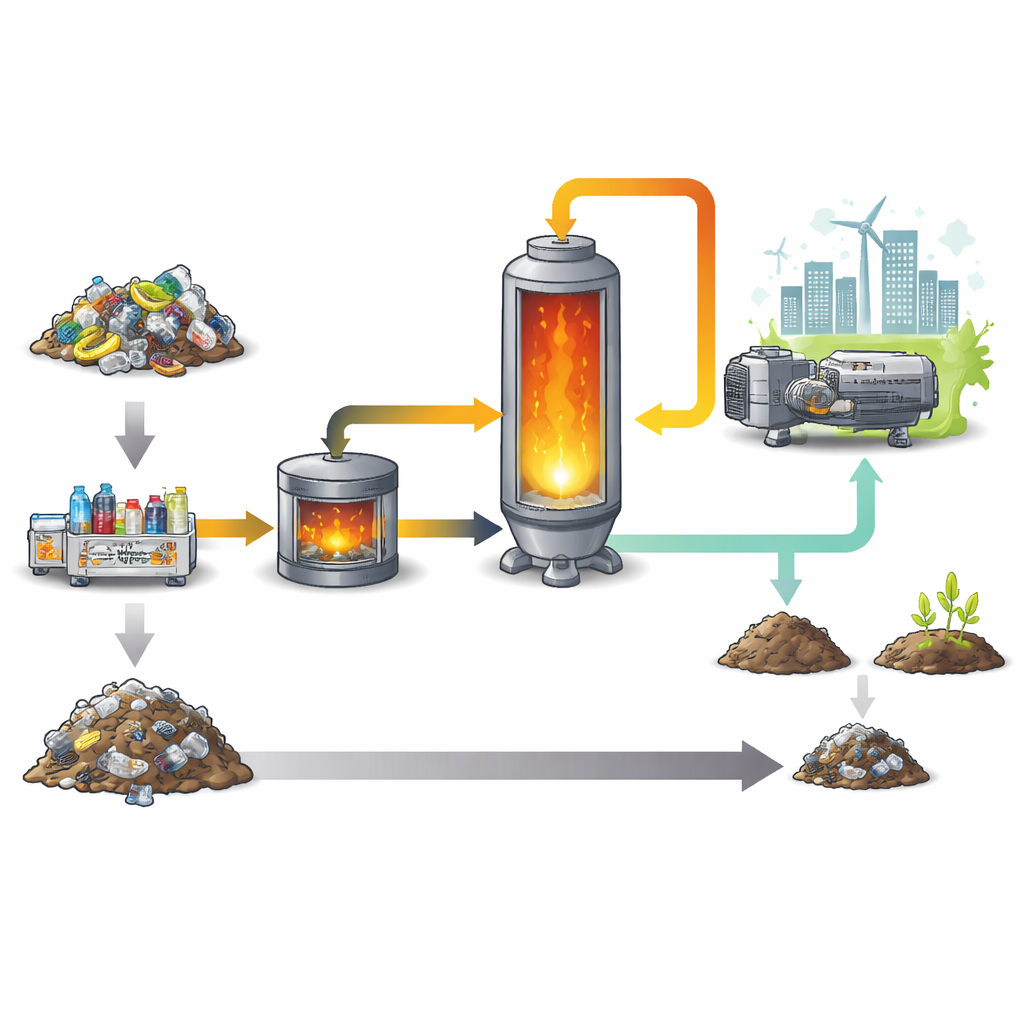
The researchers compared seven ways to handle one tonne of mixed municipal waste, all based on real Indian waste composition and transport data. Two options represent business as usual: simple landfilling with no energy recovery, and landfilling with partial capture of landfill gas for electricity. The others are more advanced thermal treatments that heat waste to release energy-rich gases and solids. These include classic incineration, milder heating called torrefaction that produces a dense solid fuel, gasification that turns waste into a flammable gas, hydrothermal treatment that cooks wet waste in hot pressurized water, and a combined system called integrated gasification, which first torrefies and then gasifies the waste.
Measuring Hidden Environmental Costs
To judge these options fairly, the team used life cycle assessment, a method that tallies up environmental impacts from the moment waste arrives at a treatment plant until residues are managed and energy is delivered. They focused on five indicators that speak directly to everyday concerns: contribution to climate change, damage to the ozone layer, nutrient pollution of lakes and rivers, land use, and freshwater consumption. Crucially, they counted both the pollution created by each system and the pollution avoided when its electricity replaces coal-based power or when its byproducts, such as biochar or digestate, stand in for synthetic fertilizers.
The Standout Performer: Integrated Gasification
The results draw a sharp contrast between simple dumping and advanced treatment. Open landfilling had by far the worst climate and water scores, adding about 1.4 tonnes of carbon dioxide–equivalent emissions and consuming water with no offsetting benefit. Even capturing some landfill gas for electricity only slightly improved the picture. Incineration with digestion, while recovering energy, still ranked poorly overall due to remaining emissions and water demand. In contrast, the thermochemical options that aggressively convert waste into fuel and useful solids performed much better. Integrated gasification came out on top: for each tonne of waste, it not only erased its own climate footprint but achieved a net reduction of about 1.1 tonnes of carbon dioxide–equivalent, saved over 1,100 cubic meters of freshwater, and required far less land than any other pathway.
Designing a Smarter Waste System
The study went a step further by linking these environmental results to earlier work tracking how waste and materials flow through a national-scale system. When recyclables are pulled out first and the remaining mixed waste is fed into integrated gasification plants, the model suggests India could convert roughly two-thirds of that stream into a clean gas suitable for power and fuels, while slashing landfill needs. Sensitivity tests showed that even when key assumptions—such as energy efficiency or grid cleanliness—were shifted by 10 percent, integrated gasification still kept its lead. That means its apparent advantages are not just a quirk of optimistic input numbers.
What This Means for Cities and Citizens
For non-specialists, the takeaway is surprisingly straightforward. How we handle household trash can either lock in decades of methane emissions and land scars, or become a tool for climate action and resource savings. This study signals that simply improving dumps is not enough. The biggest gains come from moving toward high-efficiency thermochemical systems—above all, integrated gasification—combined with better sorting and recycling. These systems are technically complex and more expensive to build than landfills, but they turn waste into energy, reduce pressure on land and water, and help close the loop in a circular economy. In other words, designing smarter waste pathways can transform today’s mounting garbage challenge into tomorrow’s clean energy opportunity.
Citation: Raj, R.S., Jain, S., Sharma, A.K. et al. Life cycle assessment of MSW-to-biofuel conversion pathways: a comparative analysis. Sci Rep 16, 8932 (2026). https://doi.org/10.1038/s41598-025-32082-y
Keywords: municipal solid waste, waste-to-energy, gasification, life cycle assessment, biofuels