Clear Sky Science · en
An integrated physics-guided machine learning approach for predicting asphalt concrete fracture parameters
Why Better Roads Matter
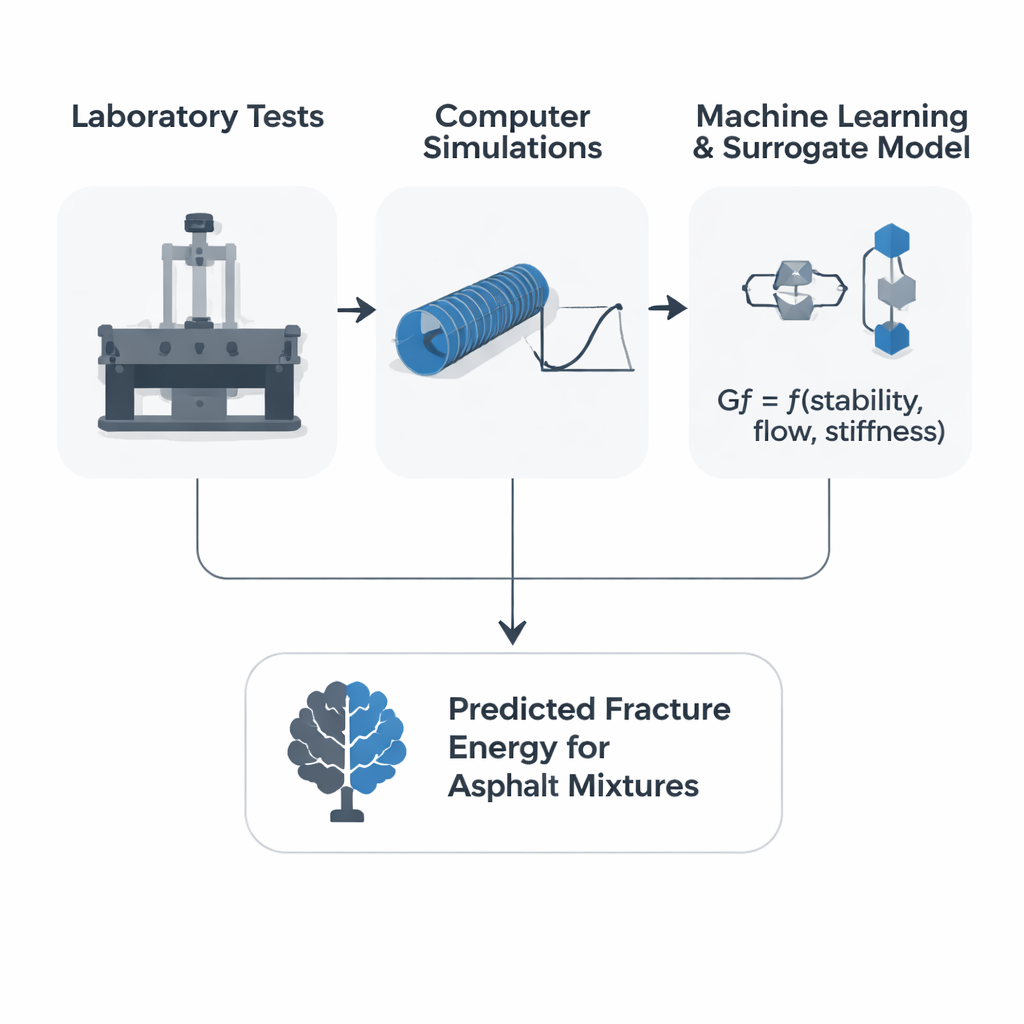
Every day, millions of drivers rely on asphalt roads to get to work, move goods, and keep cities running. Yet cracks and potholes still appear far sooner than we would like, costing money and causing frustration. This study explores a new way to predict how and when asphalt will crack—using a blend of traditional lab tests, computer simulations, and modern machine learning. The goal is to design longer‑lasting pavements more quickly and at lower cost.
How Cracks in Asphalt Are Usually Studied
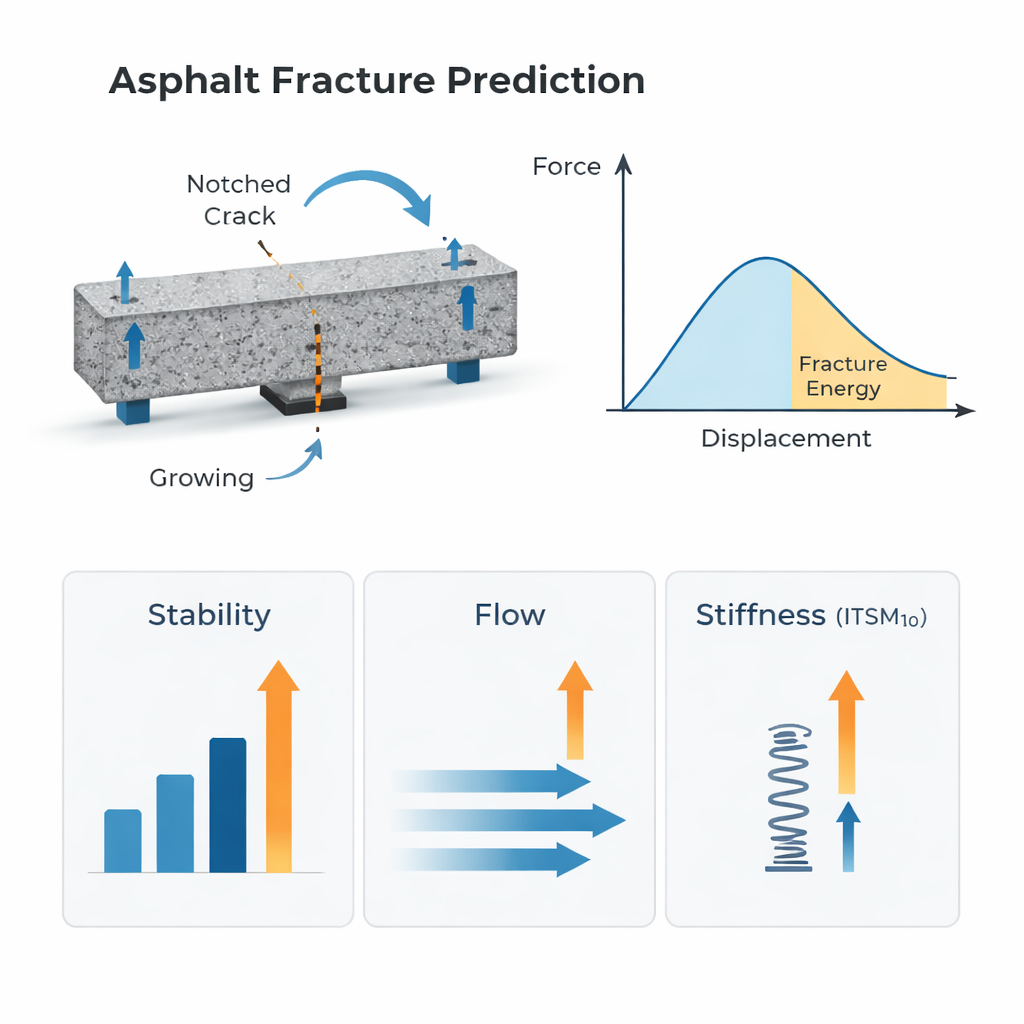
To understand how asphalt breaks, engineers often use beam‑shaped samples with a small cut, called a notch, in the middle. These "single edge notch beams" are bent until they crack, while instruments record how much force the beam carries and how far it bends. From these measurements, researchers calculate fracture energy—a number that tells how much energy the material can absorb before a crack shoots through it. Such tests are reliable, but they are slow, require special equipment, and can only cover a limited number of mixtures and temperatures.
Adding Virtual Experiments on the Computer
To go beyond what can be done in the lab, the authors built a detailed computer model of the notched asphalt beam using the finite element method, a standard engineering simulation technique. They recreated the same geometry, loading setup, and temperature as in the experiments, and used realistic properties for the asphalt so that the model would mimic its time‑dependent, rubbery behavior. By adjusting the fineness of the model’s mesh, they found a level of detail that produced accurate force–displacement curves without excessive computing cost. The simulated results closely matched the real tests in terms of peak force, stiffness, and how the beam softened after cracking, confirming that the digital model captured the essential fracture behavior.
Teaching Machines to Recognize Patterns
Next, the team turned to machine learning to connect easily measured mixture properties to how well the asphalt resists cracking. They used an existing dataset of asphalt mixtures that included properties such as binder content, air voids, unit weight, stability, flow, and a stiffness measure at typical road temperature. Before modeling, they checked how strongly these properties were related: for example, stiffer mixtures tended to carry higher loads but behaved more brittly, while richer binder contents made mixtures softer but more stretchable. Three different machine learning approaches—simple linear regression, Gradient Boosting, and AdaBoost—were trained and tested using cross‑validation. Among them, Gradient Boosting gave the most reliable predictions of stiffness and related fracture behavior.
A Shortcut Formula for Crack Resistance
To make the predictions physically meaningful, the authors introduced a surrogate equation for fracture energy. Instead of asking the computer to guess fracture energy directly from dozens of inputs, they proposed a compact expression that combines just a few key quantities: stability, flow, stiffness at 20 °C, and a characteristic beam size. This equation respects units and known trends—higher stability and stiffness generally raise crack resistance, while flow reflects how much the mixture can deform. Using this formula, they computed a "surrogate" fracture energy for each mixture and compared it with both the measured and simulated fracture energies. The average surrogate value differed from the lab and computer values by only about 2 percent, showing that this simple, physics‑guided shortcut captures the essence of the cracking process.
What This Means for Future Roads
For non‑specialists, the main message is that we can now estimate how crack‑resistant an asphalt mixture will be using a small set of routine measurements and a carefully designed equation, backed by machine learning and computer simulations. Instead of running complex fracture tests for every new mixture, engineers can screen designs quickly, fine‑tune binder content and aggregate structure, and focus lab work where it matters most. Over time, this kind of integrated, physics‑aware data modeling could help deliver more durable pavements, fewer potholes, and better value from every dollar spent on road construction and maintenance.
Citation: Elahi, M., Khan, R., Mabood, T. et al. An integrated physics-guided machine learning approach for predicting asphalt concrete fracture parameters. Sci Rep 16, 7938 (2026). https://doi.org/10.1038/s41598-025-32041-7
Keywords: asphalt fracture, pavement design, machine learning, finite element simulation, surrogate modeling